
Foreign and Arab investors remain buyers, but large-cap weakness pulls benchmark below 52,000 points
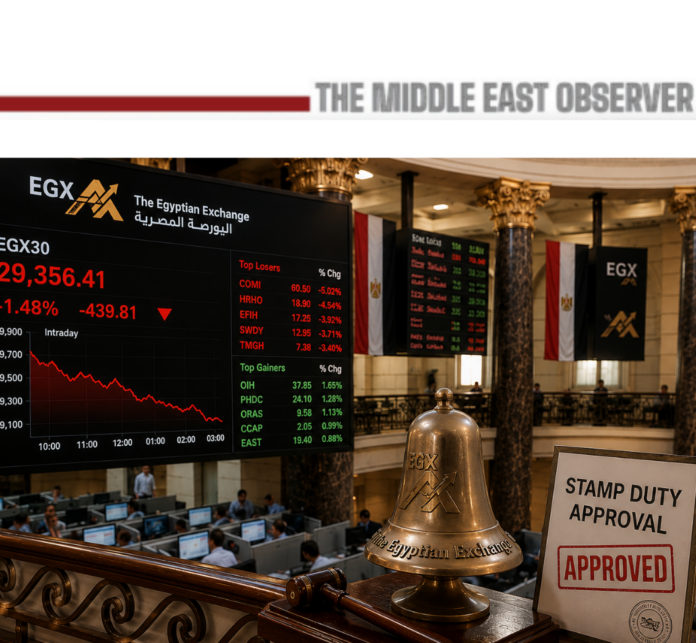
Cairo — Egyptian equities fell sharply on Tuesday as parliament’s approval of amendments to the stamp-duty regime added a new test for market liquidity, pushing the benchmark EGX30 below the 52,000-point level for the first time in several weeks despite continued foreign and Arab buying.
The EGX30 dropped 1.55% to 51,769.74 points, while the EGX33 Shariah Index fell 1.23% to 5,782.78 points. The EGX35-LV lost 1.52% to 6,010.74 points, while the EGX70 index of small and medium-sized companies declined 0.84% to 15,596.17 points. The broader EGX100 fell 1.05% to 21,324.44 points. Market capitalization stood at EGP 3.717tn.
The decline followed a softer Monday session, when the EGX30 fell 0.18% to 52,585.72 points, after opening the week higher on Sunday. The week’s Remain Supportiveshifted from consolidation to a sharper reassessment of large-cap exposure as investors weighed the impact of the new transaction-tax framework.
Stamp Duty Becomes the Market’s Immediate Test
Parliament approved amendments replacing the capital-gains-tax framework on listed shares with a transaction-based stamp duty. Under the law, a 0.5-per-thousand stamp duty is imposed on the total value of buy and sell transactions involving listed securities, applied to both Egyptian and foreign investors. Same-day trading will be subject to a lower 0.25-per-thousand rate, while listed investment-fund certificates are exempt to avoid double taxation.
For investors, the immediate issue is not only the tax rate itself but its effect on trading costs, turnover and liquidity. The approval came as the market was already struggling with weaker momentum in blue-chip shares, making the next few sessions an important test of whether investors treat the levy as manageable or as another drag on execution activity.
Government officials argue that the new regime provides greater predictability and transparency than the repeatedly postponed capital-gains tax system that had created uncertainty for investors and market participants over several years. Finance Minister Ahmed Kouchouk said the exemption granted to listed investment funds was designed to avoid double taxation and preserve the attractiveness of collective investment vehicles. Supporters of the reform contend that a transaction-based levy offers a more stable and administratively efficient framework, while critics remain concerned about its impact on trading volumes and liquidity.
Market commentary cited by local financial press pointed to weak liquidity in leading shares as a central factor behind the EGX30’s failure to hold above recent support levels. The index had failed to stabilise above the 52,600 area before slipping through 52,200 and moving toward the 51,850–51,700 support zone.
The debate comes at a particularly sensitive time for the Egyptian Exchange. Market accessibility and liquidity are already under international scrutiny following S&P Dow Jones Indices’ ongoing review of Egypt’s classification within its emerging-market universe. The outcome of that review will depend heavily on the market’s ability to maintain adequate liquidity, efficient trading conditions and accessibility for foreign investors, making the reaction to the new tax framework especially significant.
Foreigners and Arabs Buy as Egyptians Sell
Despite the broad decline, investor-flow data showed foreign and Arab investors remained net buyers. Non-Arab foreign investors recorded purchases of about EGP 16.49bn, while Arab investors bought approximately EGP 5.90bn. Egyptian investors were net sellers with outflows of about EGP 22.39bn.
As in recent sessions, the reported transaction values appear large relative to ordinary cash-market turnover and should be read cautiously as exchange-reported flow classifications. Still, the direction of flows is important: overseas and regional investors continued to absorb positions while domestic investors reduced exposure.
That pattern suggests the market weakness was driven less by a wholesale foreign exit and more by domestic selling, weak blue-chip liquidity and uncertainty over how the new tax framework will affect trading behaviour.
Small Caps Hold Up Better Than Blue Chips
The relative performance of the EGX70, which fell less sharply than the EGX30, showed that small- and mid-cap shares continued to benefit from individual investor activity. Local commentary noted that retail investors accounted for more than 78% of total trading, helping the EGX70 remain above the 15,500 level despite failing for a second time to break above 15,850.
The contrast matters because it shows that market weakness remains concentrated in large caps and liquidity-sensitive names rather than representing an across-the-board collapse in risk appetite.
Derivatives and Debt Inflows Remain Supportive
The tax approval came only days after the EGX began trading single-stock futures on Commercial International Bank (CIB) and Talaat Moustafa Group (TMG), a step designed to broaden risk-management tools and deepen market infrastructure.
The broader cross-asset backdrop also remains constructive. Foreign investors’ net purchases of government debt instruments through the EGX secondary market reportedly reached about $4bn last week, while the Central Bank continued to offer treasury bonds and sukuk. Strong debt inflows and the launch of derivatives help offset some concerns over equity-market volatility, though they do not eliminate the near-term pressure on share liquidity.
These developments are occurring alongside a broader capital-markets expansion agenda that includes prospective IPOs, state-ownership offerings and efforts to deepen institutional participation. Policymakers hope that a wider range of investment products and a growing pipeline of listings will improve market depth and resilience over time.
Market View
The key takeaway from Tuesday’s session was that the market’s first reaction to the stamp-duty approval was negative, particularly in large-cap shares. The EGX30’s break below 52,000 points will put greater focus on liquidity, technical support levels and turnover in the coming sessions.
Yet the broader picture is more nuanced than the headline decline suggests. Foreign and Arab investors remained buyers, small caps outperformed blue chips, and Egypt’s capital-market infrastructure continues to broaden through futures trading and strong activity in government debt.
For investors, the next few weeks will provide the clearest indication of how the market ultimately absorbs the reform. The durability of foreign buying may prove a more important indicator than the tax itself, offering a practical measure of whether investors view the new framework as a manageable adjustment or a meaningful constraint on liquidity.
If overseas participation remains resilient while turnover stabilises, the reform could ultimately be viewed as part of Egypt’s broader capital-market modernisation programme rather than a setback for market development. Conversely, sustained weakness in trading activity would reinforce concerns that liquidity remains the market’s most pressing structural challenge.
Related news:
Egyptian Pound Leads Emerging-Market Gains as Oil Prices Ease
Egyptian stocks recover from Monday slump before late profit-taking resumes
Read also:
Egypt–Finland Relations Enter Strategic Phase as President Stubb’s Visit Unlocks Investment Momentum