
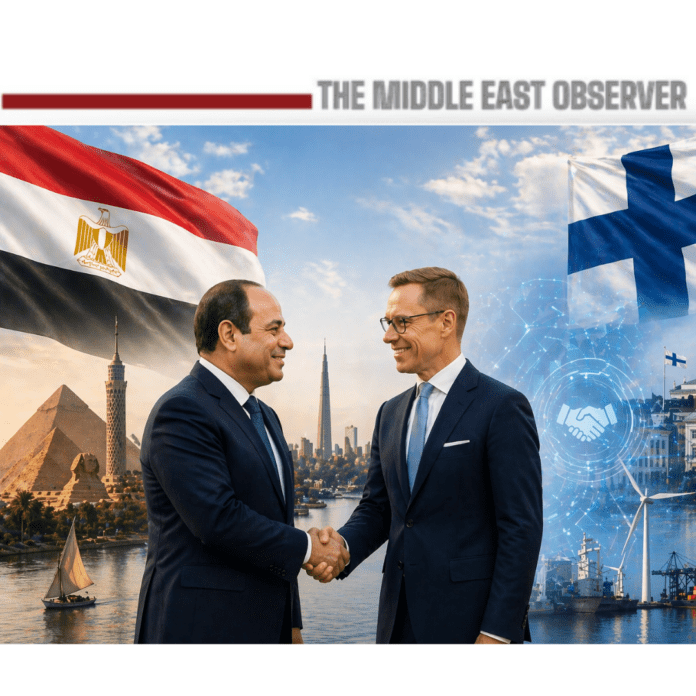
In a historic step toward deepening bilateral cooperation, Egypt and Finland have elevated their economic and strategic engagement during the official visit of Alexander Stubb to Cairo, signaling a transition from traditional trade relations toward structured, long-term investment partnerships. The visit, which combined high-level political dialogue with intensive business engagement, reflects a growing convergence between the two economies across technology, sustainability, and industrial development.
At the political level, talks between President Abdel Fattah El-Sisi and President Stubb focused on expanding cooperation in trade, investment, and advanced industries, while also addressing key regional developments, including Gaza, Sudan, and broader Middle East stability, according to official statements. Both sides reaffirmed their commitment to strengthening economic ties and enhancing coordination within the framework of Egypt’s partnership with the European Union, with Finland positioned as a supportive actor within this alignment.
The economic dimension of the visit was anchored by the Egypt–Finland Business Forum, hosted by the General Authority for Investment and Free Zones, which brought together over 20 major Finnish companies alongside senior government officials and private sector leaders. As documented in official proceedings , the forum served as a practical platform to translate diplomatic momentum into concrete investment opportunities, with both governments emphasizing a shift toward implementation-driven cooperation rather than exploratory dialogue.
Prime Minister Mostafa Madbouly positioned Egypt as a strategic gateway for Finnish investment into both Middle Eastern and African markets, highlighting the country’s extensive infrastructure development, young labor force, and expanding industrial base. He underscored the role of flagship initiatives such as the Suez Canal Economic Zone in offering competitive incentives for export-oriented investments, while emphasizing Egypt’s network of trade agreements—including the African Continental Free Trade Area—which provides access to a market of approximately 1.3 billion consumers.
From a macroeconomic perspective, the strengthening relationship is underpinned by steady trade growth. Bilateral trade reached approximately €464 million in the first 11 months of 2025, marking a 3.1% increase year-on-year. Egyptian exports—particularly textiles, chemicals, plastics, carpets, and agricultural products—have gained traction in the Finnish market, with fresh grapes alone capturing an estimated 50% market share. Meanwhile, Finnish exports to Egypt remain concentrated in high-value industrial inputs, led by timber, machinery, electrical equipment, and paper products, reflecting a complementary trade structure between the two economies.
Crucially, both sides used the visit to outline a forward-looking investment agenda centered on high-growth sectors. Discussions at the forum and in ministerial statements highlighted priority areas including digital transformation, telecommunications, renewable energy, green hydrogen, water desalination, healthcare, education, and advanced manufacturing. Egypt’s Minister of Investment and Foreign Trade Mohamed Farid Saleh emphasized that bilateral relations are entering an “advanced phase” built on technology transfer and long-term development objectives, with a clear focus on increasing foreign direct investment and boosting export capacity.
Sector-specific sessions during the forum provided further clarity on potential deal flow and collaboration frameworks. In the digital economy track, stakeholders emphasized aligning Egypt’s national digital transformation strategy with Finland’s leadership in innovation, artificial intelligence, and 5G infrastructure, with companies such as Nokia identifying Egypt as a key market for public-private partnerships in next-generation connectivity. Parallel discussions in engineering industries highlighted opportunities for localizing Finnish technologies in mining, renewable energy, and industrial manufacturing, including proposals for solar energy storage production and advanced mineral extraction systems.
Healthcare cooperation also emerged as a strategic pillar, with Egyptian officials outlining ongoing reforms under the Universal Health Insurance system and the integration of digital health technologies. Finnish expertise in medical innovation and system efficiency was positioned as a key enabler for building scalable healthcare solutions targeting both domestic and African markets, reinforcing Egypt’s role as a regional service hub.
At the corporate level, Finnish companies including HMD Global, Huhtamaki, and Eagle Timber signaled interest in expanding operations in Egypt, particularly in fintech, sustainable packaging, and timber manufacturing, while additional industrial players explored partnerships in engineering, HVAC systems, and export-oriented production. These engagements reflect a broader trend toward embedding Finnish technological expertise within Egypt’s industrial ecosystem, rather than limiting cooperation to trade flows alone.
From a strategic standpoint, Finnish officials reiterated Egypt’s importance as a regional hub for investment and trade, with Under-Secretary of State Jarno Syrjälä describing the Egyptian market as stable, resilient, and increasingly attractive for long-term partnerships. This positioning is reinforced by Egypt’s integration into major trade frameworks, including the EU–Egypt Partnership Agreement, COMESA, and the Agadir Agreement, which collectively enhance market access and streamline cross-border operations.
As observed by The Middle East Observer, the visit represents more than a routine diplomatic engagement; it marks a structural shift toward institutionalized economic cooperation driven by shared priorities in sustainability, digital transformation, and industrial modernization. The convergence of political alignment, private sector participation, and sector-specific roadmaps suggests that Egypt–Finland relations are entering a phase defined by execution, with measurable outcomes expected in the form of joint ventures, technology transfer initiatives, and increased investment flows.
In conclusion, President Stubb’s visit has effectively repositioned bilateral relations within a strategic investment framework, laying the groundwork for deeper economic integration. With both sides aligning on innovation-led growth and sustainable development, the Egypt–Finland partnership is poised to evolve into a model of cross-regional cooperation linking Northern Europe with emerging markets across the Middle East and Africa.
