
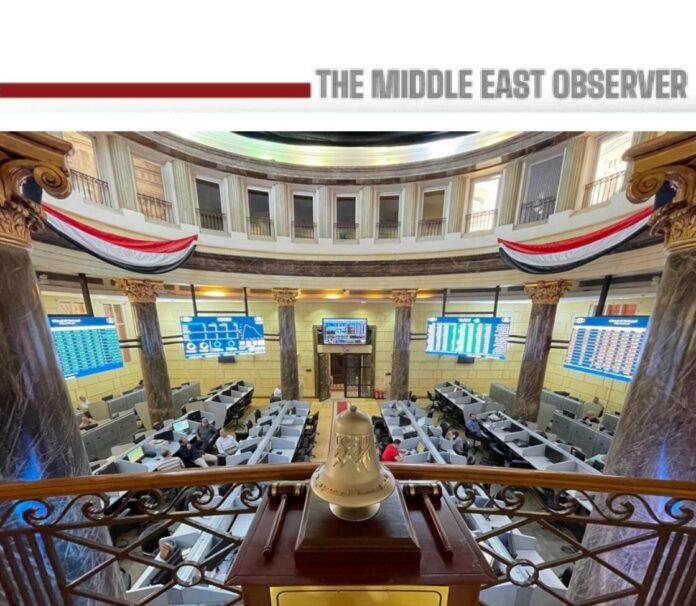
Cairo — Egypt’s stock market closed the 29 March–2 April 2026 trading week with a mixed but volatile performance, as a steep foreign-led sell-off at the start of the period was followed by a strong mid-week rebound before profit-taking resumed on Thursday. By the close on 2 April, the benchmark EGX30 had slipped 0.71% on the day to 46,399 points, while the EGX33 Shariah index fell 0.22% to 4,909.55 points. The EGX35-LV rose 0.22% to 5,313.12 points, and the broader market held up better, with the EGX70 up 0.40% and the EGX100 gaining 0.21%. Total market capitalisation stood at around EGP 3.281 tn. Relative to the previous week’s close, however, the EGX30 was effectively unchanged, underscoring a week defined more by violent swings than by a clear trend.
The week opened under heavy pressure. On 29 March, the EGX30 lost 1.27% to 46,404.27 points as Arab and foreign investors were net sellers. Selling intensified on 30 March, when the benchmark dropped a further 2.62% to 45,189.89 points, with non-Arab foreigners offloading roughly EGP 5.49 bn on a net basis. The market then stabilised on 31 March, when the EGX30 edged up 0.29% to 45,321.59 points, before staging a sharp 3.11% rebound on 1 April to 46,731.49 points as local investors returned aggressively to the buy side. That rebound partly reversed on 2 April as foreigners again turned net sellers.
The trading pattern closely tracked shifting headlines around the war involving Iran and the wider Gulf. Reuters reported that on 31 March Egypt’s blue-chip index rose 0.3% as investors weighed reports that Washington might wind down the conflict, though the EGX still ended March down 7.9%, its first monthly decline since December 2024. Two days later, Reuters said Egypt’s blue-chip index fell 0.7% on 2 April after President Donald Trump signalled US operations against Iran would continue for another two to three weeks, dimming hopes of a quick de-escalation. Reuters also noted that Gulf markets remained highly reactive to geopolitical headlines and threats to shipping and energy infrastructure, including risks around the Strait of Hormuz and an Iranian missile strike on a tanker leased by QatarEnergy.
For Cairo, the regional war narrative has become a direct market variable rather than a distant backdrop. President Abdel Fattah El-Sisi warned on 30 March that a prolonged conflict could send oil above $200 a barrel, with potentially severe consequences for fragile and middle-income economies. Reuters separately reported that Egypt’s central bank was widely expected to keep rates unchanged because the conflict had already driven up energy import costs, threatened tourism and Suez Canal revenues, and renewed inflation risks. The Central Bank of Egypt did in fact hold key rates unchanged on 2 April, citing regional uncertainty, a move that likely helped cap downside in local equities but also reinforced the market’s caution on near-term easing expectations.
At the micro level, turnover and flows confirm a market still dominated by tactical trading rather than conviction buying. EnterpriseAM reported turnover of EGP 6.2 bn on 29 March, with international investors the sole net sellers, and EGP 6.6 bn on 2 April, with international investors the sole net buyers that day. That divergence suggests that foreign accounts were trading the war headline cycle opportunistically, while domestic investors largely provided the stabilising bid during the mid-week recovery. On 1 April, for example, Egyptians were net buyers of EGP 43.8 bn, while Arabs and non-Arab foreigners were both net sellers.
Local support for the market also came from renewed privatisation and pipeline news. EnterpriseAM reported on 1–2 April that the government planned to temporarily list 20 state-owned companies by the end of April, while five state-owned firms had already submitted listing documentation to the EGX and were undergoing FRA review. The expected offerings include El Nahda Industries, Egyptian Ferroalloys, El Nasr Glass, El Nasr Mining, and Alexandria Co. for Refractories, with the government targeting up to USD 1.5 bn in proceeds from this phase. That helped reinforce the medium-term structural case for the EGX even as day-to-day trading remained hostage to macro and geopolitical stress.
MEO market reading: the week was best understood as a high-volatility consolidation. The EGX30 finished almost exactly where it started, but the path matters: a sharp foreign-led slump, a locally driven relief rally, then a renewed pullback once the war premium returned. In other words, Egyptian equities showed resilience. Until there is clearer visibility on the Gulf conflict, oil prices and Egypt’s inflation path, the bourse is likely to remain a trading market rather than a clean rerating story.