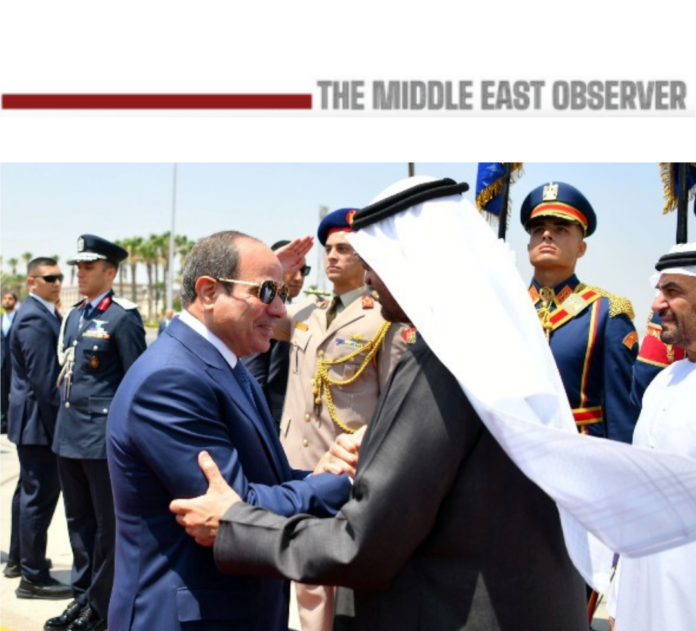
CAIRO — Egyptian President Abdel Fattah El-Sisi welcomed UAE President Sheikh Mohamed bin Zayed Al Nahyan to Cairo on Monday for talks that reflected growing efforts among regional powers to consolidate stability following the recent Iran crisis and support a diplomatic path toward a broader Middle East security framework.
The visit comes as governments across the region assess the implications of the US-Iran agreement that ended weeks of military confrontation and paved the way for the reopening of the Strait of Hormuz, one of the world’s most critical energy and shipping corridors.
During their discussions, the two leaders emphasized the importance of sustaining momentum toward de-escalation and preventing a return to instability that could undermine economic recovery efforts across the region. Both sides viewed the agreement as an opportunity to redirect attention from conflict management toward economic development, investment and regional cooperation.
The Strait of Hormuz remains central to that objective. The narrow waterway serves as a gateway for a substantial share of global crude oil and liquefied natural gas exports, making it a vital artery for international commerce. Uncertainty surrounding navigation through the Gulf in recent weeks triggered concerns among energy traders, shipping operators and insurers, contributing to higher transport costs and renewed volatility across global markets.
A return to normal maritime operations is expected to ease pressure on freight markets and insurance costs while helping restore confidence among investors monitoring developments in the Middle East. The easing of geopolitical risk could also support trade flows throughout the wider region and improve prospects for cross-border investment.
For Egypt, regional stability carries additional economic importance. Secure shipping routes in the Gulf are closely linked to traffic levels through the Suez Canal, a strategic source of foreign-currency revenues and a key component of global supply chains connecting Asia, Europe and Africa.
Alongside regional developments, the two presidents reviewed the expanding economic partnership between Cairo and Abu Dhabi. The UAE has become one of Egypt’s most significant investment partners, with Emirati capital supporting major projects across infrastructure, logistics, renewable energy, tourism, real estate and industrial development. Recent large-scale commitments, including the Ras El-Hekma project on Egypt’s Mediterranean coast, have further strengthened economic ties between the two countries.
The talks also covered developments in Gaza and other regional files, with both leaders stressing the importance of political solutions, dialogue and coordinated efforts to address sources of instability.
Beyond the immediate agenda, the Cairo meeting highlighted a broader shift underway in regional diplomacy. As tensions ease following the Iran crisis, Egypt and the UAE appear increasingly focused on shaping the economic and political foundations of a post-conflict environment centred on stability, connectivity and investment-led growth.
The summit underscored the emergence of Cairo and Abu Dhabi as key architects of regional consensus-building at a time when Middle Eastern capitals are playing a more active role in defining security arrangements, economic priorities and diplomatic outcomes across the region.