
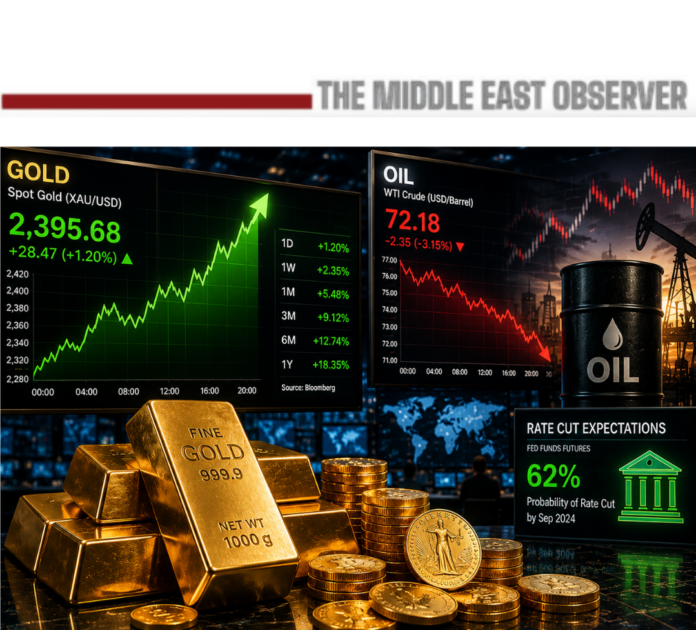
CAIRO — Gold surged above $4,300 an ounce following the announcement of a US-Iran peace agreement, as investors rapidly reassessed the outlook for inflation, interest rates and global economic growth after months of geopolitical turmoil.
The rally initially appeared counterintuitive. Traditionally, gold benefits from heightened uncertainty and conflict, while peace agreements tend to reduce demand for safe-haven assets. However, markets focused less on the end of hostilities and more on the economic consequences of the accord, particularly falling energy prices, a weaker US dollar and growing expectations that central banks may face less pressure to maintain restrictive monetary policies.
Spot gold rose more than 3% immediately after news of the agreement and later stabilized near $4,315 an ounce in Asian trading. At the same time, crude oil prices retreated sharply as traders anticipated the reopening of the Strait of Hormuz and the gradual normalization of energy flows through one of the world’s most important shipping corridors.
The shift in oil markets has become increasingly important for gold investors. During the conflict, rising energy prices fuelled inflation concerns and reinforced expectations that central banks would keep borrowing costs elevated. With oil prices falling and inflation pressures easing, markets are beginning to price in a potentially more accommodative monetary environment, a development that traditionally supports precious metals.
Federal Reserve Now Holds the Key
Attention has now turned to the Federal Reserve’s first policy meeting under Chair Kevin Warsh, where investors will scrutinize any signals regarding the future path of US interest rates.
Gold’s recent strength reflects growing expectations that a softer inflation outlook could eventually create room for lower borrowing costs. Because gold does not generate income, it typically performs best when interest rates decline and the opportunity cost of holding bullion falls.
For many investors, the Federal Reserve’s policy outlook may prove more important than developments in the Gulf over the coming months.
Central Banks Continue to Underpin Demand
Beyond short-term market movements, central-bank purchases remain one of the strongest structural supports for gold.
Monetary authorities across emerging markets have steadily increased bullion holdings in recent years as part of broader reserve-diversification strategies. Concerns over geopolitical fragmentation, sanctions risks and long-term dependence on the US dollar have encouraged many countries to increase allocations to gold as a neutral reserve asset.
Demand from central banks in China, India, Türkiye and several Gulf countries has become increasingly influential in shaping global bullion markets, reflecting a broader shift toward reserve diversification and financial resilience amid a more fragmented geopolitical environment.
This trend has helped create a durable source of demand that extends beyond traditional investment flows and provides support during periods of market volatility.
Why Analysts Remain Bullish
Several major financial institutions continue to project substantial gains for the precious metal despite its already elevated valuation.
J.P. Morgan forecasts that gold could reach $6,000 per ounce by late 2026, while Goldman Sachs expects prices to exceed $5,400 per ounce before the end of next year. The World Gold Council has outlined scenarios under which prices could rise by a further 15% to 30% in the event of renewed geopolitical shocks or a significant slowdown in global growth.
However, such projections imply gains of roughly 25% to 40% from current levels and assume a combination of sustained central-bank buying, continued reserve diversification, a weaker dollar and a supportive interest-rate environment. Any reversal in these trends could limit the pace of future gains.
Even so, analysts note that today’s gold market differs from previous cycles because demand is increasingly driven by official-sector purchases and long-term portfolio allocation decisions rather than speculative trading alone.
From Crisis Hedge to Strategic Asset
The end of hostilities between Washington and Tehran may reduce immediate geopolitical risk premiums in energy markets, but it does little to eliminate broader concerns surrounding global debt levels, fiscal deficits, trade fragmentation and the future direction of monetary policy.
As a result, investors are increasingly treating gold not merely as a hedge against conflict but as a strategic asset linked to reserve management, currency diversification and long-term economic uncertainty.
The transformation of gold’s role in global finance has been remarkable. Before the pandemic, the metal traded below $2,000 an ounce and was largely viewed as a defensive asset during periods of market stress. Today, it is increasingly regarded as a core component of reserve management strategies and institutional portfolios, reflecting deeper shifts in the global economic and monetary landscape.
The reopening of Hormuz may help stabilize oil markets and reduce inflationary pressures, yet the factors underpinning gold’s long-term appeal remain largely intact. For many institutional investors, the metal’s investment case is now tied less to individual geopolitical crises and more to structural shifts in the global financial system.
That evolution may prove decisive in determining whether gold’s latest rally becomes a temporary reaction to peace in the Gulf or the foundation for another leg higher in what has already become one of the strongest bull markets in the precious metal’s modern history.