
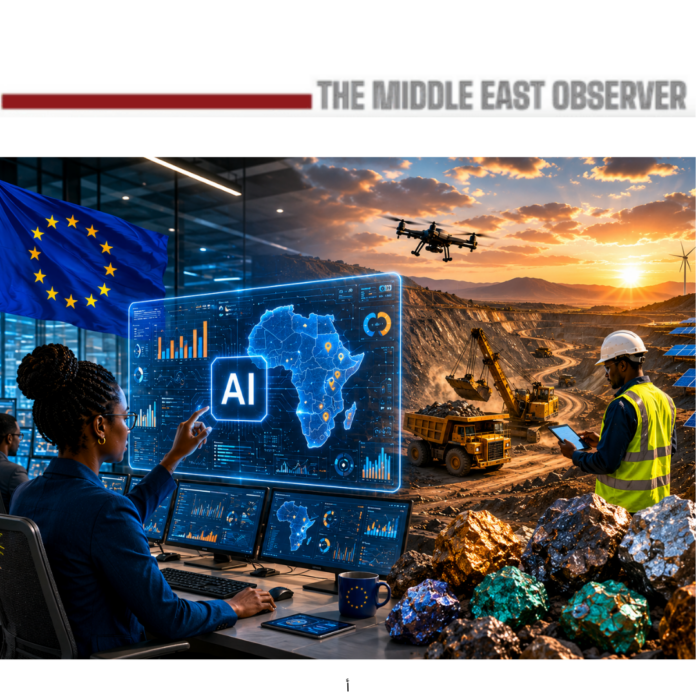
Artificial intelligence is becoming a critical instrument in the global pursuit of resource security after French mining group Eramet, AI specialist Lithosquare and France’s geological agency BRGM launched a partnership to accelerate the discovery of critical minerals across Africa. The initiative comes as the continent increasingly emerges at the centre of strategic competition among European, Chinese and Gulf investors seeking access to the metals required for electric vehicles, renewable energy systems, advanced manufacturing and next-generation digital technologies.
The initiative combines mining expertise, machine-learning technology and decades of geological data to identify deposits essential for electric vehicles, battery storage, renewable energy infrastructure and advanced digital technologies. While presented as an exploration programme, the project reflects a broader geopolitical contest over future industrial supply chains and access to resources increasingly viewed as strategic assets.
The agreement also comes as Europe seeks to reduce dependence on concentrated mineral supply chains, particularly in processing and refining activities dominated by China. In that context, artificial intelligence is emerging not merely as a mining tool, but as an instrument of industrial policy and economic security.
From Geological Archives to AI-Powered Discovery
The partnership will merge Eramet’s exploration capabilities, BRGM’s extensive geological databases and Lithosquare’s AI-driven analytics platform to process vast quantities of historical and newly acquired geological information.
For decades, African governments and mining companies have accumulated geological surveys, drilling records and mineral mapping data. Much of this information remains fragmented and underutilised. AI systems can rapidly analyse millions of geological variables, identifying patterns and anomalies that may reveal previously overlooked mineral deposits.
The initial focus will be Africa, home to some of the world’s most strategically important mineral reserves. The Democratic Republic of the Congo dominates global cobalt production, Zambia remains a major copper supplier, Zimbabwe and Namibia are emerging lithium hubs, South Africa controls substantial manganese and platinum-group metal reserves, while Morocco is rapidly developing a battery-materials ecosystem linked to its automotive manufacturing sector.
The attraction is clear. According to forecasts by the International Energy Agency, demand for minerals required for clean-energy technologies could more than double by 2040 under current policy trajectories, with lithium demand expected to grow several-fold as electric vehicle adoption accelerates globally.
Europe Responds to Resource Security Concerns
The French initiative arrives as the European Union intensifies efforts to secure access to strategic raw materials under the framework of the Critical Raw Materials Act, which aims to reduce dependency on a limited number of suppliers and strengthen Europe’s industrial resilience.
European policymakers have become increasingly concerned about vulnerabilities in supply chains for critical minerals used in batteries, semiconductors, renewable energy systems and defence technologies. The search for alternative sources has therefore become a central pillar of Europe’s strategic autonomy agenda.
In this environment, AI-assisted exploration offers a potential competitive advantage by shortening discovery timelines, reducing exploration costs and accelerating resource development.
Gulf Investors Join the Competition for African Minerals
The race for African resources is no longer confined to Europe and China. Gulf investors are becoming increasingly active participants in the continent’s mining sector as they seek exposure to industries expected to underpin the global energy transition.
Saudi Arabia has expanded its international mining ambitions through initiatives linked to Vision 2030 and investments by entities such as Manara Minerals, while the UAE has strengthened its presence across African mining and logistics networks. Morocco, meanwhile, is positioning itself as a regional battery and electric-vehicle manufacturing hub, leveraging both mineral resources and proximity to European markets.
The result is a growing convergence between mining, industrial policy and geopolitics. Access to critical minerals is increasingly viewed not simply as a commercial opportunity but as a foundation for future manufacturing competitiveness and technological leadership.
Perhaps the most significant implication of the French initiative is that it shifts the competitive advantage in mining beyond physical exploration alone. Historically, success depended on access to capital, equipment and geological expertise. Increasingly, however, ownership of data and the ability to extract insights through artificial intelligence may prove equally important.
For Africa, this evolution offers opportunities to attract investment, accelerate discoveries and expand participation in global supply chains. Yet it also raises questions about how resource-rich nations can capture greater value through local processing, refining and manufacturing rather than remaining primarily exporters of raw materials.
As the competition for critical minerals intensifies, the latest French initiative suggests that the future of mining may depend as much on algorithms and data science as on drills and excavators. In the emerging battle for Africa’s strategic resources, artificial intelligence is rapidly becoming a tool of resource sovereignty as much as geological discovery.
