
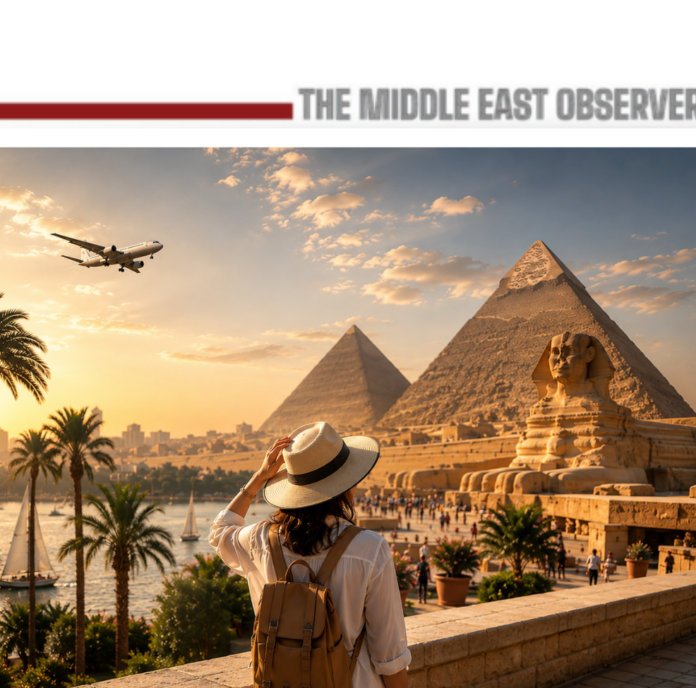
Egypt is preparing its most ambitious tourism promotion drive in decades, nearly doubling its international marketing budget to $60 million for fiscal year 2026/27 as it intensifies competition for global travellers and seeks to transform tourism into a larger source of foreign currency earnings. The plan targets 23 key international markets and forms part of Cairo’s broader ambition to attract 30 million visitors annually by 2030, positioning Egypt more aggressively against regional rivals including Saudi Arabia, the UAE, Türkiye and Morocco.
According to government plans, the new allocation represents a 95.4% increase over the previous fiscal year’s budget of $30.7 million. The campaign will focus on major source markets including Russia, Germany, Saudi Arabia, the United Kingdom, the United States, China, India, Italy, France, Poland and Turkey.
The initiative comes as Egypt’s tourism sector continues to record strong growth. Visitor arrivals reached approximately 19 million tourists in 2025, up 20.5% year-on-year, while arrivals during the first quarter of 2026 climbed 15.6% to 4.5 million visitors. Tourism revenues have become one of Egypt’s most important sources of hard currency, generating an estimated $15-16 billion annually, alongside remittances, natural gas exports and Suez Canal receipts.
Competition for Global Tourists Intensifies
Egypt’s increased spending reflects a rapidly changing tourism landscape across the wider Middle East and Mediterranean region. Saudi Arabia is investing heavily through its Vision 2030 programme to attract 150 million visitors annually, while the UAE continues expanding its premium tourism offerings. Türkiye remains one of the world’s most successful destination-marketing stories, and Morocco has steadily increased its share of European tourism flows through aggressive air-connectivity and hospitality investments.
Against this backdrop, Egyptian policy makers increasingly view tourism promotion as a strategic economic investment rather than a discretionary marketing expense. The additional $29 million in spending represents a relatively modest outlay compared with the billions of dollars in tourism revenues that each percentage point increase in visitor arrivals can generate.
The strategy also reveals a more sophisticated segmentation of target markets. Core volume markets include Russia, Germany, Saudi Arabia, the United Kingdom, Italy and Poland, which collectively account for a substantial share of Egypt’s traditional visitor base. Growth markets such as China, India, Kazakhstan, Turkey and the Czech Republic offer expanding outbound travel demand and long-term growth potential. Meanwhile, premium-spending markets including the United States, Switzerland, Austria, France and Spain are expected to support higher visitor expenditure and longer stays, helping Egypt increase tourism revenues alongside arrival numbers.
Digital Campaigns and Trade Partnerships Take Centre Stage
The tourism promotion authority has earmarked approximately $36.5 million for business-to-business initiatives, including international tourism exhibitions, joint campaigns with tour operators, familiarisation trips, roadshows and industry workshops.
Officials view these activities as critical channels for securing partnerships with airlines, tour operators and travel agencies capable of delivering sustained visitor growth.
Meanwhile, spending directed toward direct consumer engagement will more than double to $23.5 million, supporting digital advertising, search engine promotion, online booking platforms, social media campaigns and international public relations activities.
The shift highlights how global tourism competition is increasingly being fought through digital channels, where destinations compete for visibility long before travellers book flights or accommodation.
Marketing Push Linked to Capacity Expansion
The enlarged marketing budget coincides with a broader expansion of Egypt’s tourism infrastructure. The government has repeatedly stated its objective of increasing national hotel capacity from roughly 230,000 rooms currently to around 500,000 rooms by 2030, while airport expansion projects and new airline routes are being developed to support future demand growth.
The expected operational expansion of the Grand Egyptian Museum, alongside new tourism projects on the Red Sea coast, is expected to strengthen Egypt’s appeal across both cultural and leisure tourism segments.
Domestic promotion is also receiving increased attention, with EGP 500 million allocated to campaigns highlighting safari tourism, diving, yachting, golf tourism and conferences. The strategy aims to increase not only visitor numbers but also average spending and length of stay.
Officials nevertheless face challenges. Regional geopolitical tensions, airline route disruptions, global economic uncertainty and intensifying competition from neighbouring destinations could affect travel demand and tourism investment decisions. Maintaining service quality and expanding capacity quickly enough to accommodate future growth will be equally important if Egypt is to sustain annual visitor growth above 20%.
For Egypt, the next phase of tourism growth will depend less on whether travellers know about the country and more on whether the industry can convert rising global interest into longer stays, higher spending and repeat visits. The near doubling of the promotion budget suggests policy makers increasingly view tourism not simply as a visitor industry, but as a strategic export sector competing for global market share and foreign currency earnings in an increasingly crowded international marketplace.
