
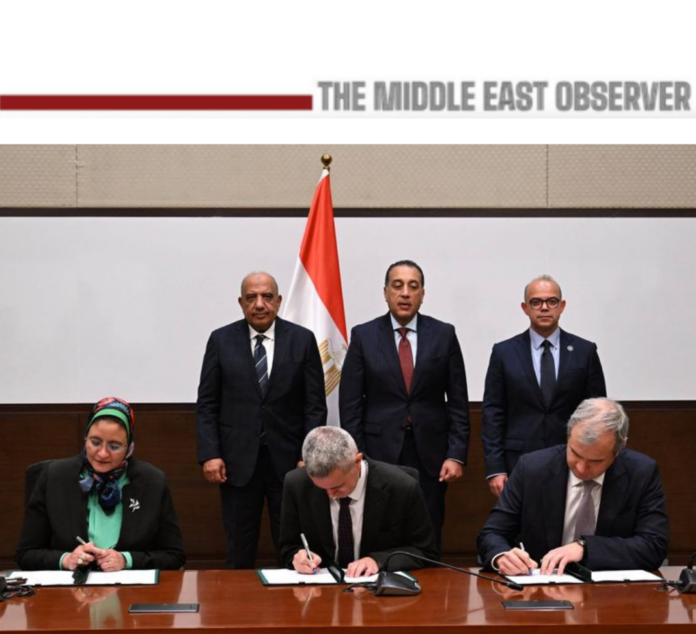
CAIRO — Egypt has taken a significant step toward implementing its evolving State Ownership Policy after signing agreements with Alcazar Energy to invest, operate and manage the 580 MW Gabal El-Zeit wind farm on the Red Sea coast under a $420 million transaction.
Gabal El-Zeit is among Egypt’s largest wind-energy projects and forms part of the country’s long-term strategy to expand renewable generation and strengthen its position as a regional clean-energy hub.
While the deal adds momentum to Egypt’s renewable-energy ambitions, its broader significance lies in the model being adopted. Rather than pursuing a traditional privatization, the government is retaining ownership of a strategic energy asset while attracting foreign capital, operational expertise and external financing through a long-term investment and management arrangement.
The agreements, signed between the New and Renewable Energy Authority, the Egyptian Electricity Transmission Company and Alcazar Energy, include both an investment and operation agreement and a power purchase agreement. Under the framework, Alcazar Energy will establish a project company in Egypt to operate and manage the wind farm while maintaining its generation capacity at no less than 580 MW.
The transaction comes as Egypt prepares to publish an updated State Ownership Policy Document aimed at expanding private-sector participation across the economy. The Gabal El-Zeit agreement offers one of the clearest examples so far of how Cairo may increasingly seek to unlock value from state-owned assets without relinquishing strategic control.
For investors, the deal signals a shift toward an asset-recycling approach in which existing infrastructure is leveraged to attract foreign direct investment, improve operational efficiency and support national development goals. The government aims to increase renewable energy’s share of electricity generation to 45% by 2030, with private-sector investment expected to play a central role in financing the transition.
For the renewable-energy sector, the agreement reinforces Egypt’s efforts to mobilize international capital while accelerating clean-energy deployment. More broadly, it provides a potential blueprint for future partnerships between the state and private investors across strategic sectors.
Investors will also be watching whether similar asset-recycling structures are extended to ports, logistics hubs, industrial zones and other state-owned infrastructure assets as Egypt advances implementation of its updated State Ownership Policy.
