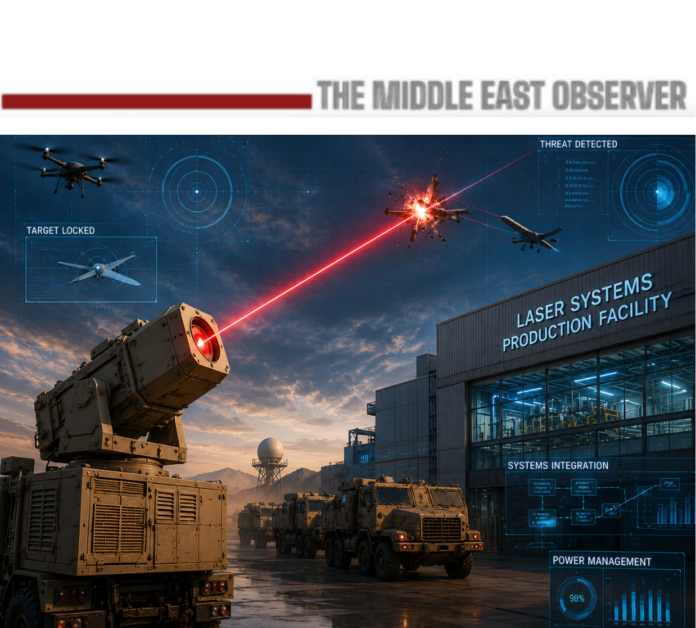
A new global military competition is rapidly taking shape—not around conventional missiles or next-generation fighter aircraft, but around high-energy laser systems increasingly viewed as a critical component of future air-defense architecture. A recent analysis published by Fast Company argues that the world has entered a decisive “laser weapon inflection point,” with the Middle East—and particularly the United Arab Emirates—emerging as one of the most strategically significant arenas for the deployment and integration of directed-energy technologies.
According to the report, the UAE is simultaneously engaging with multiple competing defense ecosystems, including Israeli, American, and Chinese systems, reflecting a broader transformation underway in global defense procurement and security partnerships. Reports surrounding the deployment of Israel’s Iron Beam system to the UAE, alongside indications of Chinese laser-defense technology appearing in Dubai and Abu Dhabi’s pursuit of advanced American counter-drone infrastructure, collectively illustrate how directed-energy weapons are moving from experimental programs into operational security frameworks.
Momentum behind laser weapons is accelerating amid mounting concerns over the rapid proliferation of low-cost drones and saturation-style aerial attacks that have increasingly challenged conventional missile-defense systems across several conflict zones. Unlike traditional interceptors—which remain costly and finite—laser systems are viewed as potentially transformative due to their lower engagement costs, rapid response capabilities, and ability to sustain repeated operations once sufficient power infrastructure is available.
For Gulf states, these systems are becoming increasingly relevant to the protection of strategic infrastructure, including energy facilities, airports, military installations, desalination plants, and key maritime corridors. The evolving threat environment has accelerated regional interest in layered defense systems capable of countering large-scale drone attacks more efficiently and at lower long-term operational costs.
Yet the Fast Company analysis argues that the primary challenge facing laser weapons is no longer technological feasibility, but industrial scalability. The article points to reports suggesting that even Israel—widely considered among the leaders in operational laser-defense deployment—still faces constraints in fielding sufficient batteries at scale during periods of heightened military activity.
This emerging reality is reshaping strategic calculations globally. The critical issue may no longer center solely on which country develops the most advanced prototype, but rather which nations possess the manufacturing depth, supply-chain resilience, procurement speed, integration capabilities, and energy infrastructure necessary to deploy such systems effectively during modern high-intensity conflicts.
The report identifies China as potentially holding a strong industrial advantage due to its large-scale manufacturing ecosystem and expanding defense export capabilities, while countries such as Turkey and Ukraine are accelerating indigenous development efforts under very different strategic conditions. The United States, meanwhile, continues to maintain a dominant role in directed-energy research and command-and-control integration, despite persistent challenges in transitioning advanced systems from development into mass operational deployment.
For the Middle East, the UAE’s diversified procurement strategy may also reflect a broader regional trend toward strategic flexibility and multi-aligned defense partnerships amid intensifying competition between major global powers. The convergence of Western, Israeli, and Asian defense technologies within the Gulf increasingly highlights how future security architectures may become more hybridized and technologically interconnected.
As The Middle East Observer observes, the rapid evolution of drone warfare and counter-drone defense is gradually transforming laser weapons from futuristic concepts into practical instruments of national security planning. However, the broader implications extend beyond the battlefield itself. The expansion of directed-energy systems may reshape defense-industrial priorities, energy infrastructure planning, military procurement models, and even geopolitical influence within emerging security alliances.
While the Fast Company analysis suggests that industrial production capacity may ultimately determine leadership in the global laser race, the broader strategic landscape appears considerably more complex. Technological integration, combat adaptability, alliance structures, cyber resilience, artificial intelligence-assisted targeting, and operational doctrine may collectively prove just as decisive as manufacturing scale in defining which countries successfully translate directed-energy systems into sustainable strategic advantage.
In this emerging era of drone-centric warfare, the race may therefore not simply be about producing larger numbers of laser weapons, nor solely about possessing the most sophisticated integrated technologies. The states most likely to shape the future battlefield may ultimately be those capable of combining industrial scale with deeply integrated multi-layered defense ecosystems—allowing diversified weapon systems to operate economically, cohesively, and sustainably under the pressures of future high-intensity conflict.