
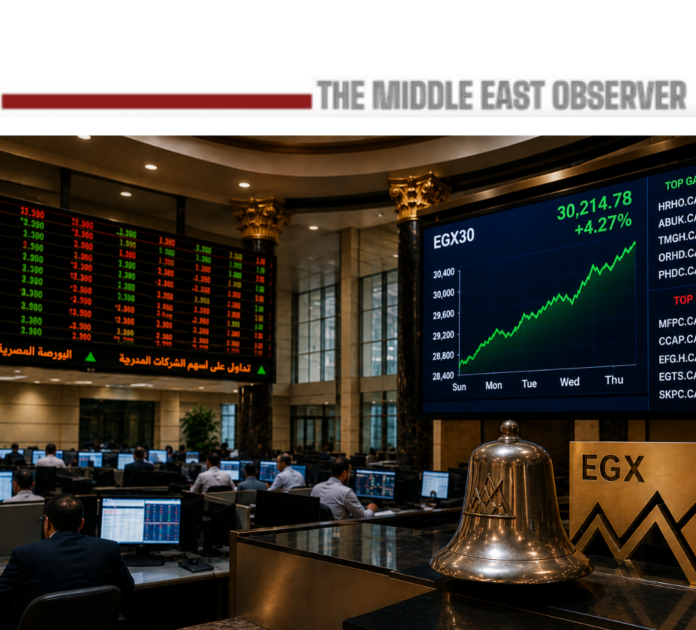
Cairo — Egypt’s stock market recorded a strong advance in the week of 3–6 May 2026, with investors encouraged by easing inflation, a stronger Egyptian pound and improving foreign reserve data, while regional geopolitical tensions showed signs of stabilisation.
The benchmark EGX30 ended the week at around 53,605 points, up 3.56% over the four-session period, marking a strong weekly advance. The broader EGX70 index rose 3.36%, while the EGX100 gained 3.1%, according to Egyptian Exchange data. Total trading values reached approximately EGP 46.6bn, reflecting improved liquidity and stronger market participation.
The rally came despite continued foreign and Arab selling pressure. Combined net sales by Arab and non-Arab foreign investors reached roughly EGP 687.8mn, including EGP 516.2mn in Arab outflows, while domestic investors remained the primary source of support.
Macroeconomic indicators helped improve market sentiment during the week. The Egyptian pound strengthened by around 1.6% against the US dollar, with the exchange rate reaching approximately EGP 52.62/$ for buying and EGP 52.76/$ for selling by Thursday, according to Central Bank of Egypt (CBE) data.
At the same time, Egypt’s foreign currency reserves rose to $53.01bn at the end of April, up from $52.83bn in March, the CBE said. The increase supported Egypt’s external liquidity position amid continued volatility in regional energy markets and global capital flows.
Inflation data also provided support. The CBE announced that core inflation slowed to 13.8% year-on-year in April, down from 14% in March, while data from Egypt’s statistics agency, CAPMAS, showed annual urban inflation easing to 14.9%, from 15.2% the previous month. The figures reinforced expectations that inflationary pressures may be gradually moderating despite ongoing geopolitical risks linked to the conflict involving Iran and shipping tensions in the Strait of Hormuz.
Interbank dollar trading volumes declined slightly by 1.1% week-on-week to around $1.7bn, according to local banking data, although volumes remained above their typical weekly average range of $750mn–$1.2bn. The decline coincided with fluctuating foreign appetite for Egyptian treasury bills as regional tensions between the United States and Iran continued to influence capital flows across emerging markets.
Regional equity markets stabilised modestly during the week. Recent reporting by Reuters indicated that Gulf markets were monitoring developments in US-Iran diplomacy and oil prices, helping reduce immediate pressure on regional risk assets.
The week’s rally reflected a combination of improving domestic macroeconomic indicators and stabilising regional conditions. While foreign investors remained net sellers overall, stronger local liquidity, easing inflation and firmer external reserve data helped support Egyptian equities. Investors are now likely to focus on whether the improving inflation trend can strengthen expectations of future monetary easing without triggering renewed pressure on the pound.