Egypt’s government has reaffirmed its commitment to accelerating the state asset offering program, including the planned sale or listing of several military-affiliated commercial entities, as the International Monetary Fund begins its seventh review of the country’s economic reform program in Cairo.
Prime Minister Mostafa Madbouly chaired a high-level meeting to review progress on the government’s privatization strategy and updates to the State Ownership Policy Document, with officials emphasizing that the broader objective extends beyond raising financing toward gradually restructuring the Egyptian economy around a larger and more integrated private-sector role.
According to Cabinet spokesman Mohamed El-Homsani, the government remains committed to offering several military-affiliated companies through the Egyptian Exchange or strategic investors, including “Wataniya” petroleum distribution, “ChillOut” fuel stations, “Silo Foods,” and the National Company for Roads Construction and Development.
Officials stated that the updated State Ownership Policy and privatization program are increasingly viewed as central pillars in redefining the state’s economic role, modernizing governance standards, improving asset efficiency, reducing long-term fiscal pressures, and expanding private-sector participation across strategic sectors of the economy.
The renewed push coincides with the arrival of an IMF delegation in Cairo to conduct the seventh review of Egypt’s $8 billion Extended Fund Facility program, alongside a separate $1.3 billion Resilience and Sustainability Facility arrangement.
According to regional media reports, the review — which includes meetings with the Central Bank of Egypt, the Cabinet, and the Ministry of Finance — could pave the way for the disbursement of approximately $1.65 billion tied to continued implementation of structural policies, particularly exchange-rate flexibility, fiscal discipline, state ownership reforms, and the expansion of private investment within the economy.
The IMF has repeatedly emphasized the importance of reducing the state’s footprint in commercial activity while creating greater room for private-sector expansion, foreign direct investment, productivity growth, and more competitive market dynamics. Recent IMF statements also noted that Egypt’s exchange-rate liberalization and stronger reserve position helped absorb part of the regional economic shocks linked to the ongoing Iran war and volatility in global energy and financial markets.
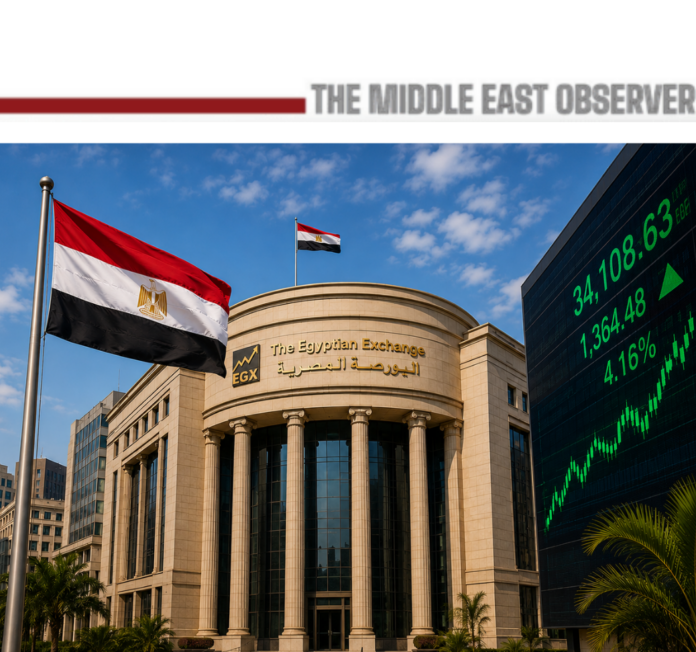
The renewed privatization momentum has also coincided with increasing activity on the Egyptian Exchange, reflecting broader efforts to deepen domestic capital markets and diversify funding channels beyond traditional state financing mechanisms. The exchange recently received a listing request from chemical industries company “SEED,” while Korra Energy and Investment is reportedly preparing to offer around 11% of its shares during the second quarter of the year.
As The Middle East Observer notes, the simultaneous return of the IMF review mission and the renewed emphasis on state asset sales underline Cairo’s attempt to move beyond short-term financing pressures toward a broader restructuring of the Egyptian economic model. The inclusion of military-affiliated companies within the offering program reflects an increasingly important phase in integrating private capital more deeply into sectors historically dominated by state entities, as Egypt seeks to improve efficiency, stimulate competition, attract long-term investment, and gradually transition toward a more diversified and investment-driven mixed economic structure amid a challenging regional economic environment.