
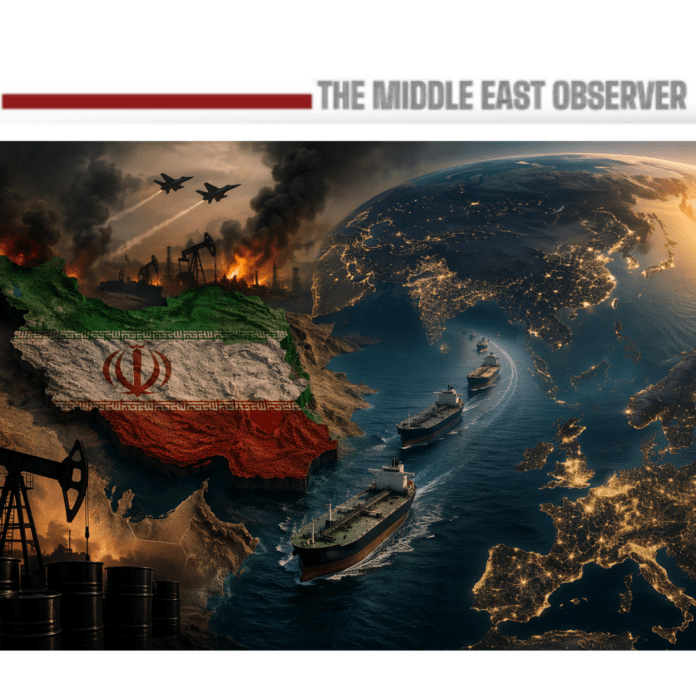
The continued disruption of flows through the Strait of Hormuz is forcing a rapid reconfiguration of global energy supply chains, raising a defining geopolitical question: who can replace the Gulf as the primary energy artery for Asia and Europe?
The answer, as The Middle East Observer assesses, is fragmented. No single supplier can replicate the scale, proximity, and crude compatibility of Middle Eastern exports. Instead, a multi-source system is emerging—anchored by U.S. exports, Saudi logistical flexibility, and Europe’s diversified gas network—but constrained by infrastructure limits, refinery mismatches, and intensifying competition between Asia and Europe.
Asia remains the most exposed. Economies such as Japan, heavily reliant on Gulf crude, have moved into contingency mode—releasing strategic reserves and sourcing alternative barrels from the United States and the Atlantic Basin. Yet the challenge is structural: refineries designed for medium-sour Gulf crude cannot seamlessly process lighter alternatives without altering output. Diesel and jet fuel yields decline, while gasoline increases, creating imbalances across fuel markets.
As The Middle East Observer observes, this shift is expected to compress jet fuel availability, raising the risk of aviation fuel constraints across key Asian hubs—even where crude supply is partially secured.
The United States has emerged as the primary swing supplier, with rising production and exports redirecting crude toward both Asia and Europe. However, export capacity is nearing its logistical ceiling. Saudi Arabia remains a critical stabilizer, leveraging Red Sea export routes to partially bypass Hormuz and maintain market presence under OPEC+ coordination.
On gas, Asia faces tighter constraints. With Qatari LNG exposed to route risks, incremental supply is expected to come mainly from U.S. exports—yet liquefaction capacity is already near peak, limiting flexibility.
Europe, by contrast, is structurally stronger on gas. Diversification led by the European Commission allows reliance on U.S. LNG, Norwegian pipelines, and North African flows, insulating the continent from immediate shortages. The stress point lies instead in refining economics.
European refining margins have turned negative as Asian competition drives crude costs higher. While fuel prices remain elevated, operating costs and input prices are eroding profitability, potentially forcing refinery run cuts.
As The Middle East Observer highlights, sustained margin pressure could tighten product output—particularly jet fuel—placing additional strain on Europe’s aviation sector and increasing operational costs for airlines.
A new supply hierarchy is thus forming: the United States as the marginal supplier, Saudi Arabia as the stabilizer, the Atlantic Basin as a supplementary source, and Europe relying on diversified gas networks, while Asia depends on stockpiles and substitution strategies.
Yet this system is inherently inefficient. Freight costs are rising, infrastructure is strained, and refinery systems lack flexibility.
The Middle East Observer concludes that if the crisis persists, the global energy system will not collapse—but it will operate under sustained and escalating strain. Asia will bear the sharper impact through supply mismatches, while Europe will absorb the shock through margin compression rather than outright shortages.
As The Middle East Observer assesses, prolonged disruption is expected to drive a structurally higher pricing environment across energy markets, with crude benchmarks remaining elevated, refined products—particularly jet fuel—experiencing disproportionate upward pressure due to refinery constraints, and liquefied natural gas markets tightening further amid intensified competition for limited supply.
In this post-Hormuz landscape, energy security is no longer defined by access alone—but by adaptability.