Cairo — The World Health Organization has issued a stark assessment of the humanitarian and health situation across parts of the Middle East, warning of escalating pressure on medical systems amid ongoing conflict, despite a newly announced ceasefire in Lebanon.
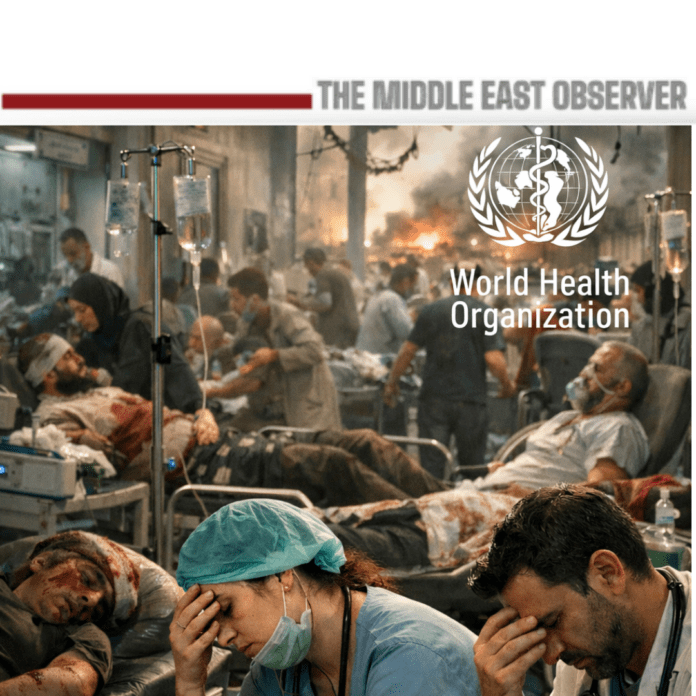
In its latest update as of 16 April, WHO welcomed the declaration of a 10-day ceasefire in Lebanon, describing it as a critical opportunity to ease pressure on an overstretched health sector. However, the organization confirmed that since early March, 139 attacks on healthcare facilities and personnel have been verified, resulting in 91 fatalities and 224 injuries. Within the week of 10–16 April alone, 22 attacks led to the deaths of 19 paramedics, injuries to 40 individuals, and damage to 19 emergency medical vehicles.
Healthcare infrastructure in Lebanon is now operating at near-total capacity. WHO reports that hospitals treating casualties are functioning at 90–100% occupancy, with emergency departments fully saturated. More than 7,000 trauma cases have placed severe strain on medical supplies, contributing to an estimated 30% shortage in essential medicines, including treatments for trauma, cancer, and chronic conditions.
The regional health situation extends beyond Lebanon. In Gaza, humanitarian partners have documented rising public health risks in displacement settings, including widespread infestations of lice, scabies, and rodents, raising concerns over deteriorating sanitation and disease control conditions.
In southern Syria—particularly in Quneitra, Dara’a, and As-Suwayda—ongoing clashes between internal security forces and local armed groups have disrupted civilian mobility and significantly constrained humanitarian access, limiting the delivery of medical assistance to affected populations.
Meanwhile, in Iraq, the restoration of core health services remains incomplete, with WHO noting that operational capacity continues to be hindered by persistent supply chain disruptions and logistical challenges.
Across the region, the crisis is further compounded by systemic supply chain breakdowns, with transport costs rising by 40–50% and a growing reliance on overland and multimodal logistics routes. These disruptions are directly impacting the availability and timely delivery of medical supplies and humanitarian aid.
Although no new environmental incidents were recorded during the reporting period, WHO cautioned that residual risks remain significant, particularly from prior damage to energy and water infrastructure. These include potential contamination threats and ongoing vulnerabilities in desalination systems, which are critical for water security in several affected areas.
The Middle East Observer notes that the current situation reflects a multi-layered health emergency, where direct conflict impacts—such as attacks on healthcare—are intersecting with indirect pressures, including supply chain disruptions, public health deterioration, and infrastructure damage.
The WHO has called for sustained humanitarian access, protection of healthcare services, and urgent international support to prevent further deterioration. As the ceasefire window opens in Lebanon, the organization emphasized the need for immediate scaling up of medical aid and system recovery efforts to stabilize an increasingly fragile regional health landscape.