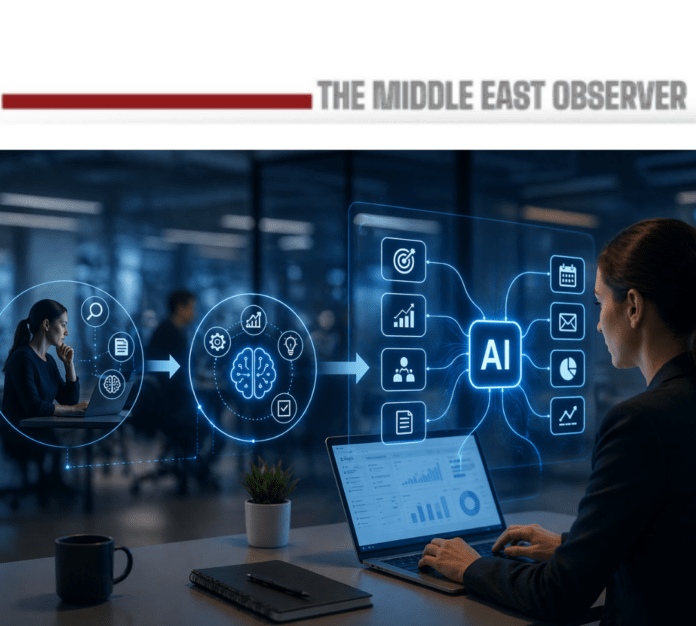
In a notable escalation of the global race toward artificial intelligence–driven operations, Meta Platforms has begun deploying internal tracking systems designed to capture employee activity, marking a significant step toward automating core workplace functions.
According to reporting by Reuters, the company is installing proprietary software across work computers of U.S.-based employees under what is internally referred to as the Model Capability Initiative (MCI). The system records mouse movements, clicks, keystrokes, and periodic screen snapshots, producing real-world behavioral datasets intended to train Meta’s next generation of AI models. As observed in analysis by The Middle East Observer, this development reflects a broader structural shift in how leading technology firms are redefining labor—from human execution toward machine replication of workflows.
Internal materials reviewed by Reuters indicate that Meta’s objective extends beyond incremental improvements in AI performance. The company is working to develop autonomous AI agents capable of executing routine digital tasks, including navigating software interfaces, interacting with menus, and completing multi-step workflows traditionally performed by employees. A Meta spokesperson confirmed that such datasets are essential, noting that AI systems require “real examples of how people actually use computers” to enhance accuracy and usability.
The initiative forms part of a wider internal transformation effort, reportedly aligned with programs aimed at embedding AI deeply into Meta’s operational structure. In this context, The Middle East Observer notes that the company’s strategy signals not only technological advancement but also a recalibration of workforce design around AI-enabled productivity. Senior leadership has outlined a longer-term vision in which AI systems handle a growing share of operational tasks, while human roles evolve toward supervision, validation, and optimization of automated processes.
This transition is already taking shape within the organization. Reports indicate that traditional job functions are being consolidated into AI-focused roles, with engineering resources increasingly redirected toward automation initiatives. Dedicated units, including advanced AI research divisions, are accelerating development, while parallel reports cited by Reuters suggest that workforce adjustments—potentially affecting up to 10% of staff—are being considered as part of broader efficiency measures tied to AI deployment.
Despite company assurances that the collected data is intended solely for AI training and not for employee performance evaluation, the rollout has generated internal concern. According to Business Insider, employees have raised questions regarding the absence of opt-out mechanisms, the scope of monitoring, and the distinction between productivity tools and workplace surveillance. Reports indicate that participation is effectively mandatory on company-issued devices, intensifying scrutiny around consent and data governance practices.
Legal analysts further note that while such monitoring frameworks are generally permissible under U.S. employment law, similar practices would likely encounter stricter regulatory constraints in other jurisdictions, particularly within the European Union under GDPR and labor protection regimes.
More broadly, Meta’s move reflects an accelerating industry-wide shift toward AI systems capable of executing complex, multi-step tasks with minimal human intervention. As highlighted by The Middle East Observer, the implications extend beyond a single company: human interaction data is increasingly being treated as a critical input for machine learning, workflows are being redesigned with automation as a primary objective, and the boundary between employee activity and AI training data is becoming progressively blurred.
While Meta maintains that the initiative is designed to enhance productivity and support its workforce, the strategic trajectory underscores a deeper transformation. By systematically capturing and modeling human digital behavior, the company is laying the groundwork for AI systems that can replicate elements of knowledge work at scale. In the assessment of The Middle East Observer, this moment represents a pivotal evolution in corporate AI strategy—marking a transition from AI as a supporting tool to AI as a central operational layer within the modern enterprise.