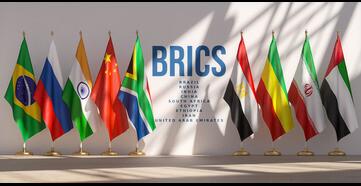
Bloc deepens financial independence through new bonds, loans, and currency-swap deals
BRICS nations are accelerating efforts to construct an alternative financial framework that operates outside the orbit of the US dollar, as China and Russia spearhead a wave of yuan-denominated initiatives spanning loans, bonds and cross-border payments.
In a landmark move this week, China and South Africa completed the bloc’s first yuan-denominated loan, worth $290 million, between the China Development Bank and the Development Bank of Southern Africa. The financing will support infrastructure, energy and social-development projects across the continent, underscoring Beijing’s determination to globalise its currency through development lending.
Simultaneously, China’s Cross-Border Interbank Payment System (CIPS) has widened its reach to 4,800 banks in 185 countries, processing more than 52 trillion yuan ($12.7 trillion) in annual transactions — about 58 per cent of China’s total cross-border flows. The expansion positions CIPS as a credible alternative to the Western-dominated SWIFT network, signalling that Chinese trade and finance can operate independently of dollar-based mechanisms.
The trend is increasingly visible across emerging markets. Around 95 per cent of trade between China and Russia is now settled in local currencies, while Chinese overseas lending has surged 35 per cent this year to $480 billion. Countries such as Kenya, Angola and Ethiopia have begun restructuring dollar-denominated debts into yuan arrangements.
Moscow is also deepening its yuan exposure. According to Reuters, Russia’s Finance Ministry is preparing to issue up to 400 billion rubles ($4.9 billion) in yuan-denominated domestic bonds on the Moscow Exchange — the first of their kind — as it grapples with a swelling budget deficit nearly five times its initial 2025 forecast. The offering, due in early December, will target both institutional and retail investors.
Elsewhere, China’s central bank renewed its 400 billion-yuan ($56.2 billion) currency-swap agreement with South Korea’s central bank for another five years, reinforcing liquidity ties and financial stability in the region.
These developments come as BRICS members intensify efforts to build financial autonomy. Russia’s planned 2027 grain exchange aims to reduce reliance on US-based trading hubs, potentially saving members $2.5 billion annually. The expanded bloc — now including Egypt, Ethiopia, Iran and the UAE — represents 45 per cent of global grain output and a quarter of exports.
Yet for many developing economies, yuan-based financing offers a pragmatic hedge against dollar volatility and tightening liquidity. With China’s financial reach now spanning African loans, Russian debt and a 185-nation payment network, the BRICS project to de-dollarize global trade is no longer theoretical — it is becoming operational.