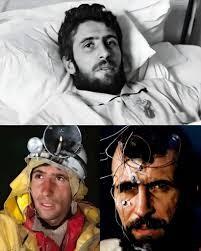
In the summer of 1962, a French scientist named Michel Siffre descended deep beneath the Earth’s surface to challenge one of humanity’s most elusive mysteries: What is time?
Siffre, a geologist and chronobologist obsessed with human perception, wanted to answer a radical question:
Is time something we experience from the outside — or something our minds create from within?
To find out, he did something almost unimaginable.
He isolated himself 440 feet underground, in a dark cave in Texas.
No sunlight. No clocks. No contact with the outside world.
Only a dim light, limited food, and a faint radio line to transmit scientific readings to his team above ground.
At first, Siffre tried to maintain some sense of order. He ate when he felt hungry, slept when tired, and logged his observations. But as the days passed, his world began to dissolve.
Without sunrise or sunset, time itself loses meaning. Hours and days blurred together. His perception of the world stretched and warped like a dream.
Gradually, his body created a new rhythm — a biological clock of its own making.
He began staying awake for 36 hours straight, then sleeping for 12.
His mind had detached completely from the planet’s natural day-night cycle.
The price was devastating.
In the silence of the cave, Michel began to hallucinate.
He saw shadows move across the walls and heard phantom voices whisper in the dark.
He forgot familiar words. His speech faltered.
He became convinced that something — or someone — was watching him.
After 180 days, his team finally brought him back to the surface.
When asked how long he believed he had been underground, he confidently replied:
“About 151 days.”
He had lost 29 days — not in sleep or memory, but in his very perception of existence.
Michel Siffre’s ordeal became one of the most important experiments in modern psychology and chronobiology.
He proved that our sense of time is not external — it is a mental construct, shaped by biology, emotion, and environment.
His findings transformed how scientists understand:
- Sleep and circadian rhythms
- Astronaut isolation and time perception in space
- The psychological effects of solitary confinement
But for Siffre himself, the discovery came at a cost.
He emerged physically weak, emotionally shaken, and mentally scarred.
It took him years to recover from the trauma of sensory and social deprivation.
Still, his name became immortal in science — not for conquering time, but for proving how fragile our grasp of it truly is.
Decades later, Siffre’s cave experiment continues to echo in philosophy, neuroscience, and art.
It forces us to confront an unsettling truth:
Perhaps time isn’t something we live in —
but something we invent, moment by moment,
to make sense of the endless dark.
As Siffre himself once reflected, “The most dangerous caves are not beneath the Earth — but within the human mind.”