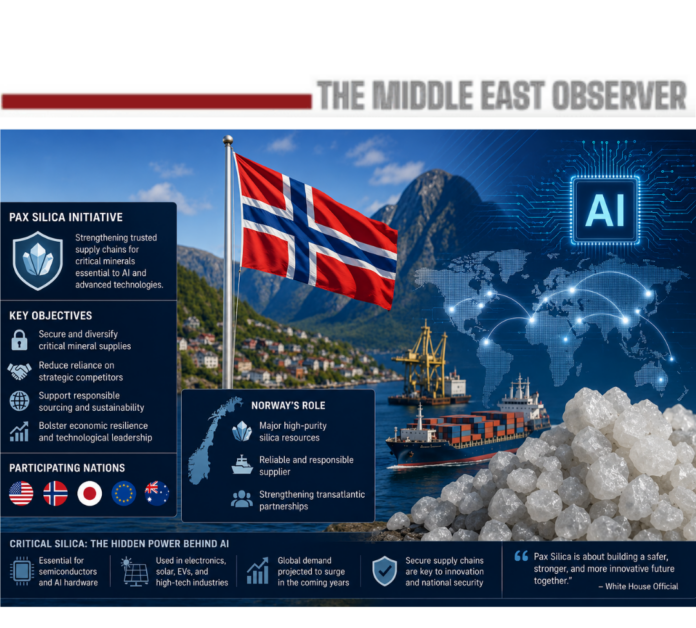
OSLO — Norway has officially joined the US-led “Pax Silica” initiative, a strategic alliance aimed at strengthening artificial intelligence supply chains and reducing Western dependence on China for critical technology infrastructure and raw materials.
According to a report by Reuters, the Norwegian government confirmed its participation in the initiative on Tuesday, describing the move as part of broader cooperation with allied countries on securing advanced technology ecosystems and strategic industrial supply chains.
Launched in 2025, the Pax Silica initiative has emerged as a central pillar of the administration of Donald Trump in its effort to strengthen coordination among Western allies in areas linked to artificial intelligence, semiconductors, and critical minerals.
The initiative focuses on securing reliable access to strategic materials and industrial infrastructure considered essential for the future expansion of AI technologies, including semiconductor production, data-center infrastructure, advanced computing systems, and rare-earth supply chains.
Norwegian officials indicated that Oslo’s participation will support cooperation on resilient technology infrastructure, industrial security, and long-term supply-chain stability, while reinforcing strategic partnerships with allied economies.
Industry analysts noted that Norway’s strategic importance within the initiative stems from its stable industrial environment, renewable-energy capacity, advanced technological infrastructure, and access to critical minerals increasingly required in AI and semiconductor manufacturing. Analysts also described Norway as an increasingly trusted allied jurisdiction for advanced technology and AI infrastructure development.
The move also reflects growing international efforts to restructure technology supply chains amid intensifying geopolitical competition between Washington and Beijing over artificial intelligence leadership and advanced industrial technologies.
Western governments have increasingly sought to reduce exposure to China-centered manufacturing networks by expanding “friend-shoring” strategies that relocate critical technology supply chains toward politically aligned countries and trusted industrial partners.
Analysts say the initiative highlights how artificial intelligence is rapidly evolving beyond a purely technological sector into a broader geopolitical and industrial-security priority increasingly linked to energy systems, strategic minerals, semiconductor manufacturing, and national economic resilience.
As The Middle East Observer notes, Norway’s accession to the Pax Silica initiative underscores the accelerating transformation of AI infrastructure into a strategic geopolitical domain, where control over supply chains, critical resources, industrial alliances, and advanced manufacturing ecosystems is becoming as important as leadership in AI software and computing itself.