
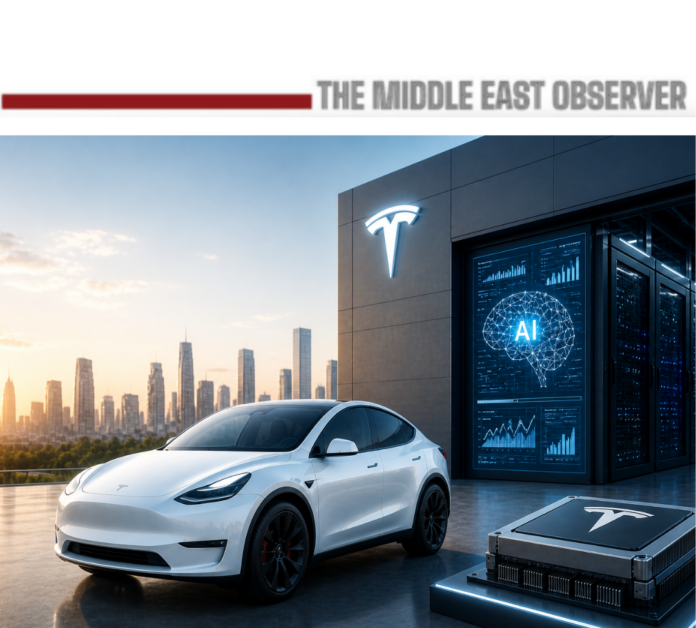
Tesla is undergoing a strategic transformation as CEO Elon Musk intensifies investments in artificial intelligence, robotics and autonomous mobility, repositioning the company beyond its traditional electric vehicle (EV) business, according to reporting by Bloomberg.
The shift comes as Tesla faces mounting pressure in its core EV segment, having lost its position as the world’s leading fully electric vehicle seller to China’s BYD, alongside slowing delivery growth and intensifying global competition. Despite these headwinds, Tesla’s valuation remains among the highest in the S&P 500, reflecting investor confidence in its long-term technology ambitions rather than its current automotive performance.
In response, Musk has outlined a transition toward what he describes as a “physical AI” company, with capital expenditure expected to exceed $25 billion this year—more than triple previous levels. The investments are aimed at advancing autonomous driving systems, humanoid robots such as Optimus, and AI-enabled infrastructure, including a major semiconductor initiative known as “Terafab,” developed in collaboration with SpaceX.
Tesla’s autonomous vehicle strategy is also evolving, with limited robotaxi services already deployed in parts of Texas, while broader expansion plans remain underway. However, industry observers note that fully autonomous mobility and large-scale robotics deployment may still be years away from commercial viability.
Operationally, Tesla continues to navigate challenges including production adjustments for key models such as Model Y, a relatively narrow product lineup compared to competitors, and reduced regulatory credit revenues in the United States. At the same time, growth in its energy storage division—despite recent volatility—remains a supporting pillar of the business.
Some signs of recovery have emerged, with demand improving across North America, Europe and the Middle East, partly driven by rising fuel prices amid geopolitical tensions. Nonetheless, analysts caution that Tesla’s near-term performance remains closely tied to its ability to execute on its next-generation technology roadmap.
As The Middle East Observer notes, Tesla’s transformation reflects a broader shift in the global automotive industry—from hardware-centric manufacturing toward AI-driven mobility ecosystems. While the company’s ambitious pivot could redefine its long-term trajectory, it also introduces execution risks that will determine whether Tesla can sustain its premium valuation in an increasingly competitive and rapidly evolving market landscape.
