
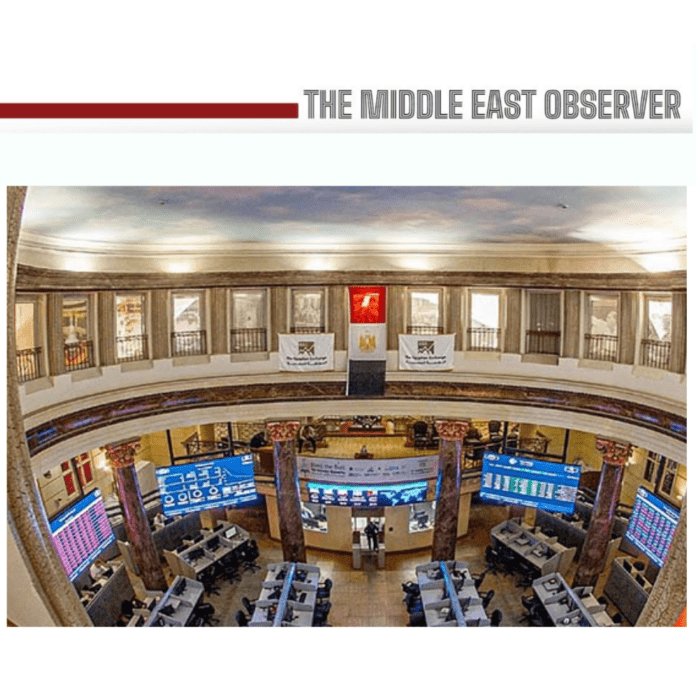
Cairo — Egypt’s stock market ended the 22–26 March 2026 week on a softer note, with the sell-off on Thursday, 26 March leaving the bourse lower overall after a brief mid-week rebound. The period was shortened by the Eid Al-Fitr holiday, with the Egyptian Exchange closed through Monday, 23 March. In EGX’s weekly summary, the EGX30 capped index fell 0.6% over the period, while the EGX33 Shariah index declined 0.76%.
Thursday’s session set the tone for the week’s finish. The EGX30 dropped 1.04% to 47,001.89 points, with the EGX33 down 0.86%, the EGX35-LV off 0.97%, the EGX70 down 0.92% and the EGX100 lower by 0.87%. Total market capitalisation closed at about EGP 3.261 tn. EnterpriseAM said turnover came in at EGP 5.8 bn, below the 90-day average, and that international investors were the sole net sellers on the day.
The week’s pattern was sharp but uneven. On Tuesday, 24 March, the EGX30 fell 1.43% to 46,930.88, even as the EGX70 and EGX100 rose, suggesting selective interest in smaller caps rather than a broad market exit. On Wednesday, 25 March, the benchmark rebounded 1.21% to 47,497.91 on EGP 7.275 bn of turnover, with Egyptian investors net buyers and Arab and foreign investors net sellers. Market capitalisation rose to EGP 3.292 tn before slipping back the next day.
The underlying driver was regional geopolitics rather than company-specific news. Reuters reported that Egypt’s blue-chip index fell 1.4% on 24 March as war-related energy worries kept pressure on regional risk assets, then rose 1.2% on 25 March after reports of a possible US-Iran ceasefire proposal improved sentiment, before losing 0.9% again on 26 March as hopes of de-escalation faded and oil rebounded.
That backdrop matters acutely for Cairo. Reuters reported on 18 March that Egypt’s energy import bill had more than doubled since the outbreak of the war, with the monthly natural gas import bill rising to about $1.65 bn and crude prices climbing from roughly $69 to $108.50 a barrel. That mix of higher import costs, inflation risk and pressure on the fiscal position helps explain why investors used rallies to trim exposure rather than chase the market higher.
Among Thursday’s movers, Nozha International Hospital, Arabian Cement and Misr National Steel – Ataqa led gainers, while Al Tawfeek Leasing, Creast Mark for Contracting and Real Estate Development and Osool ESB Securities Brokerage were the steepest decliners. Even after the week’s pullback, however, the EGX30 remained up 12.4% year-to-date as of 26 March, suggesting the market is still holding onto a strong 2026 base despite heightened regional volatility.
MEO market reading: this was not a capitulation week, but a headline-driven consolidation. The EGX showed it can still rebound quickly when war-risk eases, yet the speed of Thursday’s reversal suggests investors remain unwilling to re-rate Egyptian equities aggressively while oil, shipping and regional security risks stay unresolved. Measures aimed at deepening the market — including the launch of EGX30 futures on 1 March and a new plan to give newly listed firms tiered tax breaks over three years — may improve medium-term liquidity and listings appetite, but for now macro and geopolitical risk premiums are dominating day-to-day trading.