
The most striking aspect of the emerging US-Iran agreement is not what it contains, but how familiar it appears.
According to an analysis published by The Guardian, if the agreement is signed in Geneva on Friday as planned, nuclear negotiations between Washington and Tehran will effectively resume from the point at which they were suspended before the outbreak of the conflict. After months of military confrontation, regional instability, and significant human and economic losses, the two sides appear to be returning to many of the same issues that were under discussion before the first missile was launched.
That reality raises an uncomfortable question: if diplomacy ultimately returns to where it began, what exactly was the war intended to achieve?
The human cost of the conflict cannot be undone. There is no return for the children reportedly killed in the early hours of the war in Minab, nor for their grieving families. Across Iran, Lebanon, and the wider region, thousands of people have lost their lives or seen their futures altered by a conflict whose long-term consequences are still unfolding.
Beyond the immediate casualties, the war may have reshaped political realities across the region. While the full implications may not become clear for months or years, observers argue that military institutions inside Iran have emerged with greater influence relative to civilian political forces. At the same time, Tehran demonstrated its ability to exert pressure on the global economy through the strategic importance of the Strait of Hormuz, a maritime corridor that carries a substantial share of the world’s energy supplies.
Although the waterway remained open, the mere prospect of disruption was enough to send shockwaves through shipping, insurance, and energy markets, highlighting how geopolitical tensions can quickly translate into economic costs for countries far beyond the Middle East. For global commerce, the most immediate consequence was not a sustained surge in oil prices but a sharp rise in risk premiums, insurance costs, and freight charges as markets priced uncertainty into international trade flows.
The conflict has also reopened debate about American influence and credibility in the region. Critics argue that despite the overwhelming military dimension of the confrontation, the outcome appears to have reinforced a reality long understood by diplomats: lasting solutions to nuclear disputes ultimately require negotiation rather than military action.
Perhaps the greatest uncertainty concerns who ultimately benefited from the conflict. Iran emerged weakened economically but politically intact, while Washington appears to have secured renewed negotiations without fundamentally altering the structure of the Iranian state. The strategic balance sheet remains incomplete, and the war’s ultimate winners and losers may only become apparent long after diplomats leave Geneva.
Against this backdrop, US President Donald Trump acknowledged that efforts to bring about political change in Iran had failed to achieve their objectives. Speaking alongside Qatar’s Emir, Sheikh Tamim bin Hamad Al Thani, on the sidelines of the G7 summit in Evian, France, Trump described the agreement as a positive outcome and emphasized that no US funds were involved in securing the deal.
“The important thing is that Iran did not and will not obtain a nuclear weapon,” Trump said, warning that any future attempt to do so would carry severe consequences.
At the same time, the US president sought to distance himself from any policy aimed at regime change. He stated that he does not believe in changing governments by force and argued that nations should be governed through mutual respect rather than fear.
Trump further noted that several senior Iranian leaders had been killed during the conflict, adding that Washington was now dealing with what he described as “rational people” seeking ways to help their country.
His remarks are significant because they suggest that the ultimate objective of US policy was not the transformation of the Iranian political system, but rather the containment of its nuclear ambitions. If so, the emerging agreement may represent a return to a narrower and more pragmatic diplomatic framework than many observers had expected during the height of the confrontation.
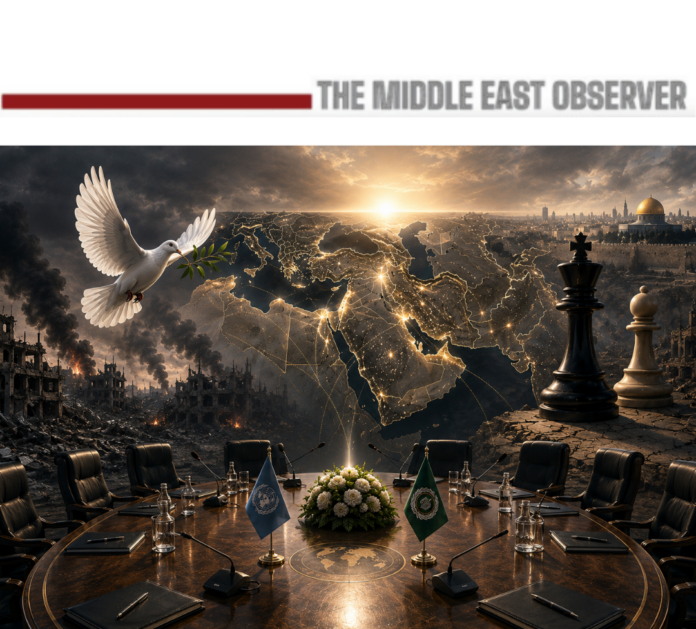
The paradox is difficult to ignore. A conflict that claimed lives, disrupted trade routes, rattled global markets, and heightened fears of a broader regional war appears to have ended where it began: at the negotiating table.
Whether the agreement will ultimately be viewed as a diplomatic success, a strategic necessity, or an expensive detour remains open to debate. What is already clear, however, is that while negotiators may be returning to familiar discussions, the region they now inhabit is no longer the same.
Wars are often fought to change realities. This one may ultimately be remembered for demonstrating how little could be changed without negotiation.