
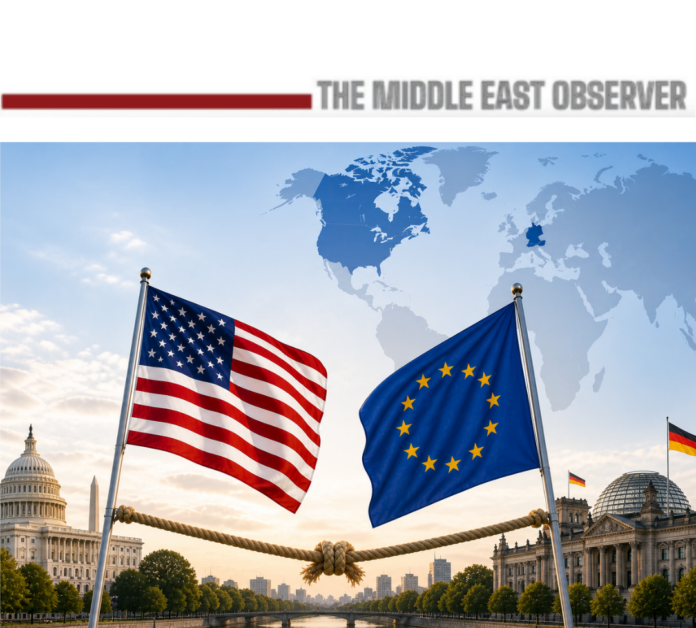
The prospect of a drawdown of United States forces from Germany is prompting a far-reaching reassessment across Europe—not because the continent faces an immediate war, but because the underlying logic of deterrence, alliance cohesion, and global force projection is being tested at its core.
For decades, the US military presence in Germany has functioned as a central pillar within NATO, anchoring both Europe’s security architecture and Washington’s global reach. Yet recent developments suggest that this long-standing framework is entering a phase of recalibration, driven by a shift in US strategic priorities.
At the heart of the debate lies a critical question: does forward military presence continue to guarantee deterrence, or has it, under certain conditions, begun to reshape risk?
Strategic analysts increasingly point to the experience of the Persian Gulf as a revealing counterexample. Despite a substantial US military footprint across Gulf states, deterrence has not consistently prevented retaliatory or asymmetric responses from Iran. In some instances, the presence of US bases has elevated the exposure of host nations, effectively positioning them as frontline actors within broader geopolitical confrontations.
This dynamic has compelled Gulf countries to significantly expand defense spending, sourcing advanced systems from the United States, Europe, and Israel. The implication is clear: military presence alone does not equate to absolute security.
Applied to Europe, the concern is therefore structural rather than hypothetical. If US bases serve as operational platforms in wider conflicts, host nations risk becoming strategic nodes within those confrontations rather than insulated zones of stability.
Germany’s role as a central hub for US forces further complicates this equation. While often framed as a cornerstone of European defense, these deployments are equally—if not more—integral to US global military architecture. From rapid deployment capabilities across Eastern Europe, Africa, and the Middle East, to intelligence, logistics, and command infrastructure anchored in German bases, the system enables Washington to project power well beyond the European theatre.
From this perspective, Europe is not merely a beneficiary of US security guarantees; it is also a critical platform supporting US global strategy. This duality introduces a nuanced risk calculus: Europe hosts an asset that enhances US strategic reach while simultaneously absorbing associated geopolitical exposure.
The strategic environment that emerged following the Russia-Ukraine War initially reinforced transatlantic unity. US leadership consolidated support for Europe, reaffirming NATO’s central role. However, the current phase signals a gradual doctrinal shift toward a more interest-driven approach.
This shift is reflected in a growing emphasis on negotiated de-escalation frameworks, a recalibration of commitments based on direct national priorities, and a reduced reliance on coordinated alliance decision-making. The reported lack of consultation with NATO allies on troop adjustments—surprising senior officials and lacking operational clarity —underscores this evolving posture.
Such developments are not merely procedural; they carry strategic weight. They reshape perceptions of reliability and compel European states to accelerate contingency planning, whether through increased defense investment or diversification of partnerships.
The implications extend beyond security into the realm of influence. The US military presence in Germany has long underpinned a significant component of Washington’s soft power, reinforcing credibility and leadership across allied networks. A reduction or reconfiguration of this footprint therefore entails not only military adjustments but also potential dilution of long-standing influence mechanisms.
From Washington’s perspective, this reassessment reflects a sovereign recalibration of priorities—balancing the benefits of forward deployment against the need for greater strategic flexibility. Signals pointing to broader shifts, including renewed attention to Greenland, suggest that this is part of a wider redefinition of US global posture.
For Europe, however, the concern is less about immediate vulnerability and more about preserving strategic cohesion within an evolving system. If deterrence can, under certain conditions, heighten exposure, and if alliance structures increasingly reflect unilateral tendencies, then the stability of the broader framework becomes the central issue.
This challenge is compounded by economic pressures. The European Union is navigating elevated energy costs, persistent inflation, and mounting productivity constraints amid intensifying global competition. At the same time, it has committed substantial financial and political support to Ukraine, while facing the imperative of accelerating defense investment to rebalance its security architecture.
In this context, Europe’s strategic response must be both measured and adaptive. The priority is not crisis management but structural resilience: containing destabilising dynamics, reinforcing collective cohesion, and recalibrating relationships that have come under strain.
The transatlantic relationship is unlikely to dissolve; interdependence across security, trade, and diplomacy remains deeply embedded. However, the trajectory points toward a long-term recalibration—one that may redefine roles, responsibilities, and expectations on both sides.
As The Middle East Observer notes, the issue is not whether Europe can adjust—it can. The central question is whether this transition will be managed through coordinated adaptation or shaped by unilateral shifts that introduce greater fragmentation into an already complex global order.
In an era defined by interconnected risks, the recalibration of deterrence is no longer a regional matter. It is a test of whether the foundations of the international security system can evolve without eroding the stability they were designed to ensure.