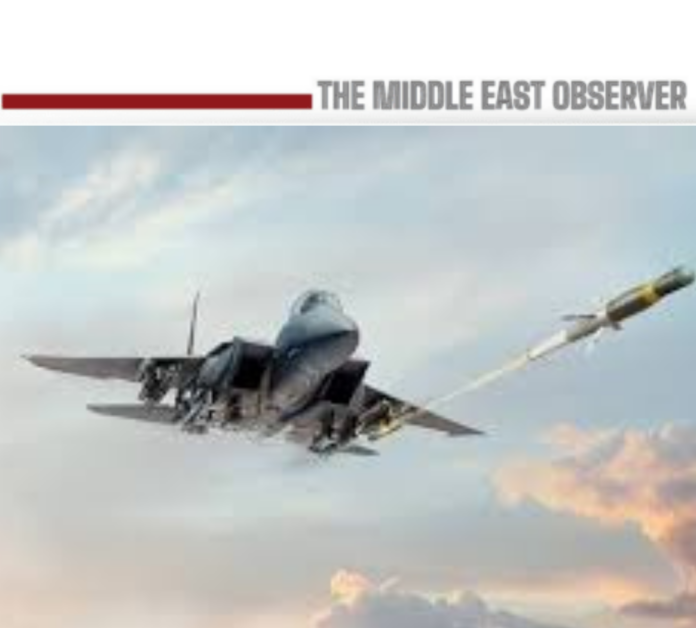
U.S. Department of State has approved military sales exceeding $8.6 billion to key Middle Eastern partners, invoking emergency provisions to expedite the process amid heightened regional tensions. According to official notifications issued to Congress under the Arms Export Control Act and statements released through the Defense Security Cooperation Agency, the approvals were made under an “emergency determination,” allowing the administration to waive the standard congressional review period while maintaining formal notification procedures. The decision, communicated in early May 2026 and reflected in U.S. government disclosures cited by international media, signals a shift toward compressing approval timelines in response to evolving security conditions.
The packages span multiple allied states, including Qatar, Kuwait, Israel, and United Arab Emirates, and comprise a mix of air and missile defence systems, precision-guided munitions, and integrated command capabilities, according to U.S. notifications and defence reporting. Official summaries associated with the approvals indicate that the largest share is directed toward Qatar, centred on Patriot missile defence support and Advanced Precision Kill Weapon Systems, while Kuwait’s allocation focuses on integrated battle command systems. Additional precision-guided systems are designated for Israel and the UAE to reinforce operational readiness. The programmes involve major defence contractors, including Lockheed Martin, RTX Corporation, Northrop Grumman, and BAE Systems. Initial deliveries—particularly for missile defence and precision munitions—are expected within 12 to 36 months, based on standard Foreign Military Sales timelines and contractor production capacity.
The use of emergency authority significantly shortens delivery timelines and limits the scope for legislative delay, a mechanism reserved for circumstances deemed critical to national security under U.S. law. While Congress retains oversight through formal notification, the compressed timeframe underscores the urgency attached to the approvals. The move comes amid sustained regional volatility linked to tensions involving Iran, prompting Washington to prioritise rapid reinforcement of allied capabilities across the Gulf.
The structure of the packages, with emphasis on missile defence, precision strike systems, and command integration, points to a dual objective: strengthening resilience against aerial threats while enhancing rapid-response capability. It also reflects a broader shift away from bilateral defence arrangements toward a more interconnected, system-level posture, in line with recent U.S. defence strategy language on integrated deterrence.
As The Middle East Observer notes, the $8.6 billion package signals a structural transition toward a networked security architecture, linking Israeli and Gulf defence systems into a more cohesive operational framework. By advancing integrated deterrence—where air defence, strike capabilities, and command systems operate as interconnected nodes—Washington is reinforcing a regional security model defined by coordination and interoperability rather than isolated capability.
The acceleration of these transfers highlights a broader policy evolution in which speed itself has become a strategic variable. In this context, the approvals extend beyond conventional arms sales, representing a deliberate effort to consolidate a regional defence framework centred on integration and responsiveness.