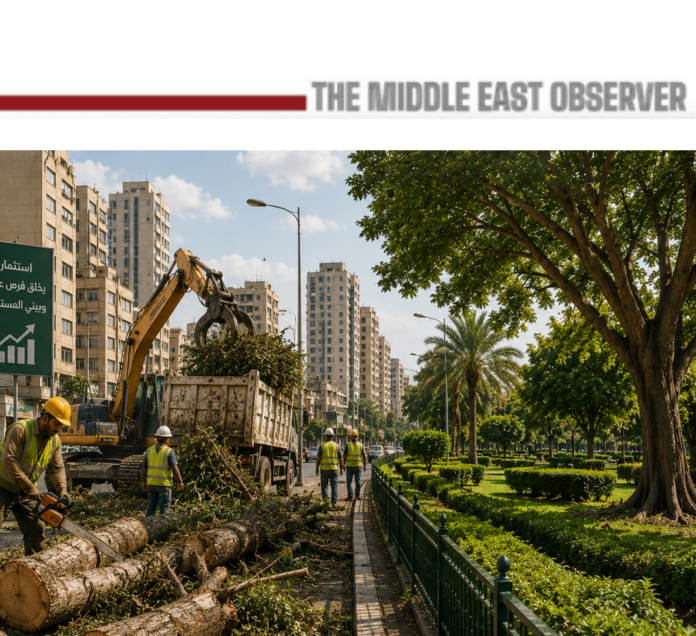
While many countries around the world celebrate Tree Day each March as part of efforts to preserve and expand green cover, Egypt has witnessed growing public debate—particularly on social media—over the increasing phenomenon of tree felling and its implications.
Deforestation refers to the removal of trees for purposes such as construction, agricultural expansion, infrastructure development, or other forms of land use. The issue has become increasingly controversial in Egypt, with differing explanations offered for the cutting of trees.
Some argue that trees are being removed for conversion into charcoal destined for export markets. Others contend that the process is linked to urban redevelopment plans that reduce greenery in older neighborhoods while concentrating landscaped environments within new residential compounds. Another viewpoint suggests that trees are being cut to facilitate road expansion projects and the installation of surveillance systems. Authorities and supporters of such measures, however, often cite public safety concerns, including the risk of aging branches falling onto roads and pedestrians. Others maintain that certain trees are being replaced with newer, fruit-bearing varieties that can generate economic value.
Legal and Environmental Dimensions
Egyptian law imposes penalties on individuals who cut down or damage trees in public spaces without the necessary authorization, although the regulations governing such activities vary according to location and circumstances.
Article 162 of the Egyptian Penal Code stipulates that anyone who intentionally destroys or damages public buildings, facilities intended for public benefit, or works of artistic or commemorative value may face imprisonment and financial penalties. The same provision applies to those who cut down or damage trees planted in places of worship, streets, public parks, or marketplaces. The law prescribes imprisonment and fines ranging from EGP 100 to EGP 500.
At the same time, environmental advocates have expressed concern over the decline of green spaces across the country. Authorities may permit the removal of trees when deemed necessary for public interest projects, such as road widening, transportation infrastructure, or urban development initiatives. The debate therefore centers on balancing development needs with environmental sustainability.
Religious Perspective
From a religious standpoint, the unnecessary cutting of trees that provide shade and public benefit is generally discouraged. However, tree removal may be considered permissible when justified by a greater public interest, such as the construction of essential facilities, road expansion, or other projects that serve the broader community, provided that environmental considerations are taken into account and, where possible, replacement planting is undertaken.
Declining Green Spaces
Concerns over tree loss are reinforced by recent data on Egypt’s shrinking green cover.
According to figures published by the Center for Alternative Policy Solutions at the American University in Cairo, green spaces in the capital declined by approximately 910,000 square meters between 2017 and 2020, falling from 7.8 million square meters to 6.9 million square meters during that period.
Research published in the Journal of Engineering and Applied Science found that Cairo lost approximately 910,894 square meters of green space between 2017 and 2020, while the average per-capita share of green space declined from 0.87 square meters to 0.74 square meters. The study highlighted significant disparities among districts, with densely populated areas facing the greatest shortage of public greenery.
The number of public parks and gardens nationwide has also decreased significantly, dropping from approximately 2,600 parks in 2014 to 1,358 parks in 2022.
Government Response and Afforestation Efforts
While concerns over tree removal persist, government authorities maintain that Egypt is simultaneously undertaking one of the region’s largest afforestation programmes through the Presidential Initiative to Plant 100 Million Trees.
The initiative forms part of Egypt’s broader environmental and climate strategy under Egypt Vision 2030. According to the Ministry of Environment, the programme seeks to improve air quality, absorb carbon emissions, reduce urban temperatures, and expand public green spaces across governorates.
The fourth phase of the initiative, launched in 2026, included the planting of more than 200,000 trees across seven governorates. Officials say these efforts are intended to offset environmental pressures associated with rapid urbanisation while enhancing the quality of life in cities and communities.
Highlighting the programme’s objectives, Dr. Manal Awad, Egypt’s Minister of Local Development and former Acting Minister of Environment, described the “100 Million Trees” initiative as a strategic national project aimed at improving environmental quality, expanding green spaces, reducing pollution, and supporting Egypt’s climate and sustainable development commitments.
Should Every Removed Tree Be Replaced?
One of the most important questions raised by the debate is whether every tree removed for development purposes should be replaced. Environmental specialists note that replacing mature trees with saplings is not always an equivalent exchange. A mature tree may take decades to provide the same environmental benefits as a newly planted replacement.
Urban planners increasingly advocate the adoption of transparent “remove-and-replace” policies that require authorities to publish environmental assessments, replacement plans, and survival-rate monitoring for newly planted trees. Similar approaches have been adopted in cities such as Singapore, London, and Dubai, where infrastructure expansion is accompanied by large-scale greening programmes and long-term maintenance commitments.
Climate Change and the Urban Heat Challenge
Environmental experts warn that the debate extends beyond aesthetics. Trees play a critical role in helping cities adapt to climate change by lowering temperatures, reducing the urban heat-island effect, improving air quality, and enhancing resilience to extreme weather conditions.
Recent studies have suggested that the loss of mature trees in some parts of Cairo may contribute to higher summer temperatures and reduced natural cooling, particularly in densely populated districts where access to green space is already limited.
Environmental advocates also argue that the effectiveness of replacement programmes depends not only on the number of trees planted, but also on their long-term survival and maturity. Replacing a decades-old tree with a young sapling may require years before equivalent environmental benefits are restored.
Why Trees Matter
Trees are among the most important components of a healthy environment and play a vital role in maintaining ecological balance. They increase oxygen levels in the atmosphere, absorb carbon dioxide, help moderate temperatures, and contribute to climate regulation.
Their root systems stabilize soil and reduce the risk of erosion and landslides, while their canopies provide habitats for birds, insects, and other wildlife that are essential to biodiversity. Trees also contribute to improving air quality and increasing atmospheric humidity.
Looking Ahead
The challenge facing Egypt is not whether development should occur, but how development can proceed while preserving environmental assets and ensuring long-term sustainability. Many experts argue that when tree removal becomes unavoidable, it should be accompanied by transparent environmental assessments, replacement planting programmes, and publicly monitored maintenance plans.
Ultimately, the debate over tree felling reflects a broader challenge confronting many rapidly growing nations: how to balance infrastructure expansion, economic growth, public safety, and environmental stewardship in an era increasingly shaped by climate change.
The discussion is therefore no longer simply about cutting or planting trees. It is about shaping the future character of Egyptian cities and ensuring that economic progress and urban development remain compatible with environmental sustainability and quality of life for future generations.