
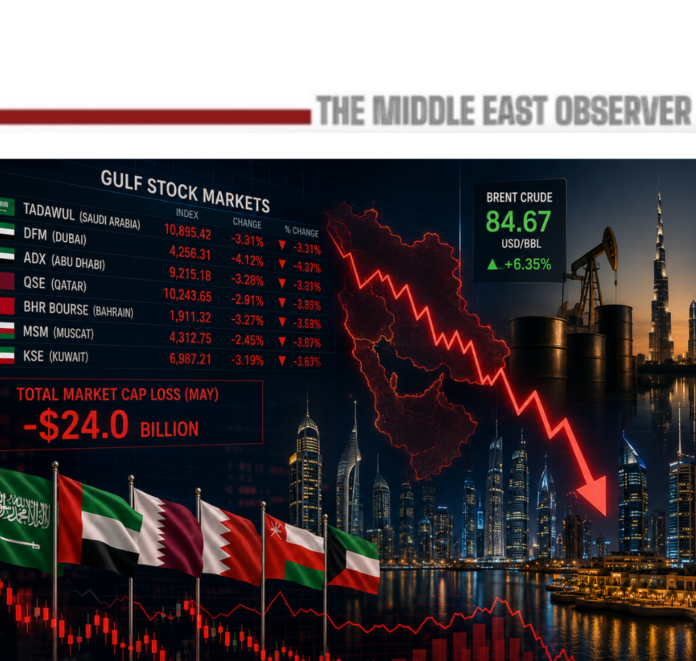
Gulf stock markets lost an estimated $24 billion in market value during May, reducing the combined capitalization of regional exchanges to approximately $4.08 trillion, according to a CNBC Arabia survey.
While the decline represents only about 0.6% of total Gulf market capitalization, it reflects persistent investor caution amid regional geopolitical tensions, uncertainty surrounding the Strait of Hormuz and continued volatility in energy markets.
The losses came despite elevated oil prices for much of the month, highlighting a key paradox facing Gulf investors. Traditionally, higher oil prices support government revenues, corporate earnings and investor sentiment across the region. However, markets remained more focused on the economic risks associated with regional instability, including shipping disruptions, rising insurance costs and uncertainty over the future of maritime trade through the Strait of Hormuz.
Saudi Arabia’s Tadawul All Share Index recorded its second consecutive monthly decline, contributing significantly to the regional downturn. The Saudi market accounts for roughly two-thirds of total GCC equity market capitalization, making its performance the primary driver of regional market trends. As a result, weakness in Riyadh often outweighs gains elsewhere in the Gulf.
Meanwhile, Oman’s Muscat Stock Exchange suffered one of the region’s sharpest monthly declines, reflecting a combination of profit-taking following previous gains and broader investor caution linked to geopolitical developments. Market participants also cited lower trading activity and reduced risk appetite amid uncertainty surrounding regional trade routes.
In contrast, Qatar’s QE Index rose 0.6% in May, marking its second consecutive monthly gain. Analysts attributed the relative resilience to selective buying in banking and defensive sectors, continued confidence in Qatar’s economic diversification agenda and expectations that infrastructure, energy and technology investments will continue to support corporate earnings growth.
Regional markets remained under pressure throughout May as investors weighed developments in U.S.-Iran negotiations and the implications of continued uncertainty surrounding shipping through the Strait of Hormuz. Several trading sessions across Gulf exchanges witnessed heightened volatility as investors reassessed geopolitical risks and their potential impact on trade flows, energy exports and economic activity.
The market reaction suggests that investors are increasingly willing to sacrifice some of the traditional benefits associated with higher oil prices in exchange for lower geopolitical risk exposure. While stronger crude prices generally improve fiscal and corporate fundamentals across the Gulf, concerns over regional stability have become a more influential factor in investment decisions.
The divergence between oil and equity performance highlights how investors increasingly view regional conflict as a potential threat to trade, corporate profitability and economic growth rather than solely as a catalyst for higher energy revenues.
Looking ahead, investor sentiment across Gulf markets is likely to remain closely tied to developments surrounding the Strait of Hormuz, progress in U.S.-Iran diplomacy and the evolution of regional risk premiums. Although oil prices continue to provide an important cushion for Gulf economies, equity markets are expected to remain sensitive to any developments that could affect shipping lanes, energy exports or broader regional stability.
For now, Gulf investors appear to be pricing not only the value of oil, but also the cost of uncertainty.
