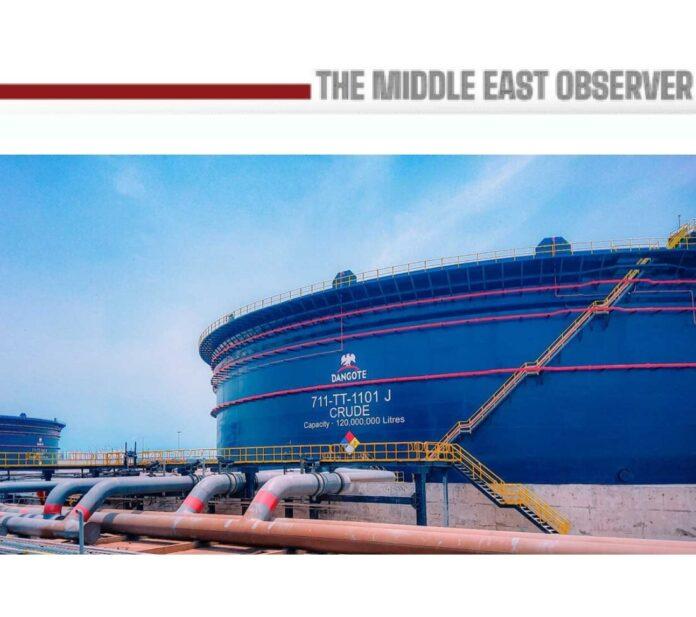
Fuel prices across Nigeria have climbed to record highs, underscoring structural vulnerabilities in the country’s energy supply chain despite the full-scale launch of the Dangote Petroleum Refinery earlier this year.
The 650,000 barrels-per-day facility—Africa’s largest—was expected to end decades of fuel import dependency and position Nigeria as a net exporter of refined petroleum products. However, recent market dynamics have limited its ability to stabilize domestic gasoline prices, which have risen by approximately 65%, the sharpest increase among major African economies.
Despite Nigeria’s status as Africa’s top crude producer, the refinery has been compelled to import significant volumes of crude oil. This paradox stems from the financing structure of the national oil sector, where a large share of crude production is already committed under pre-export financing arrangements and oil-backed loans managed by the Nigerian National Petroleum Company Limited.
As a result, substantial portions of daily output are allocated to servicing debt obligations to international oil companies, financial institutions, and commodity traders. Industry estimates suggest that roughly 400,000 barrels per day are tied up in such commitments, constraining domestic availability.
Operationally, the refinery reportedly secures only a fraction of its required crude supply locally—forcing reliance on imported cargoes priced at prevailing international market rates. This exposure has directly linked domestic fuel costs to global volatility.
Nigeria’s lack of a formal strategic fuel reserve has further intensified price pressures. Without buffer stockpiles, the country remains highly susceptible to supply shocks and price fluctuations in global markets.
Energy analysts note that a national reserve could have mitigated inflationary pressures by ensuring steady refinery feedstock during disruptions. In its absence, supply continuity remains vulnerable to external shocks.
The situation has been exacerbated by escalating geopolitical tensions in the Middle East, particularly following military actions involving the United States and Israel targeting Iran. The resulting disruption to shipping routes—especially through the Strait of Hormuz, which handles roughly 20% of global energy flows—has significantly tightened supply conditions.
With commercial shipping through the strait severely constrained, crude prices have surged, feeding directly into Nigeria’s import costs and, by extension, domestic fuel prices.
The removal of fuel subsidies by President Bola Tinubu in 2023—widely praised by international investors—has also exposed consumers more directly to market forces. While the reform aimed to stabilize public finances and attract investment, it has coincided with a period of heightened global energy volatility.
Nigeria’s experience illustrates a critical disconnect between production capacity and supply security. While the Dangote refinery represents a transformative infrastructure milestone, its effectiveness remains constrained by upstream contractual obligations, global market dependencies, and the absence of strategic reserves.
Unless these structural issues are addressed, domestic fuel prices are likely to remain sensitive to international shocks—limiting the refinery’s intended role as a stabilizing force in Africa’s largest oil-producing economy.