
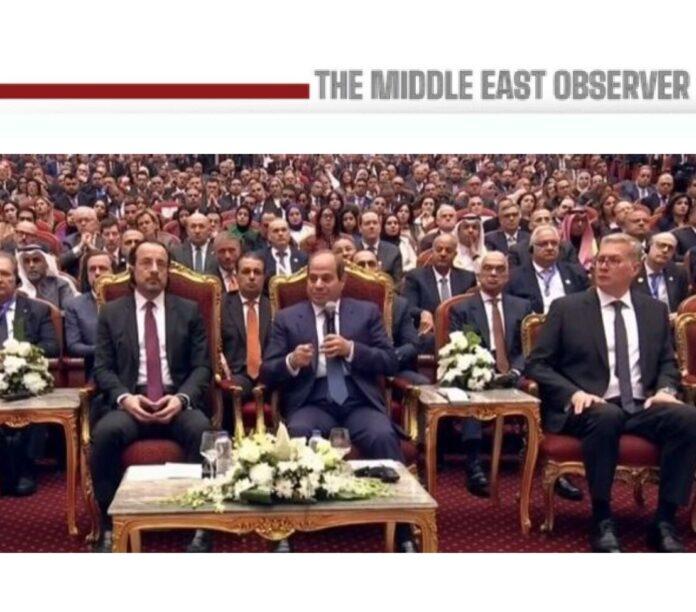
Cairo — President Abdel Fattah El-Sisi delivered a stark warning at the opening of the Egypt International Energy Conference and Exhibition (EGYPES 2026), cautioning that the ongoing regional conflict involving Iran could trigger what he described as “the largest energy crisis in modern history,” with profound consequences for global markets and economic stability.
Speaking before an audience of global energy leaders in Cairo, El-Sisi urged immediate international intervention to halt the conflict, directly appealing to U.S. President Donald Trump to lead de-escalation efforts. He warned that disruptions to critical supply routes—particularly the Strait of Hormuz—alongside attacks on energy infrastructure, could send oil prices soaring beyond $200 per barrel, intensifying inflationary pressures worldwide.
The Egyptian president emphasized that the current crisis exceeds the impact of previous global shocks, including the COVID-19 pandemic and the Russia–Ukraine war, describing it as a “dual shock” of constrained supply and surging prices that could severely affect fuel, fertilizer, and food costs—particularly in developing economies.
Amid mounting global uncertainty, EGYPES 2026 also showcased Egypt’s accelerating strategy to position itself as a regional energy hub. A key highlight was the signing of a landmark agreement between Egypt, Cyprus, and Chevron to fast-track development of the Aphrodite gas field and connect it to Egypt’s liquefaction infrastructure.
The agreement outlines the transport of Cypriot gas via a 280-kilometre subsea pipeline to Egypt’s national grid in Port Said, enabling exports to global markets. Complementing this, Egypt and Cyprus signed a broader framework agreement covering potential gas sales from the Cronos and Aphrodite fields, reinforcing bilateral energy integration.
Cypriot President Nikos Christodoulides, attending the event, praised Egypt’s growing role in regional energy cooperation, highlighting deepening strategic ties between the two countries.
On the sidelines of the conference, Prime Minister Mostafa Madbouly held talks with executives from Eni, focusing on accelerating gas production projects and unlocking new investments estimated at $2 billion.
Simultaneously, Egypt advanced exploration efforts in the Red Sea, signing new agreements with BP and SLB to expand seismic surveys and upstream activity. These moves aim to unlock untapped reserves and diversify Egypt’s energy portfolio amid tightening global supply conditions.
El-Sisi reaffirmed Egypt’s commitment to settle outstanding dues to international oil companies—estimated at $1.3 billion—by mid-2026, a step seen as critical to sustaining investor confidence and ensuring continued upstream investment.
He also called on global energy companies to intensify production efforts, including renewables, to mitigate the current supply crisis and support long-term energy security.
Beyond commercial agreements, Egypt used EGYPES as a platform to reinforce its diplomatic role in de-escalating regional tensions. Cairo has intensified high-level engagements with regional and international partners, leveraging its longstanding position as a mediator in the Middle East crisis.
Officials underscored coordinated efforts with Gulf states to safeguard energy infrastructure and ensure freedom of navigation in critical maritime corridors, amid rising geopolitical risks.
The convergence of geopolitical conflict and energy market fragility has elevated EGYPES 2026 from a sectoral gathering into a critical forum for global economic stability. With one-fifth of global energy flows transiting through vulnerable routes, continued disruption could reverberate across supply chains, inflation trajectories, and investment flows worldwide.
As the conference unfolds, Egypt’s dual strategy—combining infrastructure expansion with diplomatic engagement—positions it at the center of both the regional energy equation and broader efforts to contain a rapidly escalating global crisis.
