
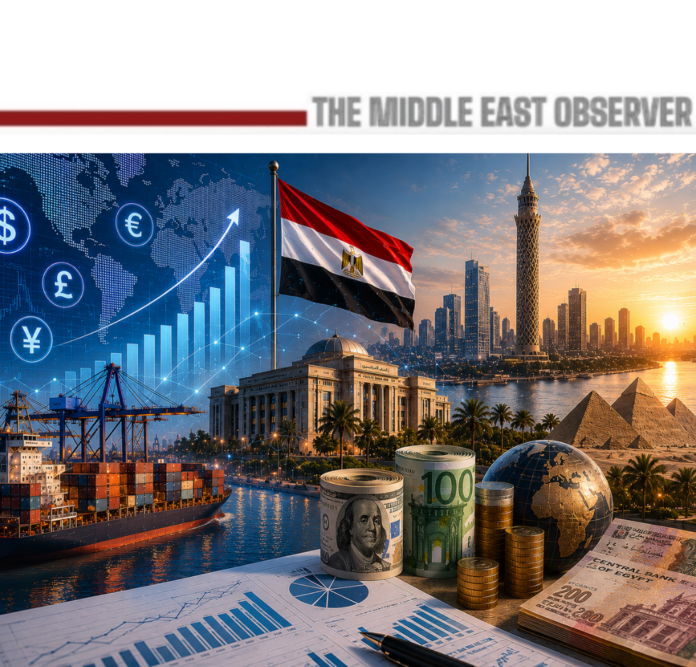
Cairo — Egypt is undergoing a structural transformation in how it generates foreign exchange, with a growing mix of remittances, tourism revenues, logistics activity, exports and foreign direct investment helping strengthen the country’s external position and support the Egyptian pound despite a challenging regional environment.
The US dollar fell to EGP 51.79 for buying and EGP 51.93 for selling this week, according to Central Bank of Egypt data, extending a decline of EGP 1.57 since 20 May. While easing geopolitical tensions have contributed to improved sentiment, economists increasingly point to strengthening foreign-currency inflows as the more durable driver of Egypt’s improving external position.
Together, remittances, tourism receipts and Suez Canal revenues generated more than $60 billion in foreign-currency earnings over the past year, highlighting the growing breadth of Egypt’s external financing base and reducing dependence on any single source of external income.
The most striking development has been the continued surge in remittances. According to the Central Bank of Egypt, transfers from Egyptians working abroad rose more than 30% year-on-year during the first nine months of fiscal year 2025/26 to a record $34.9 billion, while inflows reached an all-time monthly high of $5.5 billion in March.
The sharp increase represents one of the most significant shifts in Egypt’s external accounts since the currency liberalisation measures introduced in 2024. The restoration of confidence in official banking channels, combined with resilient labour markets across the Gulf, has helped redirect foreign-currency flows through the formal financial system.
In a recent report, EFG Hermes said remittance flows are unlikely to face significant disruption from regional tensions in the near term. Mohamed Abou Basha, Head of Macroeconomic Analysis at EFG Hermes, cited the resilience of Saudi Arabia’s economy—the largest source of remittance inflows to Egypt—and sustained government spending across major Gulf economies as key factors underpinning the outlook.
Tourism has emerged as a second pillar of Egypt’s external accounts. Tourism revenues rose 17.3% year-on-year to $10.2 billion during the first half of fiscal year 2025/26, while annual receipts reached approximately $16.7 billion in 2025. Egypt welcomed a record 19 million visitors last year, underscoring the sector’s growing role as a stable generator of foreign exchange.
The sector’s expansion has helped offset part of the decline in Suez Canal revenues following disruptions to Red Sea shipping routes and is increasingly viewed by policymakers as a strategic contributor to external stability. Authorities are targeting 30 million annual visitors by 2030, supported by continued investment in hotels, tourism infrastructure and destination development projects along the Red Sea and Mediterranean coasts.
The Suez Canal remains a cornerstone of Egypt’s external earnings, but the more significant story may now lie beyond transit fees. Canal revenues, which reached a record $10.2 billion in 2023, fell sharply to $3.9 billion in 2024 before recovering to approximately $4.1 billion in 2025. Suez Canal Authority Chairman Osama Rabie said revenues are expected to reach around $4.6 billion in 2026 as shipping activity gradually improves.
Beyond the waterway itself, Egypt is increasingly positioning the broader Suez Canal Economic Zone (SCZone) as a manufacturing, logistics and industrial platform. The zone attracted approximately $7.1 billion in investments during fiscal year 2025/26, while cumulative investments over the past several years have reached roughly $16 billion. More than 205 factories are currently operating within the zone, with another 172 projects under development across sectors ranging from renewable energy and automotive manufacturing to chemicals and logistics.
Recent government figures show SCZone revenues have more than tripled over the past eight years, while investments in the Sokhna industrial area alone have exceeded $33 billion. Prime Minister Mostafa Madbouly has also announced plans for a global logistics distribution hub within the SCZone, aiming to transform the corridor into a regional redistribution centre linking Africa, the Middle East, Europe and Asia.
For investors, the significance extends beyond canal traffic. The corridor is evolving into a multi-layered economic ecosystem combining ports, industry, logistics, energy and trade services, creating new sources of export earnings, foreign direct investment and hard-currency inflows.
Energy is emerging as another area of recovery. Petroleum Minister Karim Badawi recently said the government expects to clear all remaining arrears owed to international oil and gas companies by 10 June, after reducing outstanding dues from approximately $6.1 billion in mid-2024 to around $440 million in May 2026. The repayments are expected to support renewed exploration and production activity by international energy companies, strengthening domestic output and reducing pressure from energy imports.
Export growth is providing an additional layer of support. Egypt’s total exports rose to approximately $4.64 billion in March 2026, while food-industry exports reached $1.68 billion during the first quarter of the year. Processed food exports exceeded $6.8 billion in 2025, while manufacturing and agricultural products continue to generate increasing foreign-currency earnings as policymakers seek to broaden the country’s export base.
Gulf investment is also playing a growing role in reshaping Egypt’s external accounts. Large-scale commitments from regional investors are increasingly being deployed not only as financial support but as long-term development capital. Qatar’s planned Alam Al-Roum project on Egypt’s Mediterranean coast and the landmark Ras El-Hekma agreement with Abu Dhabi’s ADQ, which delivered $24 billion in direct inflows as part of a broader $35 billion development package, have strengthened confidence in Egypt’s medium-term financing outlook.
The impact is already visible across construction, infrastructure, tourism and related industries. These projects are increasingly viewed as long-term economic platforms capable of generating tourism revenues, employment, foreign direct investment and service exports rather than simply real-estate developments.
Beyond tourism and real estate, Egypt is investing heavily in expanding its productive capacity across agriculture, industry, logistics and trade. One of the most ambitious initiatives is the New Delta Project, an estimated EGP 800 billion land-reclamation and agricultural development programme spanning approximately 2.2 million feddans west of the Nile Delta. Designed to enhance food security, reduce import dependence and support agricultural exports, the project is expected to create up to 2 million direct and indirect jobs while stimulating investment in irrigation infrastructure, food processing, agricultural technology and logistics networks.
The project forms part of a broader strategy aimed at expanding Egypt’s productive and export-oriented capacity. Together with industrial expansion in the Suez Canal corridor, growing renewable-energy investments, manufacturing clusters, tourism developments and modern transport infrastructure, it underscores Egypt’s ambition to become a sustainable regional platform for trade, manufacturing, logistics and value-added exports, linking Africa, the Middle East, Europe and Asia.
That vision is reinforced by investments in ports, logistics centres, industrial zones and transport infrastructure designed to capture a larger share of regional supply chains and trade flows. For investors, these developments extend opportunities beyond traditional sectors into logistics, agribusiness, manufacturing, renewable energy, tourism, transportation and export-oriented services.
Challenges remain. Egypt continues to face elevated public debt levels, external financing requirements and exposure to global trade disruptions and regional geopolitical risks. Many of the country’s largest projects are also long-term investments whose full economic benefits will materialise over several years rather than immediately.
Yet the broader trend is increasingly difficult to ignore. For much of the past decade, Egypt’s external position depended heavily on a relatively narrow group of foreign-currency generators, leaving the economy vulnerable to shocks affecting tourism, shipping or capital flows. What appears to be emerging today is a broader mix of sustainable earnings sources spanning remittances, tourism, logistics, exports, energy and foreign direct investment.
The durability of that shift remains to be proven. However, the simultaneous expansion of multiple and largely independent revenue streams suggests Egypt may be entering a period in which external stability depends less on exceptional financing arrangements and more on the productive capacity of the economy itself.
For investors, that transition may prove more significant than the recent appreciation of the pound. A more diversified foreign-currency base not only strengthens resilience against external shocks but also expands the range of sectors capable of generating long-term returns, from logistics and manufacturing to tourism, agribusiness, renewable energy and export-oriented industries.
The significance of this transformation lies not in any single project or revenue stream, but in the growing interconnection between them. As new industrial zones, logistics platforms, agricultural developments, tourism destinations and energy investments move from planning to execution, they are collectively reshaping the foundations of the economy.
In an increasingly uncertain global environment, few emerging markets are simultaneously expanding their tourism base, industrial capacity, logistics infrastructure, agricultural output and foreign-investment pipeline at comparable scale. If execution remains on track, Egypt’s evolving growth model could position the country as one of the region’s most consequential investment and trade platforms over the coming decade—creating opportunities that may be considerably more difficult to replicate once the current phase of development matures.
