
Hidden deep within Egypt’s deserts are caves that preserve the memory of vanished lakes, forgotten peoples and a world that disappeared thousands of years before the first pyramid rose at Giza
In the spring of 1933, Hungarian explorer and aviator László Almásy was navigating the remote cliffs and sandstone valleys of Egypt’s Gilf Kebir plateau when he entered a shallow rock shelter hidden deep within one of the most inaccessible regions of the Sahara.
What he found made little sense.
Painted across the stone walls were human figures floating through water, their limbs extended in unmistakable swimming motions. Outside the cave stretched one of the driest landscapes on Earth, a place where annual rainfall is virtually nonexistent and water is among the rarest commodities.
Yet here, preserved in stone, was evidence that people had once swum where only sand now existed.
The discovery would become one of the most important archaeological finds in North Africa and would eventually transform scientific understanding of the Sahara itself. The paintings were not merely prehistoric art. They were the surviving testimony of a lost world.
Today, nearly a century after Almásy’s discovery, Egypt’s caves continue to reveal clues about that vanished landscape and the people who inhabited it, preserving a forgotten chapter of history that predates the Pharaohs by thousands of years.
When the Sahara Was Green
Ten thousand years ago, the landscape of North Africa would have been almost unrecognizable to modern eyes.
Monsoon systems extended far north into the Sahara, bringing seasonal rains that created rivers, wetlands and vast freshwater lakes. Grasslands stretched across regions that are now among the driest places on Earth. Herds of antelope, giraffes, cattle and hippopotamuses roamed the landscape.
Human communities flourished.
They fished, hunted, herded animals and established settlements around permanent sources of water.
What survives of their world is scattered across Egypt’s desert caves.
The paintings found within these shelters are among the oldest visual records of life in prehistoric North Africa. Unlike written histories, they offer direct testimony from the people who experienced this landscape.
The swimmers, hunters and animals painted on cave walls are effectively eyewitness accounts of a Sahara that no longer exists.
Today, the paintings appear almost impossible.
Yet they may represent one of humanity’s earliest records of dramatic climate change.
A Morning Beside a Lost Lake
Imagine standing in Egypt’s Western Desert eight thousand years ago.
The horizon would not be defined by dunes but by grasslands stretching toward distant hills. Seasonal lakes reflected the sky. Herds of gazelles and antelope grazed near the water’s edge while fishermen cast nets into shallow lagoons. Children played along reed-covered shores, and cattle herders guided animals toward fresh pasture land nourished by annual rains.
In the distance, giraffes moved across the savannah while hippopotamuses occupied wetlands that have long since disappeared.
To modern visitors, such a landscape sounds almost impossible. Yet the paintings preserved inside Egypt’s caves repeatedly depict precisely this world. The artists were not creating fantasy scenes. They were recording the environment around them.
What survives today on cave walls may therefore be among humanity’s oldest visual memories of a vanished ecosystem.
The Explorer Who Found a Lost World
The rediscovery of this vanished Sahara is inseparable from the story of László Almásy.
Part explorer, aviator, cartographer and adventurer, Almásy spent years navigating the remote deserts of Egypt and Libya during the early twentieth century. Flying over regions that few outsiders had ever visited, he became fascinated by reports of hidden valleys, lost routes and unexplored rock formations.
His discovery of the Cave of the Swimmers transformed him from explorer into a figure of historical significance.
Decades later, his life would partly inspire the protagonist of The English Patient, the bestselling novel and Academy Award-winning film.
Yet Almásy’s real achievement was arguably far greater than fiction.
He helped uncover evidence that forced scientists to rethink the environmental history of an entire continent.
What had once been dismissed as an eternal desert was revealed as a landscape shaped by dramatic climatic cycles.
The Sahara had not always been a desert.
It had become one.
The Artists Nobody Knows
The creators of Egypt’s cave paintings remain anonymous.
They left no written records, monuments or royal inscriptions.
Yet their work demonstrates extraordinary sophistication.
The paintings depict movement, animals, daily activities and symbolic scenes with a confidence suggesting long artistic traditions. They reveal societies capable of observation, creativity and cultural expression thousands of years before Egypt’s dynastic age.
Who were these people?
Archaeologists believe many belonged to pastoral communities that gradually adapted to changing environmental conditions as rainfall declined and lakes began to disappear.
Some groups moved from hunting to herding.
Others migrated in search of reliable water.
Many likely followed routes leading toward the Nile Valley.
Their names have been lost, but their images survived.
The caves became their archives.
The Greatest Unsolved Mystery in Egyptian Archaeology
If the Cave of the Swimmers provided answers, the nearby Cave of the Beasts raised even more questions.
Discovered in 2002, the site contains more than 5,000 images spread across its walls, making it one of Africa’s most significant collections of prehistoric art.
Some depict recognizable humans and animals. Others appear deeply strange. Headless figures, elongated bodies, floating limbs and hybrid creatures occupy scenes unlike anything known from later Egyptian art.
One panel appears to show human figures emerging from or being consumed by enormous unidentified beings. Another contains rows of mysterious forms whose meaning remains unknown. Archaeologists have proposed explanations ranging from ritual symbolism and mythological narratives to spiritual visions connected to prehistoric religious practices.
More than two decades after its discovery, no consensus has emerged.
The cave remains one of Africa’s greatest unsolved archaeological puzzles.
Unlike the tombs of pharaohs, whose inscriptions often explain their purpose, these paintings remain largely silent.
Their creators left questions but no answers.
That silence may be precisely what makes them so compelling.
How a Dying Sahara May Have Helped Create Ancient Egypt
Perhaps the most important story preserved in Egypt’s caves is not about art.
It is about migration.
As rainfall declined between roughly 6000 and 3000 BCE, lakes began to shrink and grasslands gradually disappeared. Communities that had once thrived across the Sahara faced an increasingly difficult reality.
Water became scarce.
Pastures vanished.
Former settlements could no longer sustain growing populations.
Many groups moved toward the Nile Valley, one of the few remaining reliable sources of water in the region.
Some scholars believe this migration may have contributed to the concentration of people, skills and cultural traditions that eventually helped lay the foundations for ancient Egyptian civilization.
The caves therefore preserve more than paintings.
They may document the environmental transformation that redirected human history.
In a profound sense, the pyramids may owe part of their existence to a climate crisis that began thousands of years earlier.
Egypt’s Forgotten Answer to Lascaux
When discussing prehistoric cave art, most people immediately think of France’s Lascaux Cave or Spain’s Altamira.
Yet Egypt possesses cave sites that are equally significant in understanding human history.
The difference lies largely in public awareness.
While European cave art became internationally celebrated, many of Egypt’s prehistoric sites remain relatively unknown outside specialist circles.
The Cave of the Swimmers and Cave of the Beasts deserve recognition not merely as archaeological treasures but as global cultural landmarks.
They document a vanished environment, a disappearing way of life and one of humanity’s most significant episodes of climate adaptation.
Their significance extends far beyond Egypt.
They belong to the shared heritage of humanity.
Nature’s Underground Cathedral
Not all of Egypt’s caves tell stories of people.
Some tell stories of the Earth itself.
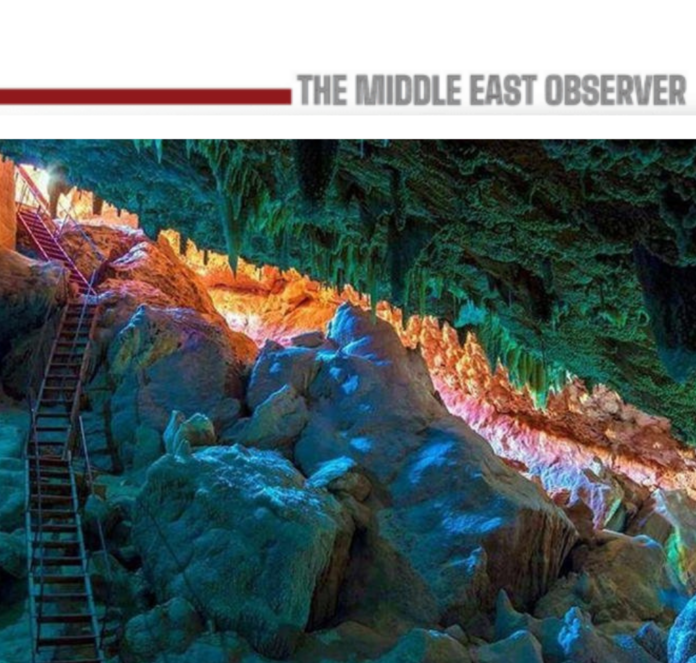
Near Beni Suef lies Sannur Cave, one of Egypt’s most spectacular geological wonders.
Formed over millions of years as water dissolved limestone and deposited minerals, the cave contains magnificent stalactites and stalagmites that resemble chandeliers, columns and frozen waterfalls.
Unlike the painted caves of the Western Desert, Sannur records geological rather than human history.
Yet both types of caves serve a similar purpose.
They preserve memory.
One records changing climates and landscapes.
The other records the slow processes that shaped the planet itself.
Together, they remind visitors that human history represents only a brief chapter within a much longer natural story.
Echoes Across Millennia
The people who painted swimmers on cave walls could not have known why the rains eventually failed.
They possessed no climate models, satellites or scientific instruments. Yet they experienced the consequences of environmental change directly as lakes contracted, vegetation disappeared and familiar landscapes became increasingly difficult to inhabit.
Their response was adaptation.
Communities moved, economies changed and new centres of population emerged along more reliable sources of water.
Thousands of years later, modern societies face their own debates about climate, migration and resilience. The circumstances are different, but the underlying lesson preserved in Egypt’s caves remains remarkably familiar: environmental change has always shaped human history.
Beneath the Sand, Another Egypt
Egypt’s caves survived because they were forgotten.
Hidden beneath cliffs, protected by desert isolation and sealed from the passage of time, they preserved evidence of a world that disappeared thousands of years before the construction of the pyramids.
Their paintings tell stories of hunters, fishermen, herders, explorers and artists whose names have vanished but whose experiences remain visible on stone walls. They reveal an Egypt that existed before dynasties, before cities and before written history—a landscape of lakes, grasslands and migrating communities.
The caves also remind us that civilizations do not emerge in isolation. Ancient Egypt did not appear suddenly along the Nile. It developed within a broader human story shaped by environmental change, adaptation and movement across landscapes that no longer exist.
Beneath Egypt’s deserts lies another Egypt, one that few visitors ever see. Its monuments are not pyramids or temples but paintings hidden in caves, fragments of memory left behind by people who witnessed the transformation of an entire world.
The swimmers still move across the stone. The beasts remain unexplained. And thousands of years after the lakes disappeared, their silent testimony continues to challenge our understanding of the past.
Far below the headlines of modern archaeology, Egypt’s caves preserve one of humanity’s oldest stories: how people adapt when their world changes around them. Their message, written not in words but in images, remains as relevant today as it was thousands of years ago.
The caves are not merely relics of a distant past. They are a reminder that beneath the sands of Egypt lies the memory of a lost world—and perhaps the earliest chapter in the story of civilization itself.