
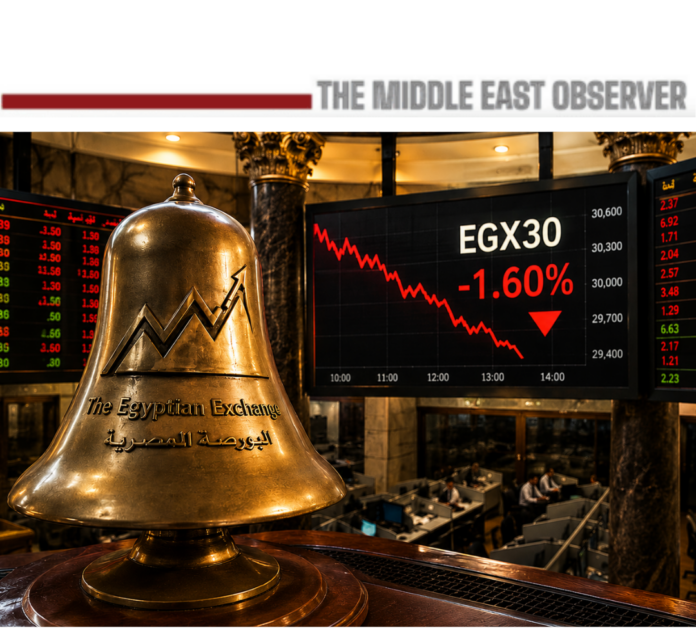
Cairo — Egypt’s stock market resumed its downward trajectory on Wednesday, 20 May 2026, with broad-based losses across all major indices as foreign selling intensified and investors continued reducing exposure following the market’s strong rally earlier this quarter.
The benchmark EGX30 fell 1.59% to 51,936.75 points, according to data from the Egyptian Exchange (EGX), slipping back below the 52,000-point level after briefly recovering in the previous session. The broader market also came under significant pressure, with the EGX70 index of small and medium-sized companies dropping 2.37% to 14,421.03 points, while the broader EGX100 declined 2.32% to 20,103.05 points.
The EGX33 Shariah index fell 1.46%, while the EGX35-LV index dropped 2.03%, reflecting broad weakness across both blue-chip and smaller-cap segments.
Total market capitalization declined to approximately EGP 3.711tn, erasing part of the gains accumulated during April and early May.
Investor flows highlighted renewed foreign pressure on the market. Non-Arab foreign investors were net sellers by approximately EGP 5.98bn, while Arab investors recorded net outflows of around EGP 228mn, according to EGX data. Egyptian investors, meanwhile, were net buyers by approximately EGP 6.21bn, partially offsetting foreign selling pressure.
Despite the broader decline, selected shares posted strong gains. Misr Hotels surged 19.99%, while North Cairo Mills rose 8.92% and Arab Cotton Ginning gained 7.22%. On the downside, recent outperformers came under pressure, with Misr Duty Free Shops falling 9.15%, while Rubex International for Plastic and Acrylic Manufacturing declined 6.94% and Dice Sport & Casual Wear dropped 6.49%.
The session came as regional markets remained volatile amid continued uncertainty surrounding negotiations between the United States and Iran and fluctuations in global oil prices. Recent reporting by Reuters indicated that Gulf equity markets traded cautiously as investors monitored geopolitical developments linked to the Strait of Hormuz and the potential impact of energy-market volatility on regional liquidity conditions.
At the domestic level, improving macroeconomic indicators have continued to provide medium-term support for Egyptian equities. Earlier this month, the Central Bank of Egypt (CBE) reported that annual core inflation slowed to 13.8% in April, while net foreign reserves rose to $53.01bn, supporting expectations of greater macroeconomic stability and improved currency conditions.
However, local analysts cited by Egyptian financial media said the recent correction reflects a combination of profit-taking after the market’s sharp rally and increased investor caution amid continued regional volatility and shifting foreign flows.
Market view: Wednesday’s session reinforced signs that the EGX remains in a short-term consolidation phase following its strong gains earlier this year. While domestic investors continued providing support during market weakness, sustained foreign selling and broad declines across sectors suggested investor sentiment remains cautious amid ongoing regional uncertainty.