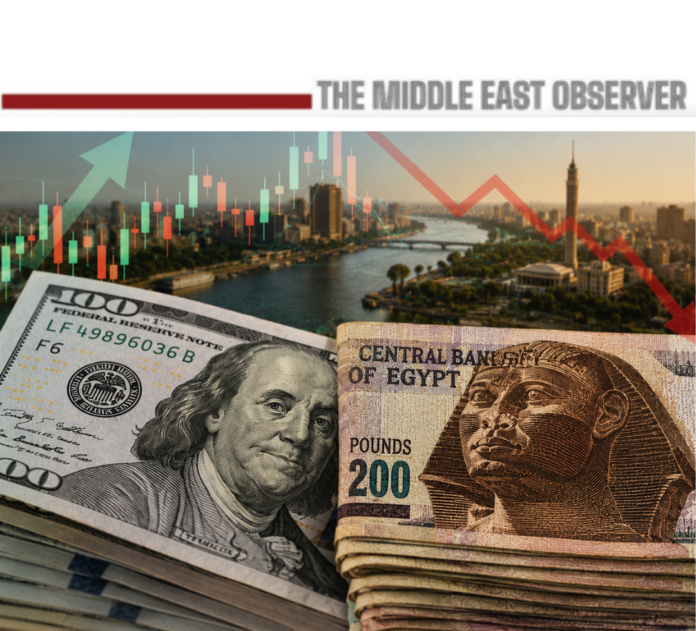
Egypt’s foreign-exchange market passed through another tense trading week between 11 and 17 May, with the US dollar again climbing above the EGP 53 threshold as investors reassessed geopolitical risk, global interest-rate expectations, and exposure to emerging-market assets.
By Sunday’s close of business, the dollar traded at EGP 53.22 for buying and EGP 53.36 for selling, compared with EGP 52.50 and EGP 52.64 a week earlier. The pound therefore weakened by around 1.36 percent over the week and remained roughly 11 percent below its pre-conflict level of EGP 47.9, according to banking data cited by Ahram Online.
The repeated move above EGP 53 increasingly points to a market adjusting to prolonged external strain rather than a temporary bout of volatility. Cairo-based bankers and FX traders said demand for dollars from importers and institutions remained firm through the week, while some foreign investors continued trimming exposure to Egyptian treasury bills as global yields rose and geopolitical risks intensified.
Pressure across emerging markets also increased after US Treasury yields climbed to one-year highs amid concerns that higher energy prices and possible shipping disruptions could complicate the global inflation outlook. Higher yields have reduced the appeal of carry-trade positions in several high-yield emerging markets, including Egypt’s local debt market, according to market analysts cited by Reuters.
Egypt remains particularly exposed to such shifts because foreign portfolio inflows into treasury bills have become an important source of foreign-currency liquidity since the March 2024 IMF-backed reform programme and currency devaluation. Earlier this year, international investors were estimated to have withdrawn between $2 billion and $5 billion from Egyptian debt instruments following the escalation in geopolitical tensions.
Yet the broader financial backdrop remains firmer than during earlier episodes of currency stress. Egypt’s net foreign assets climbed to a record $29.5 billion in January, according to central bank data, while official foreign reserves rose above $53 billion in April, providing policymakers with a larger liquidity cushion against external shocks. Recovering remittance inflows and continued Gulf-related financing have also helped moderate pressure on the balance of payments.
Regional investors meanwhile remained in defensive mode through much of the week. Gulf equities weakened as uncertainty surrounding US-Iran negotiations and maritime security in the Strait of Hormuz weighed on sentiment, while Egypt’s EGX30 index extended losses for a fifth consecutive session amid broad-based selling.
For the Central Bank of Egypt, the latest currency move reinforces a difficult balancing act: allowing sufficient exchange-rate flexibility to preserve investor confidence while preventing imported inflation from accelerating again. Economists surveyed in late March expected the central bank to maintain a cautious stance as geopolitical tensions complicated Egypt’s earlier easing cycle. Daniel Richards of Emirates NBD said further rate cuts were likely “on hold for the foreseeable future,” while Ivan Burgara of the Institute of International Finance warned that inflation risks and tighter external financing conditions were limiting room for policy easing.
Other major currencies were steadier against the pound, although Gulf-linked currencies remained elevated, reflecting Egypt’s close exposure to remittance flows, Gulf investment, tourism receipts, and oil-driven regional liquidity conditions.
Professor Mohammed Omran, writing for the Arab Reform Initiative in April, argued that the pound’s earlier move beyond EGP 54 should be viewed less as evidence of systemic crisis and more as a warning signal tied to geopolitical instability and structural vulnerabilities. Energy import costs, Suez Canal revenues, remittances, tourism flows, and foreign portfolio investment remain the principal transmission channels through which external tensions affect Egypt’s economy.
Investors will now watch whether the pound stabilises near current levels, whether foreign appetite for Egyptian debt begins to recover, and whether higher shipping and energy costs start feeding more visibly into inflation and import prices during the summer months.
For now, Egypt’s markets appear to be operating within a managed adjustment cycle rather than a disorderly currency event. The pound remains under pressure, but reserve buffers are stronger, banks are more liquid, and policymakers are no longer defending a rigid exchange-rate level at any cost.
One Cairo-based treasury manager said the market’s focus had gradually shifted from short-term exchange-rate volatility towards Egypt’s broader ability to maintain external financing stability under prolonged geopolitical stress. That — more than the symbolic EGP 53 threshold itself — is likely to shape the direction of Egyptian assets during the second half of 2026.