
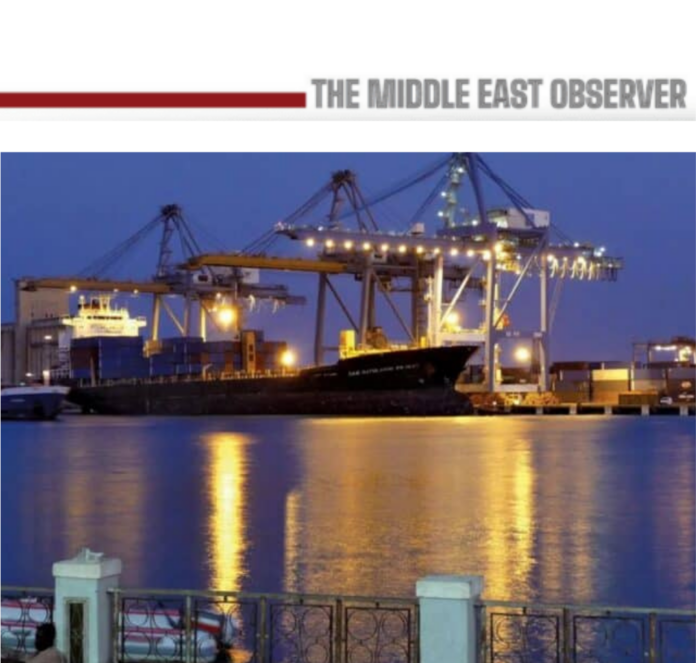
Sudan has signed a memorandum of understanding (MoU) with China’s China Harbour Engineering Company (CHEC) to modernise its Red Sea ports, marking a significant step in Khartoum’s efforts to revive critical trade infrastructure and strengthen its role in regional logistics. The agreement also reinforces China’s long-standing infrastructure partnership with Sudan as competition for commercial influence along the Red Sea continues to intensify.
Signed in Beijing on 6 July, the framework agreement between Sudan’s Sea Ports Corporation (SPC) and CHEC provides for cooperation on upgrading port infrastructure, cargo-handling equipment, digital operating systems, logistics facilities and the potential development of new port assets. Sudanese authorities said the programme is intended to improve operational efficiency, increase trade capacity and position Port Sudan as a more competitive gateway for regional commerce.
Sudan–China Ports Agreement at a Glance
The memorandum establishes a framework for future cooperation covering the rehabilitation and expansion of port infrastructure, installation of modern cargo-handling equipment, digital transformation of port management systems, development of logistics facilities and the exploration of additional port projects. Although the agreement outlines an ambitious roadmap for strengthening Sudan’s maritime sector, no investment value, financing package or implementation timetable has been announced, confirming that it remains a strategic cooperation framework rather than a binding construction or investment contract.
Strategic Importance of Port Sudan
Port Sudan is Sudan’s principal maritime gateway, handling the overwhelming majority of the country’s international trade. Since the outbreak of civil conflict in 2023, the city has also become the country’s de facto administrative and humanitarian centre after many government institutions relocated from Khartoum.
Located on the Red Sea, Port Sudan sits adjacent to one of the world’s busiest maritime corridors linking Europe, the Middle East and Asia through the Suez Canal. Approximately 10–12% of global trade and around one-third of global container traffic passes through the broader Red Sea–Suez route each year, making efficient port infrastructure increasingly important for regional supply chains and international commerce.
Improving the port’s operational capacity could reduce logistics costs, accelerate cargo handling, facilitate reconstruction imports, strengthen Sudan’s export competitiveness and expand transit trade with neighbouring African and Gulf markets.
Red Sea Logistics Competition
The agreement comes as governments and international investors continue to strengthen maritime infrastructure across the Red Sea basin. Major expansion programmes are underway at regional ports including Jeddah, Sokhna, Djibouti and Berbera, reflecting growing competition to capture increasing cargo volumes and serve evolving trade routes between Asia, Africa and Europe.
The strategic importance of resilient port infrastructure has also increased following recent disruptions to Red Sea shipping, prompting governments and logistics operators to invest in improving supply-chain resilience and regional connectivity.
China Expands Strategic Presence Along the Red Sea
CHEC, a subsidiary of China Communications Construction Company (CCCC), is among China’s leading international engineering contractors and has developed major ports across Asia, Africa and the Middle East. The Sudan agreement aligns with Beijing’s long-term strategy of supporting transport and maritime infrastructure in emerging markets while expanding commercial connectivity through overseas infrastructure investment.
China has remained one of Sudan’s most significant economic partners for more than two decades, investing in energy, transport, industrial and infrastructure projects. For Beijing, Sudan’s strategic location on the Red Sea, combined with its long-term economic potential and proximity to Gulf markets, continues to make the country an important partner despite ongoing political and security challenges.
Opportunities Accompanied by Challenges
While the agreement reflects renewed confidence in Sudan’s long-term economic prospects, successful implementation will depend on improvements in security, financing and institutional capacity.
Large-scale port modernisation typically requires investments running into hundreds of millions of dollars, together with extensive engineering works, dredging, digital infrastructure and transport connections. However, neither Sudanese authorities nor CHEC have disclosed the anticipated project value or financing arrangements.
Industry observers note that detailed feasibility studies, commercial agreements and stable operating conditions will be essential before construction can begin.
Outlook
Although the memorandum does not yet commit either party to specific construction projects, it represents one of Sudan’s most significant post-conflict infrastructure initiatives and signals continued Chinese interest in the country’s maritime sector.
If translated into financed projects, the partnership could strengthen Sudan’s position within Red Sea trade networks, facilitate post-war reconstruction and reinforce China’s commercial presence along one of the world’s most strategically important maritime corridors. Ultimately, however, the project’s long-term success will depend not only on foreign investment but also on Sudan’s ability to restore stability, strengthen public institutions and convert strategic agreements into operational infrastructure capable of supporting sustainable economic recovery.
Related news:
When Wars Travel: How a Gulf Conflict Is Starving Sudan
Egyptian Companies Poised to Anchor Sudan’s Post-War Rebuilding
Read also:
OpenAI Launches GPT-5.6 Globally as Frontier AI Race Enters a New Strategic Phase
Maersk and Hapag-Lloyd Signal Suez Canal Recovery as Confidence Gradually Returns