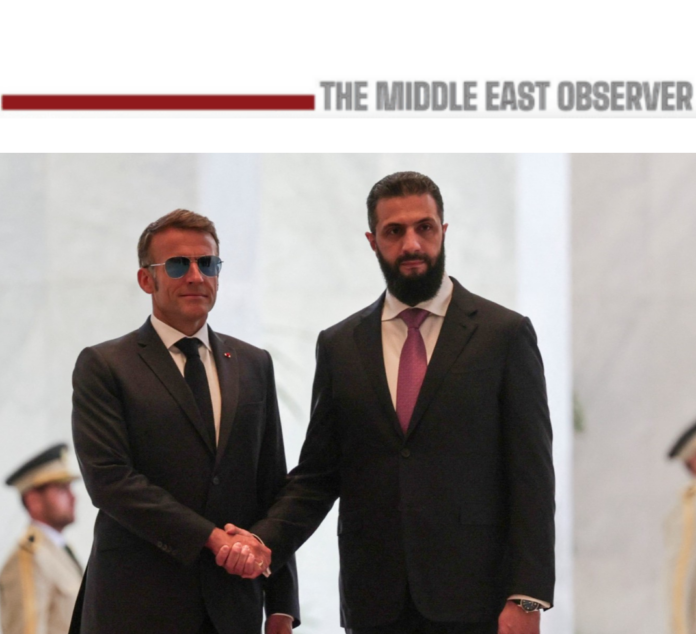
France and Syria signed a wide-ranging package of economic, development and investment agreements during President Emmanuel Macron’s two-day official visit to Damascus on 6–7 July, marking the first visit by a European Union head of state since the fall of the Assad government in 2024. The trip signals a shift from diplomatic re-engagement towards commercially driven reconstruction, as Syria’s transitional government seeks to attract foreign capital to revive an economy devastated by more than a decade of conflict.
The visit came as Syria entered a more favourable international policy environment. The United States ended its broad Syria sanctions programme in 2025, while President Donald Trump has now notified Congress of his decision to rescind Syria’s designation as a State Sponsor of Terrorism, triggering a 45-day review process before the decision becomes final. The move is expected to ease barriers to finance, trade and investment, although targeted restrictions remain on Bashar al-Assad, his associates and other designated individuals.
Macron, accompanied by senior French ministers, officials from the French Development Agency and executives from French companies including CMA CGM, Ellipse Projects and representatives of energy interests such as TotalEnergies, held talks with Syrian President Ahmed al-Sharaa before overseeing agreements covering transport, healthcare, development finance, infrastructure and investment facilitation.
Framework Pact Establishes Long-Term Partnership
The centrepiece of the visit was a Framework Declaration for Comprehensive Cooperation, creating the basis for expanded relations in trade, investment, infrastructure, healthcare, education, public administration, culture and technical assistance.
The declaration also established permanent bilateral economic committees to identify priority projects, coordinate financing and monitor implementation. These mechanisms are expected to guide French participation in Syria’s rebuilding programme and provide a structured channel for government agencies, development institutions and private investors.
CMA CGM Expands Logistics Role
The most commercially significant deal was a strategic partnership between Syria’s General Authority for Borders and Customs and French shipping and logistics group CMA CGM.
The agreement expands CMA CGM’s presence beyond its operations at the Port of Latakia to include maritime logistics, air cargo services at Damascus International Airport, inland dry-port development and customs modernisation. The project is intended to improve supply-chain efficiency, facilitate trade and reconnect Syria with regional and global transport corridors.
Healthcare and Medical Education
Syria also signed a memorandum of understanding with Ellipse Projects SAS to modernise university hospitals and medical education institutions.
The programme includes rehabilitation of teaching hospitals, upgrading medical training facilities, engineering consultancy and technical support to restore specialised healthcare services and strengthen medical education after years of damage to the sector.
AFD and Expertise France Resume Development Work
France formally resumed development engagement through agreements involving the French Development Agency and Expertise France. The arrangements cover municipal infrastructure, water services, healthcare, education, administrative capacity building and technical assistance. Expertise France said three agreements signed during the Damascus visit would allow the agency and the broader AFD Group to expand their activities in Syria.
Finance, Investment and Asset Recovery
Although no immediate commercial banking investment was announced, both governments agreed to deepen collaboration on financial sector modernisation, investment facilitation and regulatory reform.
Macron also announced that France had initiated procedures to return approximately €51 million in assets confiscated from Rifaat al-Assad, uncle of former President Bashar al-Assad, following his conviction for money laundering. The funds are expected to support development projects inside Syria.
Agreements Reached During the Visit
The visit resulted in the following agreements, memoranda of understanding and arrangements:
- Framework Declaration for Comprehensive Cooperation.
- Creation of France–Syria Joint Economic Committees.
- Strategic CMA CGM partnership covering maritime transport, logistics and customs cooperation.
- Air cargo operations agreement for Damascus International Airport.
- Inland dry ports and integrated logistics development.
- Customs modernisation and trade facilitation programme.
- MoU with Ellipse Projects SAS to modernise university hospitals and medical education institutions.
- Development cooperation agreements with AFD.
- Technical cooperation framework with Expertise France.
- Municipal infrastructure, water, healthcare and education programmes.
- Financial sector and investment facilitation framework.
- French commitment to return approximately €51 million in confiscated Syrian assets.
Gateway to a Major Rebuilding Programme
The scale of Syria’s reconstruction challenge remains considerable. The World Bank estimated Syria’s post-conflict reconstruction costs at US$216 billion, with assessed physical damage and rebuilding needs covering infrastructure, housing, public utilities, transport and social services. Other estimates place the broader requirement even higher, underlining the scale of the opportunity and the financing challenge.
By combining government frameworks, commercial partnerships and development finance, France has secured one of the earliest comprehensive European positions in Syria’s post-conflict revival. The agreements create a roadmap for future investment in logistics, healthcare, infrastructure, finance and public services, while opening opportunities for French companies in one of the Middle East’s largest prospective infrastructure programmes.
Implementation will depend on political stability, security improvements, sanctions clarity and sustained international financing. Yet the visit shows how Western engagement with Damascus is moving beyond diplomatic normalisation towards commercially driven reconstruction, with France seeking an early strategic position in Syria’s long-term economic rebuilding.
Related news:
El-Sisi, Macron Open Senghor University and Visit Qaitbay Citadel in Alexandria
Syria Turns to Chinese Smart Industrial Model to Drive Reconstruction and Investment
Read also:
Egypt & Saudi Arabia signed SAR 60 bn investment fund agreements