
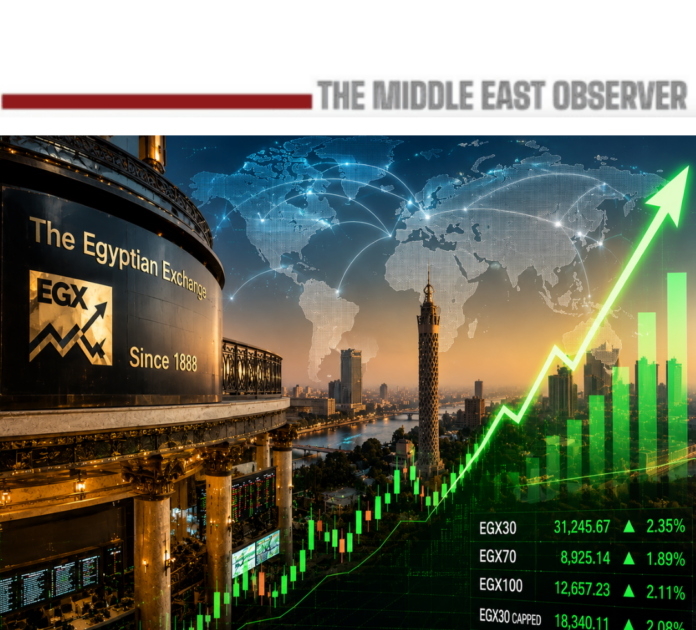
Broad market recovery coincides with renewed foreign appetite for Egyptian debt and diversified sovereign funding strategy
Cairo — Egyptian equities staged a broad recovery on Tuesday, 30 June, as buying returned across the market after recent losses, with gains in both blue-chip and small-cap stocks reflecting improving investor sentiment. The rebound came as international capital continued flowing into Egypt’s government debt market and Cairo strengthened its external financing strategy through a new Japanese Samurai bond issuance, reinforcing confidence across multiple asset classes.
The benchmark EGX30 rose 1.33% to 50,487.96 points, recovering above the psychologically important 50,000-point level after slipping below that threshold in the previous session. The advance was accompanied by broad-based gains across the market, with the EGX33 Shariah Index climbing 2.06% to 5,694.25 points, the EGX35-LV adding 1.53% to 5,916.87 points, the EGX70 advancing 2.09% to 15,503.28 points, and the EGX100 rising 1.97% to 21,141.62 points.
Market capitalisation increased to EGP 3.679 trillion, recovering around EGP 61 billion from the previous session and signalling that investors selectively rebuilt positions following the broad market correction seen over recent trading sessions.
Broad-Based Buying Supports Market Recovery
Investor activity reflected renewed confidence across market segments.
Exchange data showed Arab and non-Arab foreign investors recorded net purchases, while Egyptian investors were net sellers. At the same time, domestic institutions and retail investors increased trading activity during the session, contributing to the broad-based recovery that extended beyond heavyweight stocks into small- and mid-cap companies.
The session represented a notable improvement from Monday’s trading, when foreign selling pushed the EGX30 below 50,000 points despite resilience in smaller companies. Tuesday’s advance suggests bargain hunting emerged after recent declines, allowing the market to regain part of its earlier losses.
Among the strongest performers, Delta for Printing & Packaging surged another 20%, Golden Textiles & Clothes Wool also gained 20%, while Alexandria New Medical Center advanced 19.45%, reflecting continued strength in selected mid-cap and growth-oriented shares.
Global Capital Returns Across Asset Classes
The recovery in equities coincided with continued strength in Egypt’s fixed-income market, highlighting improving international confidence in the country’s broader macroeconomic outlook.
Secondary-market data showed foreign investors remained active buyers of Egyptian government debt during June, with monthly net inflows approaching US$8.8 billion, making the month one of the strongest periods for portfolio inflows since Egypt’s latest phase of economic reform. Attractive real interest rates, greater exchange-rate stability and improving macroeconomic fundamentals have continued to underpin demand for local-currency government securities.
Strong foreign demand for Egyptian debt also supports foreign-exchange liquidity and contributes to exchange-rate stability, factors that often precede improving sentiment towards domestic equity markets. The simultaneous strengthening of both debt and equity markets therefore represents a significant signal that international investors are increasingly viewing Egypt through a broader macroeconomic lens rather than evaluating individual asset classes in isolation.
Samurai Bond Reinforces Funding Strategy
The improvement in investor sentiment was reinforced by Egypt’s successful return to the Japanese debt market through the issuance of JPY80 billion (approximately US$500 million) in sustainability-linked Samurai bonds with five- and ten-year maturities, backed by a partial guarantee from the African Development Bank.
The transaction forms part of the government’s strategy to diversify funding sources, broaden its international investor base and reduce borrowing costs, complementing plans to issue approximately US$4 billion in international bonds during the 2026/27 fiscal year.
Together with strong inflows into domestic government debt securities and the expanding state IPO programme, the Samurai issuance illustrates Egypt’s strategy of diversifying both its sources of capital and its investor base. Rather than relying on a single funding channel, Cairo is increasingly combining domestic capital-market reforms with broader international financing initiatives to strengthen long-term financial resilience.
Capital-Market Reform Momentum Continues
Tuesday’s recovery also comes against the backdrop of an expanding domestic capital-market reform agenda.
The Egyptian Exchange continues to broaden its investment framework through the rollout of single-stock futures, preparations for covered short selling and an expanding pipeline of government and private-sector listings, including several strategically important petroleum-sector companies.
These initiatives coincide with ongoing efforts to improve market accessibility and liquidity as Egypt seeks to strengthen its standing among global emerging markets and attract a wider base of international institutional investors.
Market View
Tuesday’s session demonstrated that confidence in Egyptian assets is increasingly extending beyond the equity market alone.
The rebound in share prices was supported by improving sentiment across equities, government debt and sovereign funding markets, suggesting that investors are evaluating Egypt’s reform story through a comprehensive macroeconomic framework rather than focusing on individual asset classes.
While liquidity in the equity market remains an important challenge, the simultaneous recovery in equities, sustained foreign demand for government debt and continued success in accessing international funding markets point to strengthening confidence in Egypt’s financing strategy.
With portfolio capital returning simultaneously to equities, government debt and international bond markets, Egypt is increasingly demonstrating the characteristics of an integrated emerging capital market rather than a collection of individual investment opportunities. Sustaining that momentum through continued economic reform, stronger market liquidity and the successful execution of the government’s expanding IPO programme will determine whether the current recovery develops into a durable structural re-rating of Egyptian financial assets.
Related news:
Germany and Sweden Lead New Push for Anti-Drone Innovation in Europe
Rising Reserves and Easing Inflation Place Egypt on a Firmer Recovery Path
Read also:
Egypt’s FY2026/27 Budget Targets Lower Debt as Record Surplus Funds Service Expansion
Four Investment Banks Compete to Lead Egypt’s State IPO Programme