
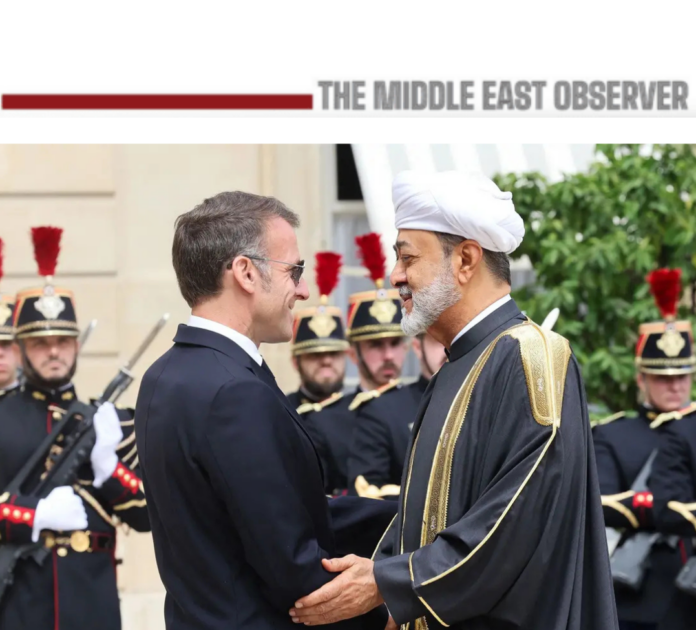
State visit delivers a broad package spanning renewable energy, water, logistics, transport, innovation and education, reinforcing Oman’s Vision 2040 ambitions while expanding the Gulf footprint of France’s industrial champions.
Oman and France have upgraded their economic relationship through a 12-deal package signed during Sultan Haitham bin Tarik’s first official visit to France, moving bilateral ties beyond traditional diplomacy into infrastructure, energy transition, logistics, technology and human-capital development.
The agreements, memoranda of understanding and declarations of intent were witnessed at the Élysée Palace by Sultan Haitham and French President Emmanuel Macron on June 29. The French presidency described the visit as part of a long-standing relationship dating back to the opening of the French consulate in Muscat in 1894, while Oman’s Foreign Ministry listed the signed instruments across energy, water, ports, transport, aviation, space, healthcare, education, culture, investment and start-ups.
The package reflects a clear convergence of priorities. Oman is seeking to accelerate Vision 2040 diversification through clean energy, logistics, advanced infrastructure and innovation. France, meanwhile, is using industrial champions such as EDF, SUEZ, CMA CGM and Airbus to deepen its Gulf presence in sectors where European engineering, utility and transport expertise remain globally competitive. The Élysée said a Franco-Omani business forum brought together more than 60 companies and produced major contracts in renewable energy, water and aerospace.
1. Wadi Dayqah Pumped-Storage Hydropower Project
The most strategically significant energy accord concerns the Wadi Dayqah Dam pumped-storage hydropower project, signed between Oman’s Authority for Public Services Regulation and France’s EDF Group. Omani reporting identified the agreement as part of the Sultanate’s renewable-energy push, while some international coverage reported a multibillion-dollar value. Because official Omani and French statements confirm the project but do not publish a binding value, the figure should be treated as externally reported rather than officially confirmed.
The project matters because pumped storage is not simply another renewable-energy asset. It is a grid-balancing technology that stores electricity by pumping water to a higher reservoir when power is abundant, then releases it to generate electricity when demand rises. Unlike conventional batteries, pumped-storage facilities can store large volumes of electricity for several hours or longer, making them one of the most established technologies for balancing solar- and wind-heavy power systems.
2. Al Kamil and Al Wafi Solar Power Plant
A contract was also signed for the first phase of the Al Kamil and Al Wafi Solar Power Plant, with a capacity of 500MW, between Nama Power and Water Procurement Company and EDF Renewables.
The project strengthens EDF’s clean-energy presence in Oman and complements the pumped-storage initiative. Together, the two projects suggest a more integrated power-sector strategy: building renewable generation while also creating storage capacity to support grid reliability.
3. Greater Muscat and Sharqiyah Water Networks
Water security formed one of the largest commercial components of the visit. Oman Investment Authority, Nama Water Services and the National Energy Centre signed an agreement with SUEZ Group and the National Trading Company for water network management in Muscat, South Al Sharqiyah and North Al Sharqiyah.
Reuters reported that SUEZ secured a €2bn, 15-year contract to operate and maintain water and wastewater services in Oman, describing it as the French group’s largest-ever contract in the Middle East. SUEZ is one of the world’s leading water and waste-management groups, giving the agreement both operational and strategic weight for Oman’s utilities sector.
4. ASYAD–CMA CGM Multipurpose Terminal
The logistics pillar was led by a master terms agreement between Oman’s ASYAD Group and France’s CMA CGM Group to establish a joint venture to develop and operate a multipurpose terminal. CMA CGM, controlled by Rodolphe Saadé, is one of the world’s largest container shipping groups and a major global logistics operator.
The strategic relevance goes beyond a single port asset. Oman’s ports — including Sohar, Duqm and Salalah — sit outside the Strait of Hormuz, giving the Sultanate a valuable logistics position as regional shipping routes face periodic geopolitical pressure. For France and its companies, Oman offers a stable platform linking the Gulf, the Indian Ocean and Europe.
5. Logistics, Ports and Muscat Metro Cooperation
Oman’s Ministry of Transport, Communications and Information Technology and the French Ministry of Transport signed an MoU covering logistics, ports and the Muscat Metro project.
This framework is less commercially specific than the CMA CGM terminal agreement, but it is important because it connects port development with urban mobility. A future metro system would mark a major shift in Muscat’s transport planning, while French companies have long experience in rail engineering, metro systems and transport management.
6. Civil Aviation Cooperation
The two sides signed an MoU on air transport between Oman’s Civil Aviation Authority and the French Ministry of Transport.
The Élysée declaration said both countries reaffirmed cooperation in civil aviation. The sector is commercially relevant because aviation supports tourism, logistics and connectivity — all central to Oman’s diversification strategy. It also aligns with France’s aerospace strengths through Airbus and its wider aviation ecosystem.
7. Space and Satellite Cooperation
A declaration of intent on space cooperation was signed between Oman’s Foreign Ministry and the French Ministry for Europe and Foreign Affairs. The Élysée also welcomed Oman’s partnership with Airbus for the construction of the Sultanate’s first satellite.
This moves the relationship into a higher-technology field. Space cooperation can support communications, earth observation, maritime monitoring, climate data and digital infrastructure — areas increasingly relevant to both economic planning and national resilience.
8. Medical Specialist Training
Healthcare cooperation was addressed through an agreement on training Omani specialist doctors between Oman’s Ministry of Health and the French Ministry for Europe and Foreign Affairs.
Although smaller in commercial scale than energy or ports, the agreement supports long-term capacity-building. For Oman, specialised medical training is part of the wider human-capital agenda underpinning Vision 2040.
9. French-Language Education
A declaration of intent on French-language education was signed between the two governments.
The education accord sits within a broader cultural and academic track highlighted by the Élysée, including student mobility, research cooperation and scholarships. For France, language and education remain core instruments of long-term influence; for Oman, they widen academic and professional channels with Europe.
10. Omani-French Museum / Bait Faransa
A separate declaration of intent concerned the Omani-French Museum, also known as Bait Faransa, between Oman’s Ministry of Heritage and Tourism and the French Ministry for Europe and Foreign Affairs.
The museum agreement reinforces the historical dimension of the relationship. It also supports Oman’s tourism and cultural positioning, an area increasingly linked to economic diversification rather than heritage policy alone.
11. Investment Promotion Framework
An MoU on investment promotion was signed between Oman’s Ministry of Commerce, Industry and Investment Promotion and the French ministry responsible for foreign trade and economic attractiveness.
The Élysée said both sides aim to facilitate investment in renewable energy, hydrogen, maritime infrastructure, logistics, information technology, transport, tourism, culture and space. The framework gives the wider package a policy channel through which commercial projects can be converted into longer-term investment flows.
12. Station 11–Station F Start-up Partnership
The final agreement was a strategic partnership between Oman Investment Authority, Oman’s Station 11 and France’s Station F to enable Omani start-ups to explore and expand into French and European markets. Station F is one of Europe’s best-known start-up campuses, making the partnership a bridge between Omani entrepreneurs and France’s innovation ecosystem.
The agreement adds an innovation layer to a package otherwise dominated by infrastructure and strategic assets. It also signals that Oman’s diversification agenda is not limited to utilities and logistics, but extends to entrepreneurship and technology-led growth.
Strategic Conclusion
The 12-deal package is not a single mega-project, but a structured roadmap for Franco-Omani economic cooperation. Its strongest commercial components are water management, renewable energy and logistics, while its wider significance lies in linking Oman’s geography and infrastructure needs with France’s industrial strengths.
For Muscat, the agreements support cleaner power, stronger water systems, port expansion, urban mobility, healthcare training, cultural diplomacy and access to European innovation networks. For Paris, they deepen the commercial footprint of French companies in one of the Gulf’s most stable and strategically positioned economies.
The key fact-based conclusion is that the instruments vary in legal and commercial weight: some are contracts, others are MoUs or declarations of intent. Yet taken together, they show how Gulf-European relations are evolving beyond hydrocarbons towards infrastructure, clean energy, industrial technology and resilient supply chains. For Oman, the package reinforces Vision 2040’s ambition to become a regional logistics and energy-transition hub. For France, it offers a durable economic foothold in a country positioned between the Gulf, the Indian Ocean and global trade routes.
Related news:
Oman’s Economic Upswing Deepens as Duqm Emerges as Regional Investment Magnet
Egypt, France Expand Strategic Partnership Through Health, Skills and Green Industry Investments
Read also:
Joint Satellite Project Strengthens Saudi-Egyptian Push into Space Economy
Egypt–South Africa Relations: Brotherhood and Solidarity on a Shared African Path
