
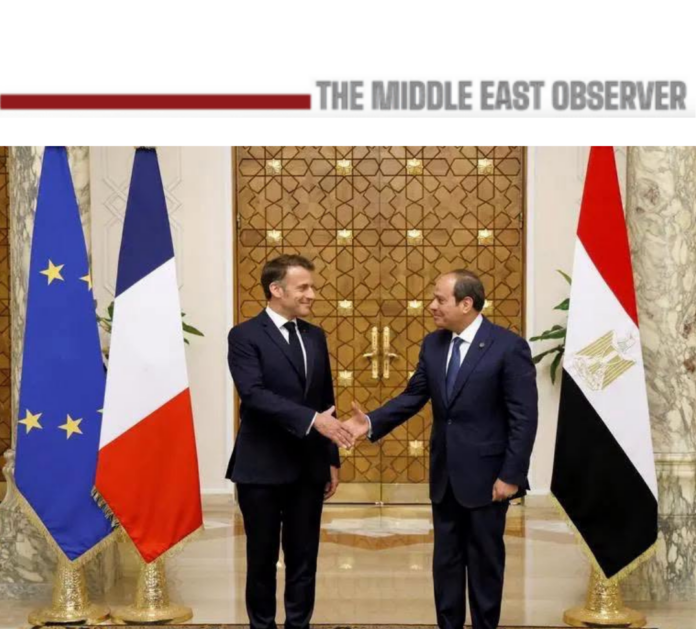
CAIRO — Egypt and France have broadened their strategic development partnership through the signing of eight financing agreements and memoranda of understanding covering healthcare, education, technical training, green industry and small business development, underscoring a growing shift in international development finance towards strengthening human capital, industrial competitiveness and sustainable economic growth.
The agreements, signed at the Ministry of Foreign Affairs, International Cooperation and Egyptian Expatriates, bring together Egyptian ministries and agencies, the French Development Agency (AFD), the European Union and several French institutions and companies. Rather than focusing solely on traditional infrastructure financing, the new package targets sectors considered fundamental to Egypt’s long-term economic transformation, including healthcare reform, workforce development, industrial decarbonisation and private-sector expansion.
Foreign Minister Badr Abdelatty described the agreements as the latest milestone in a partnership that has steadily expanded over more than two decades. During that period, AFD has helped finance projects spanning transport, renewable energy, water security, urban infrastructure and public services, supporting Egypt’s wider economic reform agenda while strengthening bilateral economic cooperation.
The centrepiece of the package is healthcare. Two financing agreements worth a combined €300 million will support Egypt’s Universal Health Insurance System (UHIS), one of the country’s most ambitious structural reforms aimed at delivering comprehensive healthcare coverage nationwide. The financing is intended to strengthen the system’s long-term financial sustainability, improve service delivery and accelerate its gradual rollout across additional governorates. A separate memorandum of understanding will enhance primary healthcare services by improving the quality, efficiency and operational capacity of healthcare facilities.
Beyond its social impact, the healthcare programme carries significant economic implications. International development institutions increasingly regard universal healthcare as a long-term productivity investment, as healthier populations contribute to higher labour-force participation, stronger human capital and lower long-term public healthcare costs. For Egypt, expanding healthcare coverage also supports broader efforts to improve social inclusion while enhancing the resilience of the country’s workforce.
Education and workforce development represent the second major pillar of the cooperation package. A grant agreement will support the expansion of French-language teaching in Egyptian public schools, while two letters of intent provide for the establishment of applied technology schools—one at the Wardan Railway Institute and another in partnership with RATP Group. Both institutions are intended to strengthen vocational education and equip graduates with skills aligned to the requirements of Egypt’s rapidly expanding transport, manufacturing and industrial sectors.
The emphasis on technical education reflects a broader evolution in Egypt’s industrial policy. As investment accelerates across railways, logistics, renewable energy, advanced manufacturing and infrastructure, demand for technically qualified workers continues to increase. Aligning education with labour-market requirements has therefore become an increasingly important component of the country’s competitiveness strategy.
Environmental sustainability forms the third pillar of the new cooperation framework. A €45 million credit facility will finance the Sustainable Green Industry Programme in cooperation with the Egyptian Environmental Affairs Agency. The initiative aims to improve industrial resource efficiency, reduce emissions, encourage cleaner production technologies and support Egypt’s transition towards a lower-carbon economy.
The programme also has growing commercial significance. As international markets tighten environmental requirements, particularly through the European Union’s Carbon Border Adjustment Mechanism (CBAM), Egyptian manufacturers face increasing pressure to reduce the carbon intensity of production. Investment in cleaner industrial processes is therefore expected not only to improve environmental performance but also to preserve export competitiveness in European and other international markets while facilitating access to sustainable finance.
Support for entrepreneurship and regional development also features prominently in the package. A grant agreement with the Micro, Small and Medium Enterprise Development Agency (MSMEDA) seeks to expand access to business services and generate new economic opportunities in targeted communities. SMEs account for the overwhelming majority of Egypt’s private-sector enterprises and play a central role in employment creation, local manufacturing and industrial supply chains. Strengthening their competitiveness remains a key objective of Egypt’s strategy to encourage private-sector-led growth.
Beyond the individual projects, the agreements highlight the increasing strategic importance of Egypt within France’s development policy. According to AFD, the agency has committed approximately €4 billion to development programmes in Egypt over the past two decades—equivalent to an average annual commitment of around €200 million—making Egypt one of AFD’s largest partners in both the Middle East and Africa. Cooperation has expanded steadily from infrastructure financing towards institutional reform, climate resilience, healthcare modernisation, vocational education and sustainable industrial development.
For France, the partnership reflects a broader strategic objective of supporting economic stability, climate transition and sustainable development across the Mediterranean while strengthening European economic engagement with North Africa. Egypt’s strategic location, expanding industrial base and role as a regional energy, logistics and manufacturing hub have further elevated its importance within French and European development policy.
The latest agreements also reinforce the broader EU–Egypt Strategic and Comprehensive Partnership, launched in 2024, under which the European Union committed a €7.4 billion package of macro-financial assistance, grants and investment support. Within that framework, investments in healthcare, education, industrial competitiveness and employment are viewed not only as development priorities but also as instruments for enhancing regional economic resilience, strengthening supply chains, accelerating the green transition and promoting long-term stability across the Southern Mediterranean.
The convergence of French bilateral financing with wider European development initiatives illustrates an increasingly coordinated approach to supporting Egypt’s structural reform programme. Rather than concentrating exclusively on physical infrastructure, international development finance is placing greater emphasis on institutional capacity, workforce skills, technological upgrading and environmentally sustainable industrialisation.
For Egypt, the significance of the package extends beyond the financial value of the agreements. The combination of healthcare reform, technical education, SME support and green industrial investment addresses several of the country’s most important long-term economic priorities simultaneously. Together, these initiatives are expected to strengthen productivity, improve export competitiveness, attract higher-quality investment and support a more diversified and resilient economy.
As Egypt continues implementing its economic transformation agenda, partnerships that combine long-term financing with technology transfer, institutional reform and human capital development are likely to become increasingly important. The latest agreements demonstrate how international development cooperation is evolving beyond traditional lending towards building productive capacity, enhancing industrial competitiveness and supporting sustainable economic growth. In that respect, the Egypt–France partnership increasingly represents not simply a financing relationship, but a strategic investment in the country’s long-term economic resilience and regional competitiveness.
Related news:
Egypt, France Launch Strategic Dialogue to Advance Economic and Political Cooperation
AI Becomes Europe’s New Weapon in Africa’s Critical Minerals Race
Read also:
El-Sisi Advances Debt-for-Development Vision for Africa’s Economic Future