
Alamein Conferences May Become the Platform for Practical Implementation
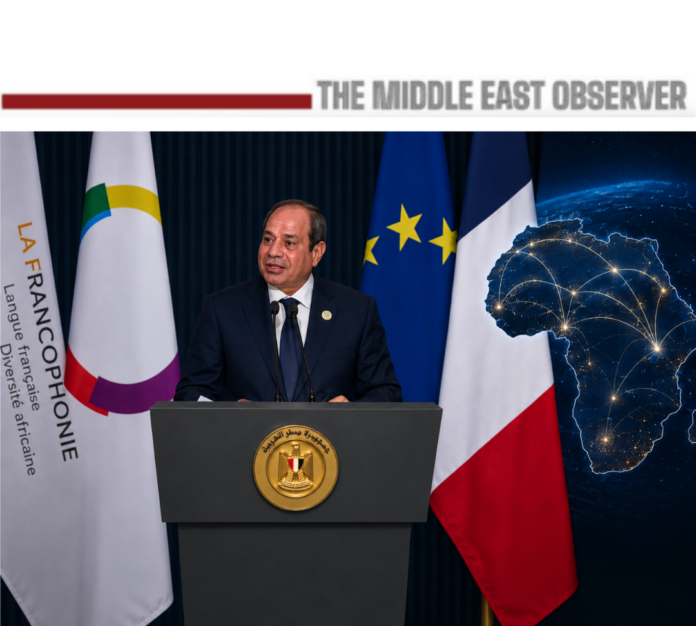
Egyptian President Abdel Fattah el-Sisi participated in the Africa-France Summit held in Nairobi, Kenya, on 11–12 May 2026 under the theme “Africa Forward,” joining more than 30 African heads of state and government alongside French President Emmanuel Macron and Kenyan President William Ruto to discuss reforming global financial governance and strengthening African-European economic cooperation.
During the summit’s working session on reforming the international financial architecture, President El-Sisi delivered a speech emphasizing that sustainable development and peace remain inseparable, warning that growing geopolitical tensions and disruptions to global supply chains continue to disproportionately impact African economies, particularly in the areas of food security, energy costs, debt burdens, and development financing.
President El-Sisi stressed that declining development assistance flows, mounting climate-related pressures, and increasing financing conditionalities have made reform of the global financial system an urgent necessity for developing nations. He called for adopting more flexible and innovative financing mechanisms capable of addressing Africa’s growing sovereign debt crisis while simultaneously enabling development projects critical to long-term economic growth.
Among the most significant proposals raised by the Egyptian President was the expansion of debt-for-development swap mechanisms, alongside broader issuance of green bonds and reforms to multilateral financing institutions. El-Sisi noted that many African countries now spend more on debt servicing than on healthcare and education combined, creating what he described as a “vicious cycle” that continues to hinder development efforts across the continent.
The Egyptian President additionally highlighted the importance of strengthening African exports, supporting emerging industries, and accelerating implementation of the African Continental Free Trade Area through enhanced regional supply chains and investments in youth skills and industrial capacity. He reaffirmed Egypt’s commitment to economic reform, infrastructure development, logistics modernization, and investment incentives aimed at positioning Egypt as a gateway linking Africa with global markets.
On the sidelines of the summit, President El-Sisi held meetings with several African leaders, including Kenyan President William Ruto, where discussions focused on expanding bilateral trade, infrastructure cooperation, regional security coordination, and strengthening African positions regarding reform of international financial institutions.
President El-Sisi also exchanged views with participating African leaders regarding mechanisms for mobilizing sustainable financing for infrastructure, renewable energy, industrial development, and climate adaptation projects amid increasing pressure on African fiscal balances. The summit itself saw growing calls from African leaders for a transition away from traditional aid-based relations toward more balanced partnerships centered on co-investment, industrial development, and financial sovereignty.
Supporting broader calls for innovative development financing models, French President Emmanuel Macron announced approximately €23 billion ($27 billion) in joint investment mobilization involving French and African companies targeting sectors including clean energy, artificial intelligence, agriculture, and infrastructure.
As The Middle East Observer notes, President El-Sisi’s proposal regarding debt-for-development swaps emerged as one of the summit’s most economically significant ideas, particularly for heavily indebted African economies seeking to balance fiscal stability with urgent infrastructure and development needs.
The proposal offers a potentially transformative “win-win” framework in which portions of sovereign debt obligations could be redirected toward financing nationally agreed development projects in sectors such as infrastructure, renewable energy, healthcare, education, logistics, industrialization, and continental connectivity projects. Such mechanisms could ease debt-servicing pressures while accelerating high-impact projects capable of generating long-term growth, employment opportunities, industrial capacity, and improved living standards across African economies.
From the donor and creditor perspective, the model offers substantial economic and geopolitical value by transforming distressed sovereign debt exposure into participation within commercially viable projects. Such frameworks could generate stable returns, expand market access, strengthen regional partnerships, support stability, and create new opportunities for private-sector companies involved in infrastructure, logistics, energy, technology, construction, and industrial supply chains.
The framework could additionally create broader opportunities for international investors, African sovereign wealth funds, regional development banks, and infrastructure financiers seeking commercially sustainable projects within high-growth African markets.
The proposal may gain further momentum in June 2026 as Egypt’s New Alamein City hosts a major series of high-level African political, economic, and investment gatherings expected to position the city as a central hub for African decision-making and development coordination.
Among the most significant events will be the 33rd Annual Meetings of Afreximbank (21–24 June 2026), held under the theme “Intra-African Trade and Industrialisation: Pathway to Economic Sovereignty,” focusing on strengthening regional integration, industrial production, and intra-African trade. This will be followed by the Alamein Africa Forum (25–27 June 2026), described as “Africa’s Premier Business Forum,” which aims to connect policy with capital through presidential roundtables, investment deal rooms, and implementation-focused development tracks linking governments with private-sector investors.
Simultaneously, New Alamein will host the 8th Mid-Year Coordination Meeting of the African Union from 24–27 June 2026, bringing together the African Union Commission, regional economic communities, and African heads of state to coordinate continental policies and accelerate implementation of Agenda 2063. The ECOSOCC Citizens’ Forum (22–23 June 2026) will also convene civil society leaders to discuss debt, climate, water security, and development financing, with recommendations expected to feed directly into African Union policy discussions.
Within this context, debt-for-development swaps may increasingly emerge as one of the most practical tools available for addressing two of Africa’s most pressing structural dilemmas simultaneously: rising sovereign debt burdens and insufficient financing for transformative development projects. If structured efficiently through transparent governance mechanisms and commercially sustainable project selection, such frameworks could establish a new generation of African development partnerships based not on traditional aid dependency, but on co-investment, long-term asset creation, shared economic returns, and mutually beneficial growth between African nations and international financing partners.
For many African economies, the debate may therefore no longer center on whether development financing must evolve, but on how rapidly practical implementation mechanisms can be established before mounting debt pressures further constrain long-term growth and industrial transformation across the continent.