
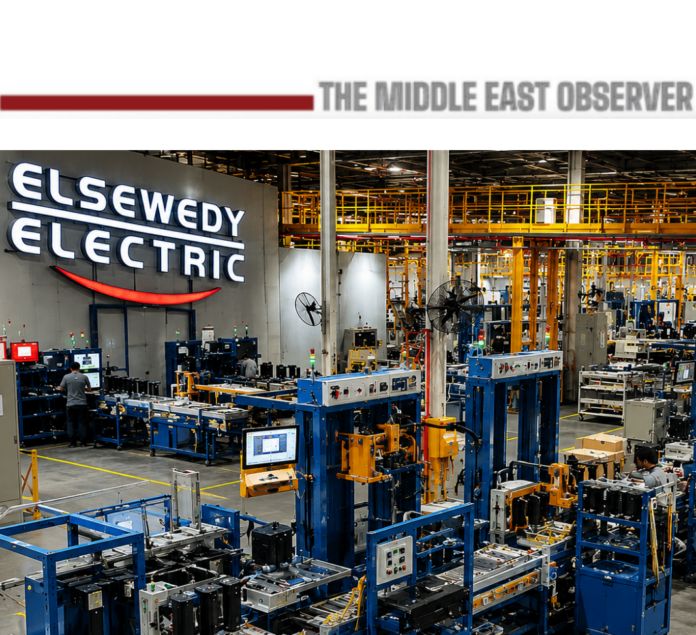
CAIRO — Elsewedy Electric will invest more than $200 million in three strategic industrial projects in Egypt aimed at expanding domestic production of copper and aluminium products, strengthening industrial supply chains and increasing export-oriented manufacturing as global demand for critical industrial metals continues to rise.
The projects, scheduled to begin commercial operations during the first quarter of 2028, will establish an integrated manufacturing ecosystem spanning electronic waste recycling, copper processing and aluminium production. The investments reflect the company’s broader strategy of moving further up the industrial value chain while supporting Egypt’s ambitions to become a regional manufacturing and export hub.
The centrepiece of the programme is an $80 million integrated recycling complex for copper scrap and electronic waste. Designed to employ advanced metallurgical technologies, the facility will have an initial production capacity of 20,000 tonnes annually, recovering high-purity copper cathodes and valuable metals from discarded electrical and electronic equipment.
The recovered copper will serve as the primary feedstock for the group’s second investment—a $65 million copper tube manufacturing plant with an annual capacity of 15,000 tonnes. The facility will supply Egypt’s growing air-conditioning, refrigeration and household appliance industries, reducing reliance on imported intermediate products while increasing local value addition across manufacturing supply chains.
Elsewedy Electric will also invest $55 million to establish a new aluminium rod production line with annual capacity of 50,000 tonnes, with the company allocating the plant’s entire output to export markets. The move is expected to strengthen Egypt’s position as a regional supplier of aluminium products used in power transmission, electrical cables and industrial applications across Europe, the Middle East and Africa.
Together, the three projects create a vertically integrated production model in which recycled copper generated by the recycling complex will supply the downstream copper tube factory, improving raw-material security, reducing import dependence and enhancing production efficiency.
The investment programme is expected to create more than 300 direct jobs and approximately 1,000 indirect employment opportunities, while introducing advanced recycling technologies that support higher-value manufacturing and more efficient resource utilisation.
The projects also reinforce Egypt’s transition towards a circular industrial economy, where valuable metals are recovered and reused rather than discarded. Electronic waste has become one of the world’s fastest-growing waste streams, with global volumes continuing to increase alongside accelerating digitalisation. Recovering copper and other strategic metals from electronic waste reduces dependence on imported raw materials, lowers environmental impacts associated with primary mining and provides manufacturers with a more secure domestic supply of critical industrial inputs.
The investments coincide with a period of strengthening global demand fundamentals for copper and aluminium. Copper has become one of the world’s most strategically important industrial metals as governments accelerate investment in renewable energy, electric vehicles, electricity grids and digital infrastructure. Industry forecasts increasingly point to tightening global copper supplies later this decade as demand outpaces new mining capacity, placing greater emphasis on recycling and secondary metal production.
For aluminium, rising investment in electricity networks, renewable energy infrastructure and lightweight manufacturing continues to support long-term consumption growth. Export-oriented production enables Egyptian manufacturers to capitalise on expanding regional demand while diversifying the country’s industrial export base.
The projects also align closely with Egypt’s industrial development strategy, which prioritises localisation of manufacturing, import substitution and increased exports of value-added industrial products. The government has identified engineering industries, electrical equipment, metals and advanced manufacturing among the sectors expected to drive industrial growth and generate higher foreign currency earnings over the coming decade.
Elsewedy Electric’s latest expansion builds on the company’s strong financial performance. During the first quarter of 2026, the company reported revenues of EGP 75.3 billion, representing a 26.8% year-on-year increase, while net profit attributable to shareholders rose 16.9% to EGP 4.85 billion, reflecting sustained demand across its cables, infrastructure, engineering and digital solutions businesses.
Industry analysts view the integrated nature of the investment programme as one of its principal strengths. By combining recycling with downstream manufacturing, Elsewedy Electric can improve raw-material security, reduce exposure to international commodity price volatility and capture greater value across the production chain. The strategy also reflects a broader global shift towards securing critical mineral supplies through circular economy models rather than relying exclusively on primary extraction.
Beyond their immediate industrial impact, the projects underscore Egypt’s broader ambition to transform its manufacturing sector from assembling imported inputs into producing higher-value industrial materials domestically. As global manufacturers increasingly seek diversified and resilient supply chains, investments integrating advanced recycling, downstream processing and export-oriented production could strengthen Egypt’s competitiveness in regional industrial markets while expanding its role in international engineering and metals value chains over the coming decade.
Related news:
Egypt Bets on Battery Storage and Manufacturing to Power Next Energy Phase
Beyond Nvidia: Where the Next AI Profits Could Be Found
Read also:
Egypt Aluminium Raises Prices by Up to EGP 5,000 per Ton in May
Trump’s $12bn Stockpile Sends a Bullish Signal to Minerals Markets
