
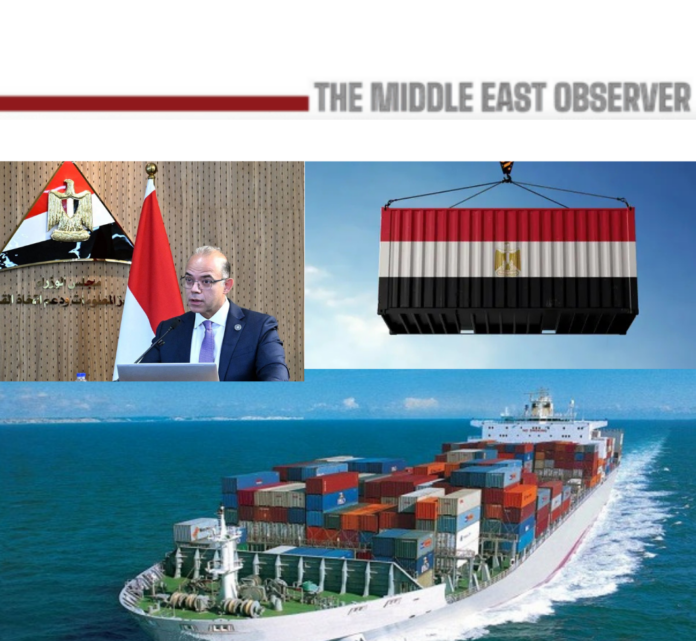
Cairo — Egypt has launched its largest-ever national foreign trade intelligence platform, as the government intensifies efforts to boost merchandise exports to $100bn by 2030, diversify export markets and strengthen the economy’s resilience to external shocks.
Inaugurated by Prime Minister Mostafa Madbouly and developed by the Cabinet’s Information and Decision Support Center (IDSC) in cooperation with the Ministry of Investment and Foreign Trade, the new Foreign Trade Information Portal is designed as a unified gateway providing exporters, manufacturers, investors and policymakers with comprehensive market intelligence, trade analytics and product-level export opportunities, marking a significant shift towards a more data-driven approach to export promotion, competitiveness and trade-deficit reduction.
The launch comes as Egypt seeks to double merchandise exports to approximately $100bn by 2030, a target viewed by policymakers as essential to reducing the country’s structural trade deficit, strengthening foreign-currency earnings and improving resilience against external economic shocks.
Madbouly said the portal forms part of a broader package of institutional, legislative, logistical and regulatory reforms intended to improve exporters’ access to global markets and strengthen Egypt’s competitiveness in international trade.
From Data Collection to Trade Intelligence
Unlike traditional statistical databases, the new platform has been designed as a decision-support tool.
According to IDSC, the portal contains more than 60 million trade records drawn from Egyptian and international sources, including the World Trade Organization, International Trade Centre, World Bank, OECD and UNCTAD. It covers approximately 6,650 product categories under the Harmonised System classification and provides users with detailed information on exports, imports, market trends, tariffs, non-tariff barriers and country-level demand patterns.
The platform enables exporters to compare markets, analyse import demand, identify potential buyers, assess competitor countries and evaluate opportunities at the individual product level.
For Egypt’s small and medium-sized exporters, which often lack access to sophisticated market research, the system could substantially reduce the cost of identifying export opportunities. For larger industrial groups, it offers a more systematic framework for market selection, investment planning and export expansion.
In effect, Egypt is attempting to institutionalise trade intelligence in the same way advanced export economies increasingly rely on data analytics to guide industrial policy and export promotion.
Why Egypt Needed the Portal
The portal addresses a structural challenge that has long constrained Egyptian trade performance.
While non-oil exports have expanded significantly in recent years, they remain concentrated in a relatively small number of products and destinations. During the launch, IDSC officials noted that nearly half of Egyptian exports are directed to only ten countries, leaving the economy vulnerable to shifts in demand, geopolitical disruptions and commodity cycles in a limited number of markets.
The challenge therefore extends beyond increasing export volumes. Egypt must diversify both the products it sells and the markets it serves.
The portal seeks to address that weakness by helping exporters identify new destinations, understand market requirements and uncover opportunities that might otherwise remain hidden within global trade data.
The Export Gap
The scale of Egypt’s export challenge remains considerable.
Official trade indicators show that non-oil exports reached approximately $48.6bn in 2025, an increase of about 17 percent compared with the previous year. However, that still leaves a gap exceeding $50bn before the government reaches its 2030 target.
Achieving the $100bn objective will require sustained annual export growth well above historical averages, rather than relying solely on currency adjustments or cyclical improvements in global demand.
The urgency is reinforced by Egypt’s continuing trade imbalance. CAPMAS data show imports remain substantially higher than exports across many categories, while monthly trade bulletins continue to record sizable merchandise deficits despite improving export performance.
For policymakers, the portal represents an attempt to improve one of the least visible but most important components of export growth: access to reliable market information.
Which Industries Stand to Benefit Most?
The platform is likely to have its greatest impact on sectors that already demonstrate international competitiveness.
Trade data indicate that Egypt’s leading export sectors include building materials, chemicals and fertilisers, food industries, engineering products, agricultural commodities, ready-made garments and medical industries. Together these industries account for the majority of Egypt’s non-oil export earnings.
For these sectors, future growth will depend increasingly on identifying new markets, understanding technical standards, navigating regulatory requirements and responding quickly to changing demand patterns.
The ability to compare market opportunities at the product level could become particularly valuable for manufacturers seeking to expand into Africa, Central Asia, Latin America and emerging Asian markets where information gaps remain significant.
Beyond Traditional Markets
One of the portal’s most important functions may be helping exporters expand beyond their traditional destinations. While Europe, the Gulf and the United States will remain critical markets, future growth opportunities are increasingly emerging in East and West Africa, Central Asia and selected Latin American economies where demand for food products, construction materials, chemicals, engineering goods and pharmaceuticals continues to rise.
The African Continental Free Trade Area (AfCFTA) offers particular long-term potential. By improving visibility into market demand and import patterns across African economies, the platform could help Egyptian companies increase their presence in some of the world’s fastest-growing consumer markets while reducing dependence on a limited number of export destinations.
Egypt and the New Geography of Global Trade
The timing of the launch is strategically significant.
Global supply chains are undergoing a period of reconfiguration as companies seek to diversify production networks, reduce geopolitical risk and build greater resilience into sourcing strategies. International organisations including the WTO and UNCTAD have highlighted growing demand for trade diversification and supply-chain flexibility amid an increasingly fragmented global trading environment.
Egypt occupies a potentially advantageous position at the intersection of Europe, the Gulf and Africa. Combined with major investments in ports, logistics infrastructure, industrial zones and free-trade agreements, the country is attempting to position itself as a regional manufacturing and export hub.
However, location alone is insufficient.
Converting geographic advantage into export growth requires accurate market intelligence, efficient logistics and rapid commercial decision-making. The portal is intended to become part of that infrastructure.
International Benchmark: Lessons from Vietnam, Morocco and Poland
Egypt is not the first country to use trade intelligence as a tool for export transformation.
Vietnam combined export promotion, industrial clustering and market intelligence to increase merchandise exports from less than $100bn in the early 2010s to more than $400bn today, becoming a major manufacturing hub for electronics, textiles and consumer goods. Morocco has leveraged its proximity to Europe, logistics infrastructure and sector-focused industrial policies to build globally competitive automotive and aerospace export industries. Poland, meanwhile, used its integration into European value chains and extensive export-support mechanisms to become one of Central Europe’s leading manufacturing exporters.
The common lesson is that export growth rarely depends on production capacity alone. Successful exporting nations combine industrial policy, logistics, market access and sophisticated trade intelligence systems that help businesses identify opportunities and respond rapidly to changing demand. Egypt’s new portal is intended to provide part of that institutional infrastructure.
From Database to AI-Powered Trade Intelligence
The most transformative phase of the project may still lie ahead.
IDSC officials indicated that future development stages will integrate additional government services and eventually incorporate artificial intelligence capabilities. If implemented effectively, the platform could evolve from a searchable database into an AI-driven trade intelligence engine.
Potential applications include automated identification of promising export markets, competitor benchmarking, demand forecasting, early-warning systems for regulatory changes, tariff and non-tariff barrier alerts, and customised export-readiness assessments for businesses.
Such capabilities would move the platform beyond information provision and towards active decision support, creating a closer link between industrial policy, investment promotion and export strategy.
Execution Will Determine Success
The portal’s ultimate impact will depend less on the volume of data it contains than on how effectively that information is translated into commercial decisions.
Data platforms succeed only when they are continuously updated, integrated into business processes and supported by complementary reforms in customs, logistics, export finance and certification. Exporters must not only have access to information, but also the tools required to act on it.
Over the past decade, Egypt has invested heavily in ports, industrial zones, logistics corridors and trade agreements. The Foreign Trade Information Portal represents an attempt to add a missing component to that infrastructure: actionable trade intelligence.
Beyond supporting exporters, the platform could also play a wider role in Egypt’s industrial development strategy. As manufacturing clusters expand across the Suez Canal Economic Zone and other industrial hubs, the portal has the potential to help investors identify sources of raw materials, intermediate goods and supply-chain partners, strengthening local industrial linkages and reducing information barriers between producers and suppliers. It could also evolve into a valuable reference point for quality standards, technical specifications and regulatory requirements across different export markets, helping Egyptian manufacturers align production with international compliance standards and improve market access.
Its success will ultimately be judged not by the 60 million records it contains, but by whether it helps Egyptian companies win market share, diversify exports, deepen industrial integration and narrow the gap between today’s $48.6bn export base and the government’s ambition of becoming a $100bn export economy by the end of the decade.
