Tariff cuts and resource access anchor a broader EU strategy to secure supply chains and deepen Indo-Pacific ties
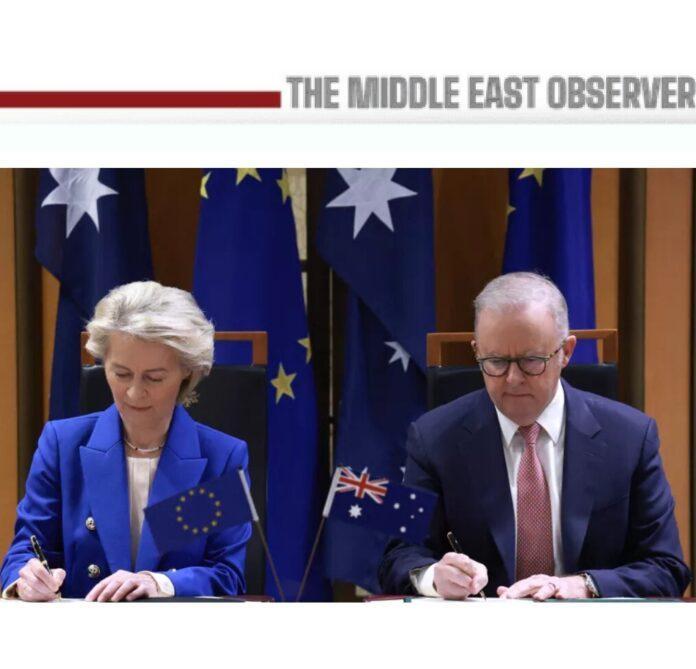
A sweeping free trade agreement between the European Commission and Australia marks a significant milestone in Brussels’ accelerating push to reconfigure its global trade architecture. Finalised after protracted negotiations, the accord was formally sealed by Ursula von der Leyen and Anthony Albanese, signalling both an economic breakthrough and a strategic alignment between two like-minded partners. The agreement is expected to eliminate tariffs on the vast majority of Australian exports of manufactured goods and mineral resources into the EU, while granting European exporters broader access to the Australian market. Brussels estimates the deal could save around €1bn annually in duties, with exports projected to rise by up to 33% over the next decade.
The deal comes against a backdrop of heightened geopolitical uncertainty, with both sides presenting it as a mechanism to strengthen supply chain resilience and secure access to critical inputs. Tariffs on key Australian exports—including lithium, aluminium, manganese and, over time, hydrogen—are set to be phased out, reinforcing Canberra’s ambition to position itself as a major supplier in the global clean energy transition. In parallel, European manufacturers are expected to gain improved market access for high-value goods such as vehicles, pharmaceuticals, chemicals and advanced machinery, sectors likely to benefit from reduced trade barriers.
Agriculture, long the most contentious pillar of negotiations, was ultimately resolved through a calibrated compromise. Tariffs on a range of European exports—including cheese, wine, chocolate and processed foods—will be gradually reduced, while sensitive sectors within the EU will remain protected through quotas and safeguard mechanisms. Australia secured limited access for beef and sheep meat exports under defined thresholds, reflecting Brussels’ need to balance liberalisation with domestic political considerations, particularly amid resistance from parts of the European farming sector.
The agreement also reflects a broader strategic shift in EU trade policy, as Brussels intensifies efforts to diversify partnerships and reduce exposure to concentrated supply chains. In recent years, the EU has expanded its global trade footprint through agreements with Latin American partners, including the Mercosur bloc, alongside updated arrangements with Mexico and continued engagement across the region. In Asia, negotiations with India and several ASEAN economies remain ongoing, while economic ties with China continue to be significant but increasingly shaped by a more cautious and selective approach. Within the MENA region, discussions with Gulf states—particularly the UAE—as well as North African economies are advancing, driven by shared interests in energy transition, infrastructure and industrial cooperation.
This outward-looking strategy is further underscored by shifts in the transatlantic landscape. Since the return of Donald Trump to the White House, trade relations between the EU and the United States have faced renewed uncertainty, with policy divergence and a greater emphasis on domestic industrial strategies prompting Brussels to accelerate alternative partnerships. The EU–Australia agreement is therefore widely seen as part of a broader effort to hedge against external volatility while anchoring new economic corridors with politically aligned economies.
For the MENA region, the implications are both competitive and strategic. Preferential access for Australian critical minerals and clean energy exports may intensify competition in sectors where Gulf and North African producers are seeking to expand, particularly hydrogen and downstream industrial applications. At the same time, the agreement highlights the EU’s evolving criteria for partnership—centred on regulatory alignment, supply chain security and long-term industrial integration. This dynamic could create opportunities for MENA economies pursuing structural reforms and investing in green and industrial capacity to align more closely with European supply chains, particularly in energy, logistics and advanced manufacturing.
Ultimately, the EU–Australia agreement extends beyond tariff liberalisation to reflect a broader recalibration of global trade. It points to a more fragmented yet strategically aligned economic landscape, where resilience, resource security and political convergence are becoming increasingly central to trade policy. While the immediate economic gains for Europe and Australia are tangible, the longer-term significance of the deal may lie in its role as a template for future agreements—shaping how countries structure partnerships in an increasingly complex and competitive global economy.