
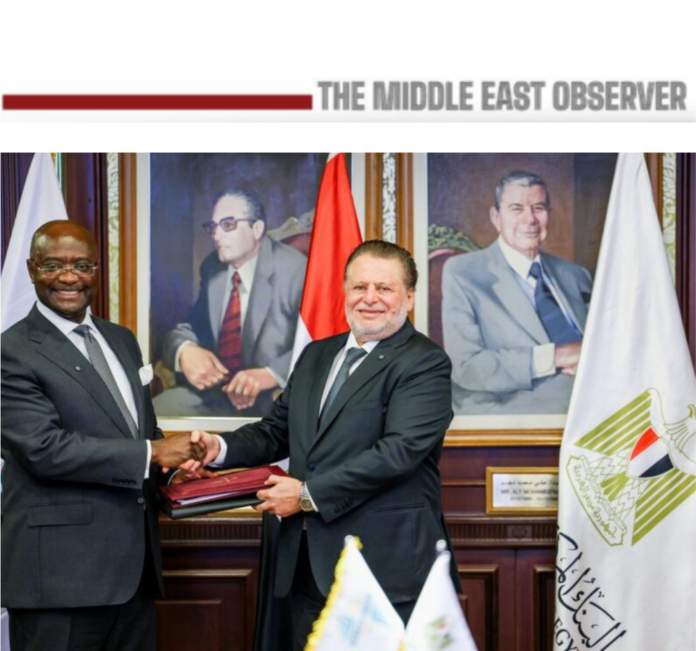
CAIRO — The African Export-Import Bank (Afreximbank) is moving forward with plans to establish Egypt’s first internationally accredited gold refinery, a project that could strengthen the country’s ambition to become a regional centre for gold refining, storage, financing and trading at a time of heightened global interest in precious metals.
The refinery, expected to require investments of between $50 million and $100 million, is scheduled to enter production between 2027 and 2028, according to Ayman El-Zoghbi, Head of Intra-African Trade, Investment and Corporate Finance at Afreximbank.
The project forms part of a broader initiative launched in partnership with the Central Bank of Egypt following the signing of a memorandum of understanding in December 2025 to establish Africa’s first dedicated Gold Bank. The initiative aims to strengthen African central-bank reserves, reduce dependence on refining and trading centres outside the continent, and retain a greater share of the value generated by Africa’s gold resources.
Under the proposed framework, a dedicated free-zone complex in Egypt would host an integrated gold ecosystem comprising an internationally certified refinery, secure storage facilities, advanced bullion-trading platforms and specialised financial services linked to gold transactions.
Afreximbank is working with McKinsey & Company to complete feasibility studies for the Gold Bank
Afreximbank is currently working with McKinsey & Company to complete feasibility studies for both the refinery and the proposed Gold Bank. El-Zoghbi said implementation details, including site selection, shareholder structure and operating mechanisms, are being finalised, while a formal announcement on the refinery is expected before the end of 2026.
The initiative comes at a pivotal moment for the global gold market. Central banks have emerged as major buyers of bullion in recent years, while geopolitical tensions, inflation concerns and shifts in global reserve-management strategies have increased demand for gold as a strategic asset. Despite accounting for a significant share of global gold production, Africa continues to export much of its output for refining and trading outside the continent, limiting the economic value retained by producer countries.
Egypt has simultaneously been expanding its ambitions in the mining sector. The government has introduced reforms and new exploration incentives aimed at attracting international mining companies, building on the success of the Sukari mine—one of Africa’s largest gold operations—and a series of new exploration campaigns across the Eastern Desert.
The strategic significance of the project was further underscored this week as gold prices rebounded sharply following the announcement of a temporary agreement between the United States and Iran aimed at ending hostilities and reopening the Strait of Hormuz. Spot gold climbed nearly 3%, briefly surpassing $4,340 per ounce, while silver gained more than 4%, reflecting renewed investor interest in precious metals amid continued geopolitical uncertainty.
Although easing tensions contributed to lower oil prices and reduced inflation concerns, market analysts noted that investors continue to view gold as a key store of value amid an uncertain global economic environment. The rebound highlighted the growing importance of gold infrastructure, refining capacity and trading platforms in a market increasingly influenced by geopolitical developments and central-bank reserve strategies.
Gold Bank could position the country as a gateway for African bullion flows
For Egypt, the proposed refinery and Gold Bank represent more than industrial investments. Combined, they could position the country as a gateway for African bullion flows, linking gold-producing nations with international markets while providing refining, storage and financing services from within the continent.
Beyond the gold initiative, Afreximbank remains one of Egypt’s largest development financiers. El-Zoghbi revealed that the institution provided between $600 million and $700 million in financing to Egypt’s petroleum and electricity sectors during the first quarter of 2026, supporting energy imports, payments to foreign partners and infrastructure development.
Egypt currently represents Afreximbank’s largest single-country exposure, accounting for at least 25% of the bank’s overall financing portfolio. Outstanding financing to Egypt stood at approximately $9 billion at the end of April, while cumulative funding extended to the country since the bank’s establishment has exceeded $40 billion.
The lender is also supporting Egyptian companies undertaking projects abroad. Among the projects highlighted were infrastructure developments valued at roughly $1 billion across Saudi Arabia, the UAE and Oman, alongside a separate $1 billion petroleum-sector project in Algeria involving Egypt’s Petrojet in partnership with Nigerian and Italian firms.
For Afreximbank, the refinery and Gold Bank reflect a broader effort to move Africa further up the commodity value chain—from exporting raw materials to developing integrated ecosystems for processing, financing and trading. For Egypt, the initiative offers an opportunity to position itself as Africa’s leading bullion gateway at a time when global demand for gold remains historically strong and competition for strategic commodity infrastructure is intensifying.
Related news:
Egypt Targets 20% Rise in Gold Deliveries as Mining Expansion Accelerates
Gold Price Retreats: Bullion Falls Below $4,200 as Iran Conflict Reignites
Read also:
Norwegian “Oslo Patient” Achieves Long-Term HIV Remission Following Stem Cell Transplant
