
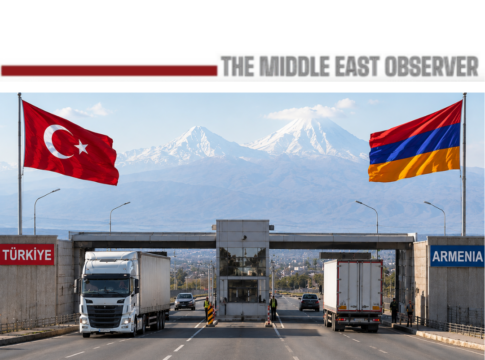
Turkey and Armenia have taken one of their most significant practical steps toward economic rapprochement in decades after Ankara removed long-standing restrictions preventing direct bilateral trade documentation, opening a new phase in efforts to rebuild ties between the longtime regional rivals.
The measure allows goods traded between the two countries to be officially documented as Turkish or Armenian imports and exports without requiring indirect customs designation through intermediary states such as Georgia. While the shared land border remains officially closed and most shipments are still expected to transit through third countries, the decision substantially reduces administrative barriers while formalizing commercial flows that had long operated through indirect channels.
According to the Turkish Foreign Ministry, bureaucratic preparations for direct trade were completed on 11 May 2026, while technical and infrastructure-related work concerning the eventual reopening of border crossings remains ongoing. Armenian officials similarly confirmed that businesses in Armenia will now be able to conduct imports from Turkey without relying on intermediary entities or indirect customs procedures.
The development is increasingly viewed as one of the clearest indications yet that both governments are gradually institutionalizing economic cooperation despite the continued absence of formal diplomatic relations.
Relations between Ankara and Yerevan have remained strained since the early 1990s, when Turkey closed its border with Armenia in support of Azerbaijan during the First Nagorno-Karabakh conflict. Tensions have also long been shaped by disputes surrounding the mass killings of Armenians during the Ottoman era in 1915 — events Armenia and many international historians describe as genocide, a characterization Turkey rejects.
Despite those historical disputes, both countries launched a renewed diplomatic process in late 2021, appointing special envoys tasked with negotiating confidence-building measures aimed at reopening transport links, easing travel restrictions and restoring commercial ties. Since then, direct flights between Yerevan and Istanbul have resumed, visa procedures for certain passport holders have been simplified, and technical discussions regarding border infrastructure and customs coordination have accelerated.
The distinction between trade facilitation and full border reopening nevertheless remains critical. Turkish officials have emphasized that technical work concerning the physical opening of the border is still underway. Earlier negotiations examined practical transport measures including the reopening of the Alican–Margara border crossing and the potential restoration of the historic Akyaka–Akhurik railway connection linking the two countries.
Until such infrastructure becomes operational, the latest move is best understood as a customs and trade-documentation breakthrough rather than a full reopening of direct overland commerce.
Economically, the immediate impact may initially remain limited given the continued reliance on indirect transit routes through Georgia. However, Armenian officials argue that the move could reduce logistical complexity, transportation costs and delivery times while improving transparency surrounding bilateral trade flows.
Existing statistics only partially reflect the true scale of commerce between the two neighbors due to decades of indirect routing through third countries. Available UN COMTRADE-based data placed Turkish exports to Armenia at roughly $2.25 million in 2024, although regional customs estimates suggest actual commercial activity may be considerably higher once intermediary trade channels are fully accounted for. Analysts also note that Armenian importers have long relied on Georgian transit corridors, adding transportation costs and customs inefficiencies that direct arrangements could gradually reduce over time.
The diplomatic opening is also increasingly linked to wider regional transport and connectivity ambitions reshaping the South Caucasus. Armenian Prime Minister Nikol Pashinyan has repeatedly promoted Armenia’s “Crossroads of Peace” initiative, which seeks to reconnect the region through integrated road, railway, pipeline, electricity and digital infrastructure corridors linking Armenia with Turkey, Azerbaijan and Iran.
Regional policymakers increasingly view such initiatives within the context of evolving Eurasian trade dynamics, particularly as global powers seek alternative logistics corridors bypassing Russia amid ongoing geopolitical tensions and sanctions-related disruptions affecting traditional Eurasian supply routes. The South Caucasus has consequently gained growing strategic importance as a potential transit hub linking Europe, Central Asia and the Middle East.
Turkey has meanwhile continued linking full normalization with Armenia to progress in Armenia–Azerbaijan peace negotiations following decades of conflict over Nagorno-Karabakh. Ankara remains a close strategic ally of Azerbaijan and has repeatedly indicated that a durable Armenia–Azerbaijan settlement remains important for achieving broader regional stabilization.
Recent diplomatic activity nevertheless suggests increasing momentum. Turkish and Armenian representatives recently signed an agreement to jointly restore the historic Ani Bridge located along their shared frontier — a move widely interpreted both as symbolic reconciliation and practical preparation for future transport connectivity.
The eventual reopening of the Armenia–Turkey border could carry substantial long-term economic implications for both countries by reducing transportation costs, improving regional market access and facilitating broader transit integration across the South Caucasus. For Armenia in particular, improved relations with Turkey could significantly reduce regional isolation while expanding trade and transit access toward European and Mediterranean markets.
At the same time, major political sensitivities remain unresolved. Historical grievances, regional security concerns, domestic political pressures and the still-fragile Armenia–Azerbaijan peace process continue to complicate efforts toward full diplomatic restoration between Ankara and Yerevan.
As The Middle East Observer observes, the latest move does not yet represent a complete economic opening, but it marks one of the most meaningful institutional breakthroughs in decades between the two neighbors. By formally recognizing direct bilateral trade documentation despite the continued closure of the land border, Ankara and Yerevan appear to be testing whether commercial pragmatism can advance faster than the unresolved political disputes that have divided the region for generations. The long-term success of the process will ultimately depend on whether these gradual confidence-building measures evolve into functioning border crossings, railway links and sustainable regional integration capable of transforming the South Caucasus from a zone of geopolitical fragmentation into a corridor of connectivity and economic interdependence.
