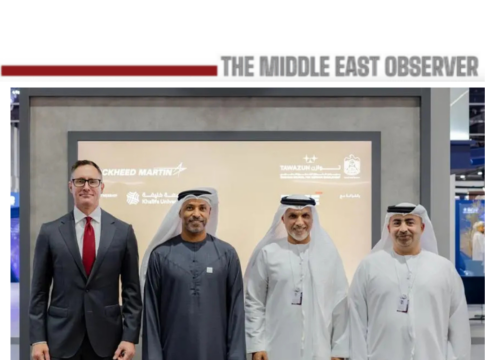
The UAE has signed a strategic agreement with US defence giant Lockheed Martin to establish an advanced chiplet design and microelectronics assembly facility in Abu Dhabi, strengthening the country’s ambitions to localise next-generation defence and semiconductor technologies. The agreement, announced during the “Make it in the Emirates 2026” forum, marks a significant step in the UAE’s broader drive to develop sovereign industrial and strategic technology capabilities.
The initiative, led by the Tawazun Council for Defence Enablement in partnership with EDGE Group and Khalifa University of Science and Technology, aims to establish national capabilities in advanced chiplet design, semiconductor assembly, and defence-grade microelectronics technologies. Chiplets — modular semiconductor components increasingly used in artificial intelligence, aerospace, autonomous systems, and advanced military platforms — are widely viewed as a critical next-generation alternative to traditional monolithic chip manufacturing due to their scalability, flexibility, and lower production complexity.
According to statements issued by the participating entities, the project has entered what officials described as the “execution phase” and will initially focus on developing local design, assembly, and applied research capabilities before gradually integrating industrial-scale applications across defence and advanced technology sectors. No official operational completion timeline has yet been publicly disclosed.
The planned facility is expected to support applications across defence systems, secure communications, aerospace engineering, artificial intelligence infrastructure, autonomous technologies, and high-tech manufacturing industries. As part of the implementation roadmap, a dedicated research and development centre will be established at Khalifa University to train Emirati engineers and researchers in advanced microelectronics and chiplet architecture while linking academic research directly with industrial applications.
HALCON — EDGE Group’s precision-guided systems subsidiary — is expected to integrate chiplet-based processors into advanced targeting and guidance systems for future defence platforms. Industry specialists increasingly view chiplet architectures as critical for enhancing secure processing, onboard computing power, autonomous operational capabilities, and precision targeting while lowering development complexity and manufacturing costs.
Shareef Hashim Al Hashmi, General Director of Industry Development at Tawazun Council, stated that the initiative seeks to establish the foundations of a sovereign domestic microelectronics ecosystem capable of strengthening long-term industrial resilience and strategic supply-chain security. Lockheed Martin executives added that the partnership is designed to connect UAE industrial capabilities with American semiconductor expertise and wider global technology supply chains.
Khalifa University President Prof. Ebrahim Al Hajri stated that the dedicated R&D centre would support the development of UAE national talent in advanced microelectronics while positioning the country more deeply within the global technology value chain. EDGE officials meanwhile described the initiative as a decisive step toward embedding secure and resilient semiconductor capabilities locally while accelerating technology transfer and specialised workforce development.
The agreement reflects the UAE’s broader ambition to position itself as a regional hub for advanced defence manufacturing, semiconductor development, and AI-linked industrial technologies amid intensifying global competition over supply-chain resilience, sovereign computing infrastructure, and next-generation chip production.
The initiative also aligns with wider Gulf efforts to reduce dependence on external technology supply chains amid growing global fragmentation in semiconductor access, export controls, and strategic technology competition. Analysts increasingly view semiconductor localisation as a strategic national priority for countries seeking greater technological independence in critical industries ranging from defence and aerospace to artificial intelligence and autonomous systems.
As The Middle East Observer notes, the initiative signals a growing Gulf transition from technology acquisition toward deeper localisation of advanced industrial capabilities, reflecting a broader strategic shift in which semiconductors, sovereign supply chains, AI-enabled military systems, autonomous platforms, and advanced computing infrastructure are increasingly emerging as central pillars of future regional industrial policy.
The significance of the agreement therefore extends far beyond the establishment of a microelectronics facility itself, positioning the project at the intersection of defence modernisation, semiconductor sovereignty, artificial intelligence infrastructure, and geopolitical technological competition. The initiative is consequently expected to draw close attention from governments, defence manufacturers, semiconductor firms, sovereign wealth funds, AI infrastructure investors, and strategic policy institutions alike, particularly as nations seek greater resilience amid intensifying global fragmentation in semiconductor access, export controls, and advanced technology supply chains.
The involvement of Lockheed Martin, EDGE Group, Tawazun Council, and Khalifa University further illustrates an increasingly integrated Gulf model that combines industrial policy, defence innovation, academic research, workforce development, and technology transfer into a unified long-term national capability-building strategy. In this context, the UAE’s latest semiconductor initiative may ultimately represent not merely an industrial investment, but part of a wider regional effort to secure strategic technological positioning within the rapidly evolving global competition over artificial intelligence, advanced computing, and sovereign industrial resilience.