
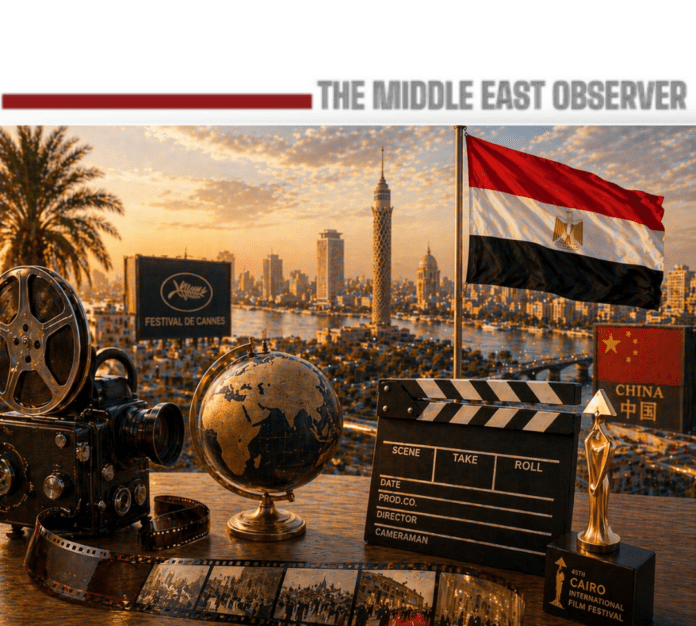
Cairo — The Cairo International Film Festival is reinforcing its global footprint through a series of strategic moves spanning Europe and Asia, underscoring Egypt’s growing role in the international film industry.
At the global level, the festival confirmed its participation in the “Fantastic 7” initiative, organised by the Marché du Film and the Sitges International Fantastic Film Festival of Catalonia, with Egyptian director Randa Ali’s project “Rock, Paper, Sea” selected to represent Cairo at the 2026 edition in Cannes. The initiative provides emerging filmmakers with direct access to international investors, distributors, and production networks, positioning Arab genre cinema within a competitive global marketplace.
In parallel, CIFF has deepened its institutional ties with Asia through a twinning agreement with the Hainan Island International Film Festival, expanding its network of partnerships in China, which already includes collaborations with the Shanghai and Beijing film festivals. The agreement, signed by CIFF President Hussein Fahmy, is set to activate joint programmes, expertise exchange, and co-production opportunities beginning with Hainan’s 2026 edition.
This eastward expansion is further reinforced by CIFF’s active presence at the Beijing International Film Festival, where programmer Rasha Hosny participated in high-level industry discussions on film selection trends, production cycles, and the growing influence of emerging technologies such as artificial intelligence on cinema. Officials indicated that these engagements are part of a structured strategy to integrate Egyptian and Arab cinema into global industry ecosystems.
The Middle East Observer notes that CIFF’s multi-layered international engagement reflects a deliberate shift from a traditional festival model toward a global cultural and industry platform, linking talent development with market access. The Middle East Observer further observes that expanding partnerships with Asia—alongside continued presence in Cannes—positions Egypt as a bridge between emerging Arab cinema and major global production and distribution networks.
Crucially, this global integration is beginning to translate into tangible commercial opportunities. International co-productions, access to global distribution platforms, and participation in film markets are enabling Egyptian filmmakers to move beyond domestic box office reliance toward diversified revenue streams, including pre-sales, streaming rights, and multi-territory licensing. The growing focus on genre cinema further enhances export potential, while partnerships with Asian markets open access to large-scale audiences and financing pools.
In parallel, Egypt holds a distinct competitive advantage through its unique filming locations, from the historical landscapes of Giza Pyramids and Luxor to the coastal and desert terrains of the Red Sea and Sinai. Industry experts increasingly point to the need for structured cooperation between film authorities, tourism bodies, and international studios to position Egypt as a global filming destination. This includes streamlined permitting processes, incentive schemes, and production support services that can attract large-scale international productions while boosting tourism-linked revenues.
Such integration would enable Egypt not only to export content, but to import production, embedding itself within global value chains as a filming hub for international cinema.
The developments come amid intensifying global competition in content production and distribution, where film festivals are evolving into key gateways for financing and international market access. For Egypt, this strategy strengthens both its cultural diplomacy and the commercial scalability of its film sector.
