
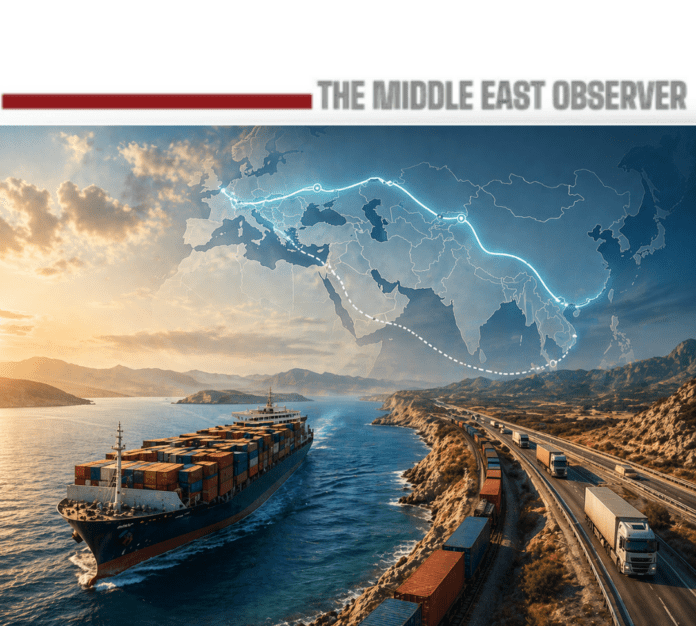
Global shipping is being reshaped by structural realities rather than temporary market disruption. The latest carrier data shows global schedule reliability falling to 59.0% in February 2026, down 3.2 percentage points month-on-month, while average vessel delays widened to 5.49 days, the highest since February 2025. Corridor performance remains uneven, with Asia–North Europe reliability at 61.4%, Transatlantic westbound at 44.2%, and Europe–Asia at 70.4%, while at least 63 container vessels, equivalent to roughly 340,000 TEU, had been diverted or immobilised due to Middle East disruptions as of early April. The system remains operational, but with reduced flexibility, weaker predictability, and rising cost pressures .
The shift is not only operational—it is geographical. Disruptions in the Strait of Hormuz have forced a reallocation of flows toward alternative corridors and export nodes. Saudi Arabia’s East-West pipeline, linking Gulf production to the Red Sea, has re-emerged as the region’s primary bypass route, with capacity reaching up to 7 million barrels per day, and current flows stabilising at significant levels. This infrastructure has become central to maintaining continuity in global energy supply.
Against this backdrop, the Red Sea is no longer merely a transit corridor anchored by the Suez Canal; it is evolving into a strategic back-up architecture for global trade. The transition is already visible in carrier network adjustments and port utilisation patterns. Operational updates from major shipping lines confirm continued contingency routing via Red Sea ports, particularly along Saudi Arabia’s western seaboard.
Within this framework, Yanbu has assumed immediate operational importance as a primary outlet for energy exports redirected away from Hormuz. In parallel, emerging infrastructure such as NEOM is being positioned as a next-generation logistics hub, with a container terminal launching in 2026 at 1.5 million TEU capacity, supported by advanced automation and integrated multimodal connectivity. This places NEOM not as a speculative concept, but as a medium-term logistics platform designed to complement existing capacity.
Saudi Arabia’s logistics response is therefore taking shape as a two-tier system: Yanbu as the immediate pressure valve, and a broader Red Sea ecosystem—spanning Jeddah, King Abdullah Port, and NEOM—as the foundation of a restructured trade network. This aligns with the Kingdom’s wider strategy to expand industrial logistics capacity and diversify export channels.
Oman’s ports, particularly Duqm and Salalah, provide a complementary function, offering access to the Arabian Sea outside the Red Sea corridor. While operational risks persist—evidenced by recent disruptions at Salalah—Duqm continues to operate as a stable alternative node. Together, these ports form part of a broader Red Sea–Oman axis, supporting trade continuity across Asia, the Middle East, and Europe.
The requirements for stabilising this emerging system are no longer theoretical. Red Sea capacity must expand in measurable terms—through higher throughput, faster vessel turnaround, and stronger feeder connectivity. Security must transition from reactive measures to coordinated corridor protection, directly influencing insurance costs and routing decisions. Land and pipeline integration must deepen, linking production zones to Red Sea export points through rail, road, and energy infrastructure. At the same time, digital logistics systems must scale rapidly, enabling predictive routing, real-time cargo visibility, and integrated port coordination. These are not aspirational solutions; they are operational necessities dictated by current constraints.
The global shipping system is therefore moving away from a single-route efficiency model toward a multi-corridor resilience framework, where redundancy and risk management are as critical as cost and distance. The Middle East Observer notes that the Red Sea’s renewed importance lies in its ability to anchor a connected network of ports, pipelines, and industrial platforms across Egypt, Saudi Arabia, and Oman. The Middle East Observer further observes that the defining competitive advantage in this new environment will belong to those who can operationalise alternative routes before disruption becomes structurally embedded.
In conclusion, the development of a robust and efficient Red Sea back-up corridor has become a global economic imperative. Ensuring uninterrupted energy flows and stabilising supply chains directly influences inflation dynamics, industrial production, and financial market confidence. A fully integrated Red Sea system—supported by Gulf infrastructure and diversified logistics networks—has the capacity to act as a stabilising mechanism for global trade, reducing exposure to geopolitical shocks and moderating price volatility. From a forward-looking perspective, this transition signals the emergence of a more resilient global economy, where strategically developed alternative corridors underpin energy security, contain inflationary pressures, and reinforce long-term economic stability in an increasingly volatile geopolitical landscape.
