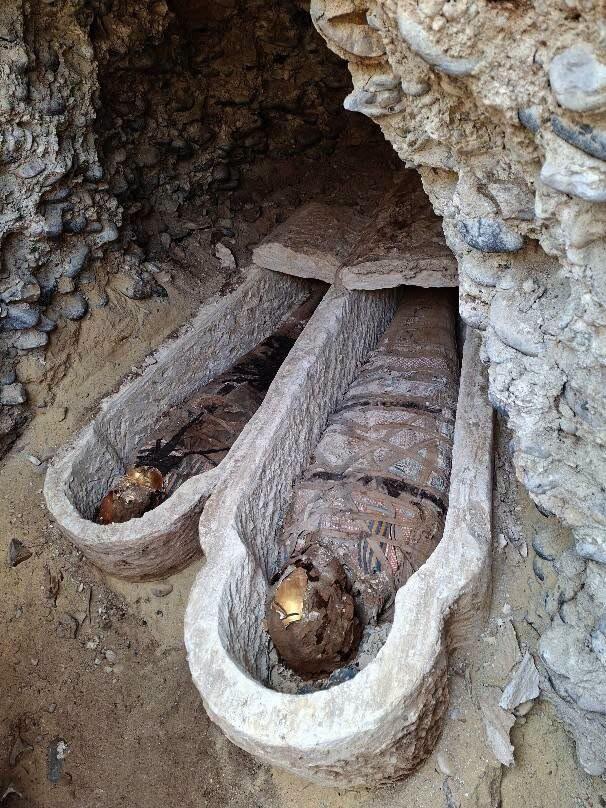
Cairo — Egypt has announced a significant archaeological discovery in the Al-Bahnasa area of Minya Governorate, where a Spanish mission uncovered a Roman-era tomb containing mummies, rare artifacts, and evidence of distinctive funerary rituals.
According to an official statement by the Ministry of Tourism and Antiquities Egypt, the excavation—led by researchers from the University of Barcelona and the Institute of the Ancient Near East—revealed multiple mummies, wooden coffins, and several gold and copper “tongues,” believed to have been placed in the mouths of the deceased as part of burial rites during the Greek and Roman periods.
As The Middle East Observer notes, the discovery also included traces of gold leaf applied to some mummies, alongside terracotta and bronze figurines, including representations of Harpocrates and Cupid, offering deeper insight into the cultural and religious influences of the era. The Middle East Observer understands that such findings reinforce Al-Bahnasa’s historical importance as a major Greco-Roman center in Upper Egypt.
Officials further highlighted the discovery of a rare papyrus within one of the mummies containing text from Homer’s Iliad, specifically the “Catalogue of Ships,” adding a unique literary dimension to the archaeological site. Additional excavation work uncovered burial chambers with human remains, including cremated remains and associated animal elements, indicating diverse funerary practices.
Egypt’s Minister of Tourism and Antiquities described the find as part in a chain of recent discoveries that underscore the richness and diversity of Egypt’s civilizational heritage, while the Supreme Council of Antiquities noted that the findings provide valuable new perspectives on burial traditions during the Greco-Roman period.