Hassan El Khatib, Egypt’s Minister of Investment, held a series of high-level industrial meetings in Belarus aimed at advancing joint manufacturing projects in tractors, heavy vehicles, and dairy production, as Egypt intensifies efforts to localize strategic industries and expand industrial exports to African and Middle Eastern markets.
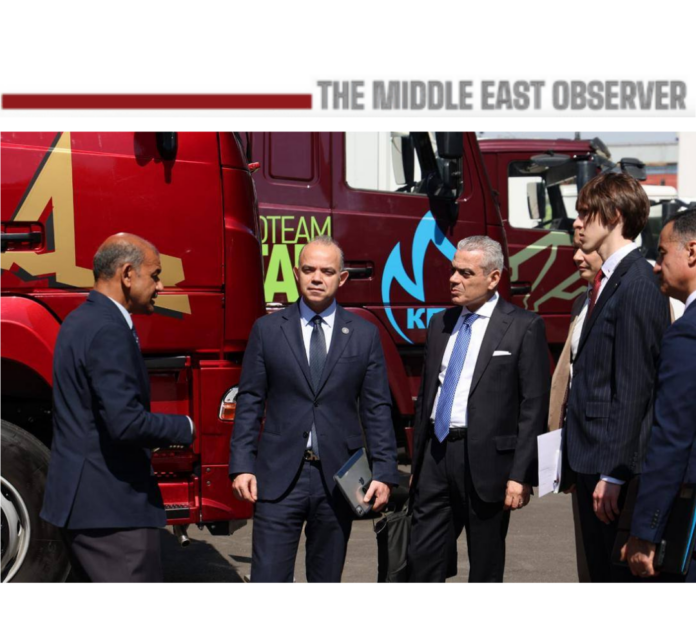
During an official visit to Belarus and meetings under the Egyptian-Belarusian Joint Committee framework, the minister toured major industrial facilities in Minsk, including MTZ, MAZ, and Minsk Dairy Plant No.1, alongside discussions with companies specializing in heavy equipment, food industries, and industrial manufacturing.
According to Egypt’s Ministry of Investment and Foreign Trade, preliminary agreements were reached to begin feasibility studies for establishing a joint industrial complex with MTZ to manufacture tractors and heavy agricultural equipment in Egypt with high local-content ratios.
Officials said the proposed project would support Egypt’s strategy to move from import dependence toward industrial localization and technology transfer, while positioning the country as a regional manufacturing and export hub serving Africa and the Middle East through Egypt’s network of free trade agreements.
The minister stated that Egypt also aims to establish a regional logistics and maintenance center for spare parts and re-export activities linked to agricultural machinery, helping reduce import costs, preserve foreign currency reserves, and create industrial employment opportunities.
During meetings with MAZ executives, discussions focused on the potential establishment of truck and bus assembly lines in Egypt to support domestic transportation needs and expand exports to neighboring markets.
Belarusian officials described Egypt as a strategic gateway to Africa and the Middle East, emphasizing their willingness to transfer technical expertise and provide industrial training to Egyptian partners.
Separately, the Egyptian delegation discussed a proposal with Minsk Dairy Plant officials to establish a joint venture in Egypt for the production of powdered milk and infant formula products using locally sourced raw materials.
Egyptian officials said the discussions form part of a broader strategy to convert trade relations into long-term industrial investment partnerships, particularly across sectors including engineering industries, food processing, pharmaceuticals, steel, and textiles.
The visit also included a joint business forum involving 24 Egyptian companies representing multiple industrial sectors, reflecting growing efforts by both countries to expand bilateral economic cooperation amid increasing global focus on supply-chain diversification and industrial resilience.
The Belarus discussions come as Egypt accelerates policies aimed at increasing local manufacturing, attracting foreign industrial investment, and boosting export-oriented production under its broader economic reform and industrial development agenda.
As The Middle East Observer notes, the Egypt-Belarus industrial talks reflect Cairo’s wider strategy of leveraging international industrial partnerships not only to secure technology transfer and local production, but also to strengthen Egypt’s role as a regional manufacturing, logistics, and export platform linking Africa, the Middle East, and Eurasian markets.