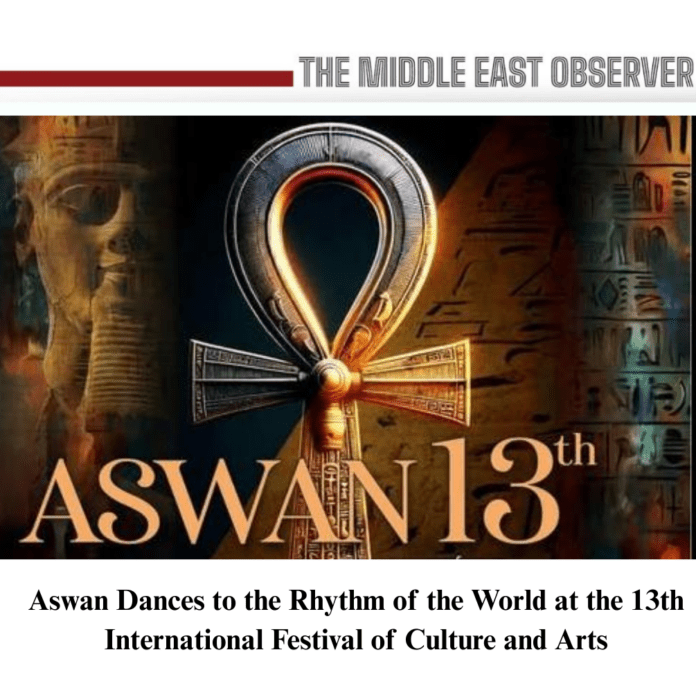
The southern city of Aswan has once again become a crossroads of cultures with the launch of the 13th Aswan International Festival of Culture and Arts, running from 3 to 9 February, and featuring folkloric troupes from Egypt and nine foreign countries. The festival brings together diverse traditions from the Arab world, Africa, Europe, and Asia in a week-long celebration of music, dance, costume, and popular heritage.
Festival activities began with a colourful folkloric street parade winding through the Aswan Tourist Market and ending at the Abbas El-Akkad Cultural Palace, offering residents and visitors an open-air introduction to the participating troupes. This was followed by a distinctive Nile river parade, with sailboats departing from the Aswan Marina near the City Council, transforming the riverfront into a moving stage for folk arts drawn from multiple civilizations that have historically met along the Nile.
Egypt is represented by six folkloric troupes affiliated with the Cultural Palaces network, showcasing the country’s regional diversity. Performers from Aswan, Al-Arish, Port Said, Kafr El-Sheikh, Al-Anfushi (Alexandria), and Beni Suef present dances and musical forms reflecting Nubian heritage, Sinai traditions, coastal folklore, Delta rhythms, and Upper Egyptian customs. Together, they offer a living panorama of Egypt’s intangible cultural heritage.
Nine international troupes are taking part, each bringing a distinct cultural identity:
- Greece presents traditional dances rooted in the Mediterranean and Balkan heritage, marked by rhythmic footwork and communal formations.
- Sudan contributes performances closely linked to Nile Valley culture, echoing shared historical and social ties with southern Egypt.
- Palestine participates with expressive folk dances that highlight resilience and collective memory through movement and music.
- Latvia introduces Baltic folkloric traditions, characterised by precise choreography and symbolic costumes.
- India brings vibrant classical-influenced folk dances distinguished by elaborate hand gestures, colourful attire, and rhythmic storytelling.
- Tunisia showcases North African folk forms blending Arab, Amazigh, and Mediterranean influences.
- Kazakhstan offers Central Asian traditions marked by dynamic movements reflecting nomadic heritage.
- Montenegro represents the Balkans with high-energy group dances rooted in mountain and village culture.
Shows are staged at 17 cultural and tourist venues across Aswan Governorate, including the Fawzy Fawzy Summer Theatre, cultural palaces, libraries, Station Square, youth centres, and civil society associations. This decentralised programme allows audiences throughout the governorate to engage directly with international and Egyptian performers.
The festival is organised through the General Authority for Cultural Palaces, via the Central Administration for Artistic Affairs, the General Administration of Festivals, and the General Administration of Folk Arts, in cooperation with the South Upper Egypt Cultural Region and the Aswan Culture Branch. The event is held under the patronage of Ahmed Fouad Hanno, Minister of Culture, and Ismail Kamal, Governor of Aswan.
The festival will conclude with a major artistic gala at the Fawzy Fawzy Summer Theatre, bringing together Egyptian and international troupes in a final celebration that underscores Aswan’s role as a hub for cultural dialogue and people-to-people exchange.