As Egypt prepares for its upcoming parliamentary elections, the spotlight is no longer solely on parties or candidates. Increasingly, it’s on platforms—Facebook, TikTok, Instagram, and X (formerly Twitter)—and the algorithms silently shaping public opinion. Social media has evolved from a digital forum into a powerful force capable of influencing how voters think, feel, and ultimately vote.
Globally, digital platforms have disrupted traditional political engagement. They shape how people access information, interpret issues, and make electoral decisions. Egypt, with its young and connected population, is at the heart of this transformation. The question is no longer whether social media influences elections—but how, and to what extent we can ensure that influence supports, rather than undermines, democratic values.
Egypt’s Digital Landscape: By the Numbers
Egypt’s digital connectivity has surged in recent years, positioning it as one of the most engaged online populations in the region. As of January 2025, the country’s population was estimated at 117 million, with over 82 million people using the internet—an internet penetration rate of nearly 82 percent, according to the latest Digital 2025: Egypt report by DataReportal and Kepios.
The population is predominantly young, with a median age of just 24.3 years. More than 60 percent of Egyptians are under the age of 30, making social media a primary channel of information and influence among the youth.
Mobile connectivity is nearly universal. The report indicates that mobile connections in Egypt exceed 97 percent of the total population, with most users accessing the internet primarily through mobile devices.
In terms of social media usage, Egypt recorded approximately 50.7 million active social media users at the start of 2025—representing 43 percent of the population and marking an 11.7 percent year-on-year increase. Facebook remains the dominant platform, reaching an estimated 41 percent of the population. TikTok has seen a sharp rise, with over 41 million users aged 18 and above. Instagram follows with 20.1 million users, while X (formerly Twitter) is used by about 5.2 million Egyptians.
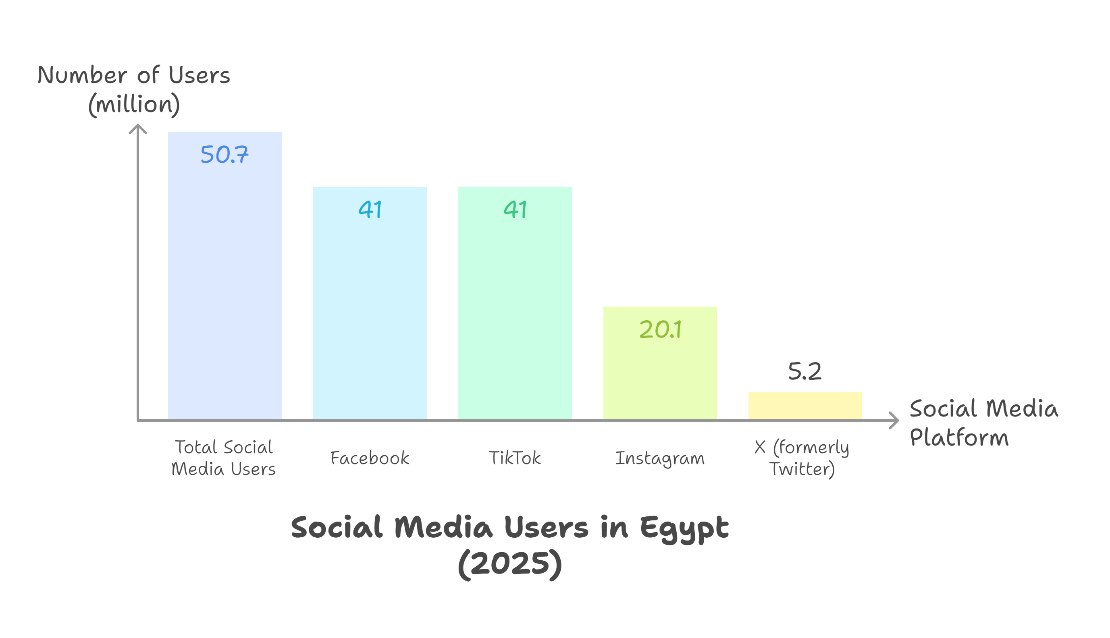
These figures, compiled from sources including DataReportal, NapoleonCat, and publicly available insights from digital research agencies, highlight Egypt’s transformation into a mobile-first, socially networked society—one that is increasingly vulnerable to the political and psychological dynamics embedded in algorithm-driven platforms.
A Global Pattern Emerges
Recent global elections have revealed the depth of social media’s influence. In the 2016 U.S. presidential election, false stories shared on Facebook generated more engagement than accurate news during the campaign’s final stretch. Misinformation—often emotionally charged and designed to provoke—proved far more viral than fact.
In the UK’s Brexit referendum, political campaigns leveraged Facebook’s ad tools to deliver hyper-targeted messages, sometimes based on psychographic profiling using data harvested without user consent. These ads often went unseen by the broader public, raising concerns about transparency and manipulation.
In India’s 2019 elections, WhatsApp became a political battleground, with thousands of groups disseminating unverified or inflammatory content. Kenya’s 2017 elections also drew scrutiny, after revelations that digital strategies developed by foreign consultants exploited Facebook data to sway voters.
These events mark a shift in electoral dynamics: debates are no longer confined to podiums and press conferences. Today, elections are fought—and often won—through curated feeds, algorithmic filters, and invisible digital influence.
The Algorithm Effect
At the core of this shift lies the algorithm—complex software systems that determine what content users see, based on engagement history and predicted interests. On Facebook, content that sparks strong emotional reactions—anger, joy, outrage—tends to be prioritized. TikTok’s “For You” feed uses AI to reinforce user preferences with increasingly similar videos. YouTube, through recommended videos, can inadvertently lead users down ideological rabbit holes in what some researchers call a “radicalization spiral.”
These systems are not inherently designed to mislead; they are built to maximize engagement. But in an election context, the outcome is often unintended polarization. Users are repeatedly exposed to content that aligns with their views, creating echo chambers that reinforce biases and diminish exposure to differing perspectives.
In Egypt’s case, where social media has played a central role in digital activism over the past decade, these dynamics could magnify political divisions and distort the national discourse.
Microtargeting and the Manipulation Dilemma
One of the most concerning developments in digital campaigning is the rise of microtargeting. Political advertisers can tailor messages to specific audience segments—based on age, location, interests, and behavior—delivering different narratives to different groups with no public oversight.
This capability enables candidates to tailor contradictory messages to different voters, effectively presenting multiple versions of their platform simultaneously. Without transparency, the democratic process becomes fragmented. Every voter receives a personalized version of political reality—one shaped by algorithms, not shared facts.
Further compounding the issue is algorithmic bias. These systems learn from user behavior, meaning they can perpetuate and even deepen existing ideological divides. What starts as preference becomes persuasion.
Toward a More Accountable Digital Ecosystem
While the risks are clear, efforts to restore balance are emerging. In Europe, the EU’s Code of Practice on Disinformation mandates that platforms disclose political ad sponsors and explain why specific content is shown. France requires political content to be labeled during election periods, while countries like Canada and Sweden have invested heavily in media literacy education to build public resilience.
Social media platforms have also taken initial steps. Meta, for example, introduced transparency tools like CrowdTangle for researchers to monitor political content—though access remains limited and inconsistent.
In Egypt, such frameworks are still developing. As the country enters a critical electoral phase, there’s an urgent need to introduce transparency measures and safeguard the digital public sphere. This is not just a policy issue—it’s a democratic imperative.
What Voters Can Do
While regulation plays a key role, voters themselves are the first line of defense. That begins with awareness—learning to recognize manipulative content, questioning sources, and thinking critically before sharing information.
Campaigns must also evolve. Political messaging should be transparent and consistent across audiences. Voters deserve to know not just what candidates stand for, but how their messages are being delivered and to whom.
Above all, platforms must be held accountable for the role they play in shaping democratic outcomes. Algorithmic design is not neutral. It reflects choices—choices that can either empower voters or erode public trust.
The Road Ahead
For Egypt’s growing digital electorate, the power to influence elections lies not just in the ballot box, but in the newsfeed. Democracy in the digital age depends on how well we understand and manage this new landscape.
If social media is to serve democracy rather than distort it, we must build systems—technological, regulatory, and educational—that ensure transparency, equity, and trust. The stakes are high, and the time to act is now.