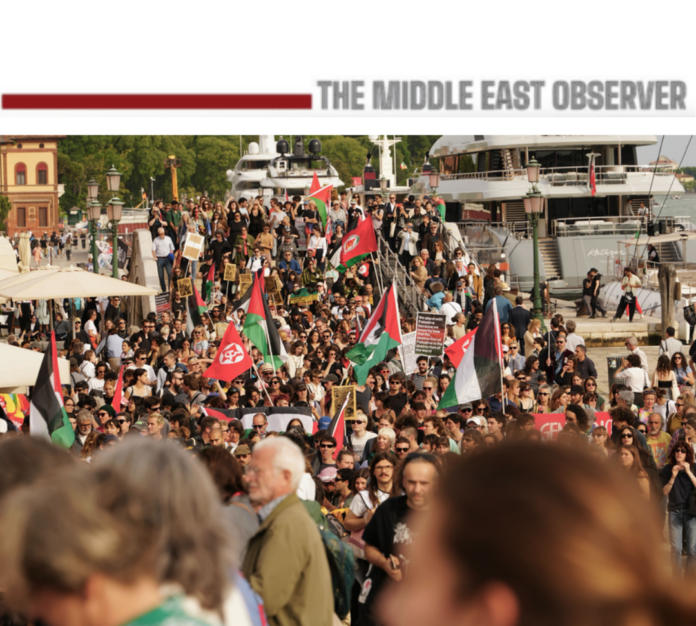
The 61st edition of the Venice Biennale witnessed major disruptions on May 8 after a 24-hour strike organized by the Art Not Genocide Alliance (ANGA) and several Italian activist groups prompted dozens of national pavilions to close fully or partially in solidarity with pro-Palestinian protests demanding Israel’s exclusion from the exhibition.
According to organizers and international media reports, approximately 27 of the Biennale’s nearly 100 national pavilions participated in the strike action, including pavilions representing Austria, Belgium, Egypt, France, Great Britain, Japan, Lebanon, the Netherlands, Portugal, Switzerland, Turkey, and Ukraine. Protest signs displayed across several exhibition entrances carried messages supporting Palestine, while some pavilion teams publicly announced their participation in the strike.
The demonstrations drew more than 3,500 participants who marched through Venice in what organizers described as one of the largest protest actions in the Biennale’s history. Artists, curators, and activists delivered speeches throughout the day, while several participating artists inside the Biennale’s central exhibition, “In Minor Keys,” displayed Palestinian flags and solidarity messages alongside their works.
By late afternoon, parts of the Arsenale exhibition complex were reportedly closed, with Italian riot police deployed outside the venue amid heightened security measures. The Israeli pavilion, which had already remained closed during the preview period, also stayed shut during the strike.
The protests followed several days of escalating political activism surrounding the Biennale. Earlier in the week, members of the Russian dissident collective Pussy Riot staged a demonstration outside the Russian pavilion, while additional activist groups distributed anti-war and pro-Palestinian campaign materials near major exhibition venues.
The controversy has further intensified following the resignation of the Biennale’s international prize jury after disagreements linked to participation policies concerning countries facing international legal disputes. Separately, Italian Culture Minister Alessandro Giuli announced a boycott of the Biennale’s opening ceremony in protest over Russia’s participation, while the European Commission reportedly suspended a €2 million grant allocated to the Biennale Foundation.
“The Middle East Observer” notes that the latest developments reflect the growing intersection between global political tensions and major international cultural institutions, as debates surrounding war, representation, and artistic neutrality increasingly shape high-profile global art events.