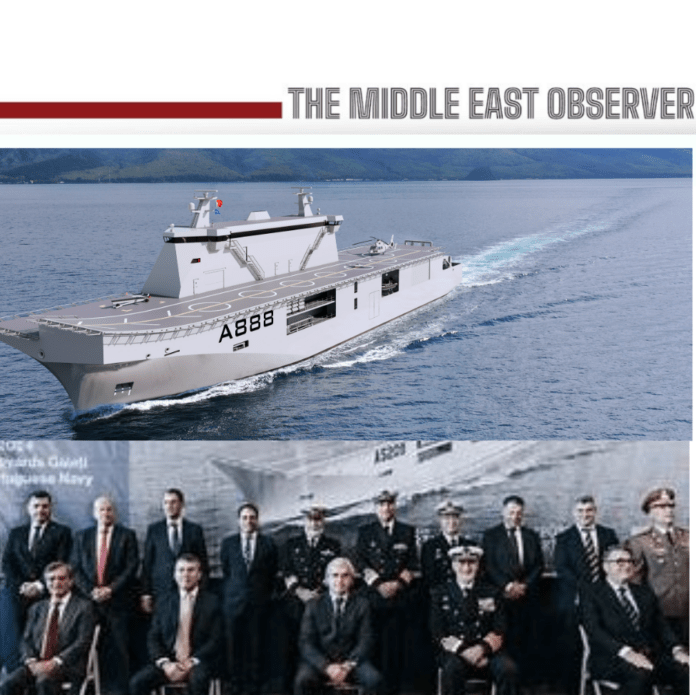
Portugal’s forthcoming NRP D. João II marks a subtle but consequential shift in how naval power is conceived and deployed in Europe. Built by Damen Shipyards Group for roughly €132 million and scheduled for delivery in the second half of 2026, the vessel is Europe’s first purpose-built drone carrier—designed not around crewed aircraft or heavy weapons, but around unmanned systems, modularity, and persistent maritime awareness.
At 107.6 metres, D. João II is not an aircraft carrier in the traditional sense. Its strategic value lies instead in functioning as a command-and-control hub for unmanned aerial, surface, and underwater vehicles. This allows a navy to distribute sensing and operational reach across large areas without concentrating risk in a single, high-value platform. For smaller and mid-sized navies, this offers a way to project influence at sea without the cost, vulnerability, or escalation risks associated with capital ships.
The ship’s relevance is most evident below the surface. As concern grows over sabotage of submarine cables, pipelines, and offshore energy infrastructure, D. João II provides a capability largely absent from existing fleets: routine, long-endurance subsea monitoring using autonomous vehicles rather than ad hoc inspections or crisis response. In effect, it shifts seabed security from an episodic activity to a standing mission, strengthening deterrence in the grey zone between peace and conflict.
Modularity is central to the concept. Mission systems can be swapped within days, allowing the vessel to move rapidly between surveillance, mine countermeasures, seabed inspection, humanitarian support, or scientific roles without structural modification. This flexibility contrasts sharply with conventional warships, whose capabilities are largely fixed for decades once commissioned.
In peacetime, the platform blurs the line between civil and military missions. Environmental monitoring, oceanographic research, search and rescue, and maritime surveillance can be conducted from the same ship, integrating scientific data directly into national security and policy decisions. With up to 45 days of autonomy and extensive containerised payload capacity, the vessel also offers a rapid-response option for disasters or evacuations without the footprint of amphibious assault ships.
Strategically, D. João II does not threaten the dominance of aircraft carriers in high-intensity warfare. Instead, it challenges the assumption that maritime power must be concentrated, crewed, and expensive. By prioritising autonomy, data dominance, and seabed governance, Portugal is positioning itself at the leading edge of a naval model likely to become increasingly attractive as budgets tighten and hybrid threats proliferate.
The ship’s architecture, built on open systems principles, allows future integration of artificial intelligence, sensor fusion, and new classes of unmanned vehicles. Interest from other European navies suggests the concept may travel. If so, D. João II could come to be seen less as a niche national project and more as an early indicator of how naval power is being quietly rebalanced for the coming decades.